Death. The soul leaves the body. The body is a shell, nothing more than a vessel for the soul, the fifth, transient element. For example, we call your body "yours." Like a possession. Not yourself. Do you see what I mean? "Self" is personality and thought and memories (not memory). And what is personality and thought and memory? Chemicals in your brain. But not even that. The way those chemicals come together, with the physical tissue of your brain and its orientation in space and time. But these things, personality and thought and memory, self, are not physical, nor would we ever presume to describe them as such. Really, how would we describe them? Abstractions. Not matter, but abstractions. It's a small step from abstractions to energy. After all, how would you describe energy? Try; it's really damn hard. Okay, you can say "I don't know" now. Self is so amorphous, indescribable, intangible, abstract… you get the picture.
Death. I keep wandering away from it (intentionally, perhaps..?). Body is a possession, a vessel, a shell. Even when you're alive. But it's a possession like a home. A house or an apartment. It's very personal, very you. Still, when the soul leaves, it's just a fallen log, a discarded muffin in a muddy parking lot (don't ask), a footprint in wet sand. It's the physical manifestation of memory, a dead body is. I want to be cremated. I want my body to go to the fire. Well, actually it's between cremation or just being left out for the animals and the plants and the elements. Air (the great oxidizer) and water (the great eroder) and earth (the great consumer) and fire (the great equalizer) and life. Other life: dogs and raccoons and birds and worms and beetles and trees and fungi and soil bacteria. Either way I am returned; even if I was embalmed and locked in a metal box and buried (*shudder shudder*) I would eventually return to the universe as organic molecules and even atoms. It would just take longer. Much longer.
One thing about my faith is that it's not particularly comforting. But that's the thing: that's because it's realistic. The world is not "made" for us. We are not "supposed" to be able to survive, thrive in it.
The "meaning" of life is that it works. There is no great reason.
The soul is recyclable, but not always recycled. Yes, reincarnation is in here somewhere, but I've got my own bent on it.
But I do know what happens when you die by a hand or a force other than your own. Sort of. Obviously I don't know, really. I mean, no one does. If only we could remember… Think of the first law of thermodynamics; conservation of energy and matter. Add up all the energy and mass on both sides of the chemical equation and they'll match. Mostly. I'm not going there, at least in this paragraph. Besides, I forget what the principle or whatever is called. Well, what is a soul but… something. I mean, there aren't specifics, but souls are like the gods; they have to be made of something. And there's only two things in the universe (don't you even think about it): matter and energy. Personally I'm leaning toward energy, and it makes sense/sounds good: heat energy, light energy, life energy. You know? But the point of this whole idea is that souls can neither be created nor destroyed (perhaps they can be converted, but not going there right now). Anyway, this means they have to be re-used, and I think they come out the other side looking pretty much the way they did. It's, like, hard to change energy, man…
Whoa, I just started making sense! Like, trippy, right? Betcha didn't see that one coming, huh?
So, souls survive the journey from one body (the deceased) to another (the newly born) pretty much unchanged. I have no thoughts on the actual method of the journey at this moment; I will just say that Death is neutral among divines (I'm not even sure he qualifies as a divine) and men, and there are Angels [of Death] and Reapers involved. What; you thought I didn't have a theory? Silly, silly; you don't know me yet, do ye? Actually, have you been, like, paying attention?
BTW: I've been writing this to myself. Because I talk to myself. I know, circular, but I get hold of an idea and I'm like a terrier with a bone. Never let it go. Just sayin'.
So, I don't really know the mechanism, and the importance of that statement is that I don't know why we don't know who/what we were. I think that now would be the time to point out that souls are present in all living things, so species, even kingdom, is sort of a nonissue.
Showing posts with label Bad. Show all posts
Showing posts with label Bad. Show all posts
Thursday, March 31, 2011

Sunday, March 27, 2011
Good and bad and everything in between.
I've started watching Dexter again. I don't know why I ever stopped; it's such a fascinating study in human nature. Or... something else... I guess Dexter would describe himself as other-than-human, but what is it that makes us human? If it is the physical condition of being human (born human, of humans, in humanity, with the same genetic makeup as humans and the same material needs) then Dexter is most certainly human. And he's not a sociopath, as I've heard suggested. He displays some sociapathic characteristics, but he wouldn't care about all these people, even Harry, if he was. And he does care, and that's why the show's interesting.
I've watched all the usual crime/forensics/police dramas: CSI (in its many incarnations), Law & Order (in its ever-more-numerous masques), Bones, Inspector Lynley, and such, and I feel this has made me better able to appreciate Dexter. I do not mean to suggest that any of these are realistic (I have come to realize over the years that many are far from accurate, most notably CSI (in which techs are given guns and the lab rats go into the field). I think maybe this innacuracy allows me to juxtapose CSI (which, I must admit, is probably the worst perpetrator) with Dexter. But knowing these shows allows me to ignore all the forensics and police procedural part. I imagine Dexter's as accurate perhaps as L & O, but the point is not accuracy, precisely. The other route a show like this usually goes is invariably the drama route, which I suppose they are, deep down inside, but Dexter doesn't even really land there. Sure there's the family drama, with his sister and his father and his girlfriend and her kids. But it's not really about these people; it's all about him.
At the core, every story is very specific; it's about one or a few people and the world's relationship with them. That's what a main character is: a focus, a thumbtack on a map with strings radiating. It seems simple, even simplistic when I say it like that. Oh, well.
On the surface Dexter looks like another fascinatingly twisted string of executions that draw us in a mob to the gallows (everybody likes a good beheading). But I think underneath it's a more subtle weaving pushing common ideals--such as the morals we're taught when we're three and too young to think--and challenging our senses of ourselves. Actually, I think that most people who watch it tend to ignore that bit, and that's why it's survived so long. People feel gratified to watch Dex fulfill their needs for justice (even though justice resides in a different realm and looks not at all like what we think justice should), but they don't examine why. I've long given up trying to be disgusted at the revenge-fantasy this heroic vigilante-ism brings to the surface in me. I'm comfortable with my amygdala; are you?
I like Dexter.
I've watched all the usual crime/forensics/police dramas: CSI (in its many incarnations), Law & Order (in its ever-more-numerous masques), Bones, Inspector Lynley, and such, and I feel this has made me better able to appreciate Dexter. I do not mean to suggest that any of these are realistic (I have come to realize over the years that many are far from accurate, most notably CSI (in which techs are given guns and the lab rats go into the field). I think maybe this innacuracy allows me to juxtapose CSI (which, I must admit, is probably the worst perpetrator) with Dexter. But knowing these shows allows me to ignore all the forensics and police procedural part. I imagine Dexter's as accurate perhaps as L & O, but the point is not accuracy, precisely. The other route a show like this usually goes is invariably the drama route, which I suppose they are, deep down inside, but Dexter doesn't even really land there. Sure there's the family drama, with his sister and his father and his girlfriend and her kids. But it's not really about these people; it's all about him.
At the core, every story is very specific; it's about one or a few people and the world's relationship with them. That's what a main character is: a focus, a thumbtack on a map with strings radiating. It seems simple, even simplistic when I say it like that. Oh, well.
On the surface Dexter looks like another fascinatingly twisted string of executions that draw us in a mob to the gallows (everybody likes a good beheading). But I think underneath it's a more subtle weaving pushing common ideals--such as the morals we're taught when we're three and too young to think--and challenging our senses of ourselves. Actually, I think that most people who watch it tend to ignore that bit, and that's why it's survived so long. People feel gratified to watch Dex fulfill their needs for justice (even though justice resides in a different realm and looks not at all like what we think justice should), but they don't examine why. I've long given up trying to be disgusted at the revenge-fantasy this heroic vigilante-ism brings to the surface in me. I'm comfortable with my amygdala; are you?
I like Dexter.
Wednesday, March 16, 2011
Playing god and other human pursuits.
Today I'm thinking about euthanasia. Alternately, murder. I don't know.
Up until a few years ago I was set on a career in veterinary medicine. I wanted, needed to be a veterinarian. I... honestly, I don't really know why it was so important to me. At first I suppose it was just like, "Oh I love animals, and I want to work in the sciences, and I want to help the animals that live with us." I have always liked animals more than humans to some extent; as I've aged it's shifted from disgust with the human race and reverence of non-human animals to, well, I'm still pretty disgusted with humans, but it's less of a generalization and more on a case-by-case basis. So when I was little I deemed non-human animals more deserving of medical care. I counter any protests of "But you're human, and our pets need humans to provide that care," with "I was, like, six years old." Six-year-olds aren't known for their expansive considerations of reality (ie how the world works).
As I got older I developed more concrete reasons for becoming a vet. I started feeling that pulling at my heart when I thought of animals suffering illness or mistreatment. I realized that I felt personally obligated to do whatever I could to help them, for they could not help themselves. I still feel that obligation, but I realize now that your life's work should also be something that is fascinating to me, and my fascination is not in veterinary medicine.
My career plans are not the point. So what is? you ask. The point: one disparity between medicine for humans and non-humans is at the end of medicine. By that I mean, of course, how and when death comes.
The very simple fact is: humans often choose when an animal will die. Another simple fact: it is illegal and usually considered amoral for humans to choose when a human will die (with exceptions and/or loopholes). Why? If you ask someone that question, chances are they will have a hard time with a solid answer. I've thought about this question a lot, and I've come to the conclusion that the law is as it is because there is an inherent assumption that humans are more important than non-humans. I wouldn't expect an easy answer out of anyone to this question, either, even though it's basically a yes/no question.
My take is that it's something that people believe deeply--perhaps subconsciously--but are uncomfortable voicing aloud. But shouldn't a person be able to say what she thinks? Also, this belief in human superiority is probably widely-held, so speaking it aloud would place one squarely within the clear--albeit close-mouthed--majority.
I will speak: I do not agree with the statement that humans are more important than non-humans. I strongly believe that humans are of equal importance with non-humans. Who knows, maybe I'll change my mind in a few years; I did start out believing that non-humans were of more importance than humans.
The most trouble I have with that statement is the use of "important." Calling something important implies that there is a purpose for it, and we've already said there is no purpose for living things, nor even for living. Actually, Oxford English Dictionary defines important as "of great significance or value; likely to have a profound effect on success, survival, or well-being." You could argue that because of the inclusion of "profound effect on... survival" it might have bearing on the relationship between these two things (humans and non-humans); actually there is no relevance to this comparison because the it is not comparing to methods of finding food or shelter or anything like that, so there is no element of survival. It is not calling into question the survival skills of either being, but comparing them as if they were instrumental to some sort of universal scheme, which smacks of monotheism (and actually most religions with divinity/-ies).
So the natural next question is "Why then do we decide when animals die and not when humans die?" When we can't easily answer that one, we might go to "Why is it socially acceptable to decide for animals and not humans?" or even "Is it right?" And then we get to right vs wrong, my least favorite dichotomy of all time (and I can even say with confidence that I will never meet another dichotomy that I loathe more).
It's been a hard week.
Up until a few years ago I was set on a career in veterinary medicine. I wanted, needed to be a veterinarian. I... honestly, I don't really know why it was so important to me. At first I suppose it was just like, "Oh I love animals, and I want to work in the sciences, and I want to help the animals that live with us." I have always liked animals more than humans to some extent; as I've aged it's shifted from disgust with the human race and reverence of non-human animals to, well, I'm still pretty disgusted with humans, but it's less of a generalization and more on a case-by-case basis. So when I was little I deemed non-human animals more deserving of medical care. I counter any protests of "But you're human, and our pets need humans to provide that care," with "I was, like, six years old." Six-year-olds aren't known for their expansive considerations of reality (ie how the world works).
As I got older I developed more concrete reasons for becoming a vet. I started feeling that pulling at my heart when I thought of animals suffering illness or mistreatment. I realized that I felt personally obligated to do whatever I could to help them, for they could not help themselves. I still feel that obligation, but I realize now that your life's work should also be something that is fascinating to me, and my fascination is not in veterinary medicine.
My career plans are not the point. So what is? you ask. The point: one disparity between medicine for humans and non-humans is at the end of medicine. By that I mean, of course, how and when death comes.
The very simple fact is: humans often choose when an animal will die. Another simple fact: it is illegal and usually considered amoral for humans to choose when a human will die (with exceptions and/or loopholes). Why? If you ask someone that question, chances are they will have a hard time with a solid answer. I've thought about this question a lot, and I've come to the conclusion that the law is as it is because there is an inherent assumption that humans are more important than non-humans. I wouldn't expect an easy answer out of anyone to this question, either, even though it's basically a yes/no question.
My take is that it's something that people believe deeply--perhaps subconsciously--but are uncomfortable voicing aloud. But shouldn't a person be able to say what she thinks? Also, this belief in human superiority is probably widely-held, so speaking it aloud would place one squarely within the clear--albeit close-mouthed--majority.
I will speak: I do not agree with the statement that humans are more important than non-humans. I strongly believe that humans are of equal importance with non-humans. Who knows, maybe I'll change my mind in a few years; I did start out believing that non-humans were of more importance than humans.
The most trouble I have with that statement is the use of "important." Calling something important implies that there is a purpose for it, and we've already said there is no purpose for living things, nor even for living. Actually, Oxford English Dictionary defines important as "of great significance or value; likely to have a profound effect on success, survival, or well-being." You could argue that because of the inclusion of "profound effect on... survival" it might have bearing on the relationship between these two things (humans and non-humans); actually there is no relevance to this comparison because the it is not comparing to methods of finding food or shelter or anything like that, so there is no element of survival. It is not calling into question the survival skills of either being, but comparing them as if they were instrumental to some sort of universal scheme, which smacks of monotheism (and actually most religions with divinity/-ies).
So the natural next question is "Why then do we decide when animals die and not when humans die?" When we can't easily answer that one, we might go to "Why is it socially acceptable to decide for animals and not humans?" or even "Is it right?" And then we get to right vs wrong, my least favorite dichotomy of all time (and I can even say with confidence that I will never meet another dichotomy that I loathe more).
It's been a hard week.
Sunday, March 13, 2011
More thoughts on morality, along the lines of "Why?"
The Quest of Dr. Paul Farmer : NPR
In a way it articulates what I have been trying to say: "charity" as such is beyond the scope of what [I would suggest] most of us concieve of as charity. Charity is self-sacrifice but not in the sense that there is sacrifice. I look at Farmer because he is an example near-at-hand, and I see that he sacrificed time and money to help the poor of Haiti. More significantly, perhaps, is that he sacrificed that staple of American life: comfort. In the excerpt from Mountains, Kidder tells of how he met Farmer and came to learn about his life. He writes:
But is charity such ignorant sacrifice? ("Sacrifice" here meaning something that takes from the one who gives it.) And is sacrifice charity? I guess the question is not if we should redefine something but what we should redefine? I think we've pretty clearly got the meaning of "sacrifice" down here, but I think we've got a bit more difficulty in "charity."
I felt as though, in Farmer, I'd been offered another way of thinking about a place like Haiti. But his way would be hard to share, because it implied such an extreme definition of a term like "doing one's best."This is an excerpt from a piece on the NPR site (which is actually an excerpt from Mountains Beyond Mountains) about Paul Farmer, the guy I was talking about in my last post.
In a way it articulates what I have been trying to say: "charity" as such is beyond the scope of what [I would suggest] most of us concieve of as charity. Charity is self-sacrifice but not in the sense that there is sacrifice. I look at Farmer because he is an example near-at-hand, and I see that he sacrificed time and money to help the poor of Haiti. More significantly, perhaps, is that he sacrificed that staple of American life: comfort. In the excerpt from Mountains, Kidder tells of how he met Farmer and came to learn about his life. He writes:
He worked in Boston four months of the year, living in a church rectory in a slum. The rest of the year he worked without pay in Haiti, mainly doctoring peasants who had lost their land to a hydroelectric dam.Yet Kidder noted as they had dinner in Miami:
He clearly liked the fancy restaurant, the heavy cloth napkins, the good bottle of wine. What struck me that evening was how happy he seemed with his life.While we can't get into Farmer's mind, it seems to me that he would have to view his work in Haiti as anything but a sacrifice in order to keep up this hectic lifestyle.
But is charity such ignorant sacrifice? ("Sacrifice" here meaning something that takes from the one who gives it.) And is sacrifice charity? I guess the question is not if we should redefine something but what we should redefine? I think we've pretty clearly got the meaning of "sacrifice" down here, but I think we've got a bit more difficulty in "charity."
Friday, March 11, 2011
The Evolution of a Sort of Moral Code; A Belief in Ethics, If You Will.
Ethics and morality are slippery and always-controversial subjects. I often avoid them for that very reason, but I find that I cannot always stand quietly by in the shadows. I need for my voice to be heard.
I'm reading Pathologies of Power by Paul Farmer, a fairly well-known medical anthropologist. You may have heard of Tracy Kidder's book Mountains Beyond Mountains, which is about Farmer's quest for global health. I don't mean the sort of global health that is tracking who gets sick and where so disease can be controlled and contained, I mean global health in the sense that the whole world, everyone in the world has access to such resources that might keep or make them healthy.
I just have a quick note (because I've only just started the book) about my thoughts on charity and morality, actually.
"The ends justify the means." When Machiavelli wrote that, he was thinking and writing of governments and rulers, not the rights and freedoms of the ruled; in fact, I've heard it argued that he was thinking the opposite, and many commonly define his "ends" as a total subjugation of the people. I believe that, whatever the original ideas behind the statement, it can be applied to my concept of charity and morality. The end in this case is the improvement of living conditions and quality of life for a people, and the means are all the charities that funnel money and labor into this project, and all the donations by the well-off to those charities.
The first part (of two) of Farmer's book is titled "Bearing Witness;" the first part of the first part--a sort of prologue to the part--is an elaboration on that title. Farmer says he is anxious about the title and a reason he gives is that he is apprehensive of misrepresenting the poor.
I want to emphasize that I don't think that charity and such is "bad," I just think it's maybe not as truthful as we'd like it to be.
I'm having trouble forming coherent sentences, so I think I'm going to go to sleep now. But as I read the book, I'm sure I'll have a lot more to say. Thanks for listening!
I'm reading Pathologies of Power by Paul Farmer, a fairly well-known medical anthropologist. You may have heard of Tracy Kidder's book Mountains Beyond Mountains, which is about Farmer's quest for global health. I don't mean the sort of global health that is tracking who gets sick and where so disease can be controlled and contained, I mean global health in the sense that the whole world, everyone in the world has access to such resources that might keep or make them healthy.
I just have a quick note (because I've only just started the book) about my thoughts on charity and morality, actually.
"The ends justify the means." When Machiavelli wrote that, he was thinking and writing of governments and rulers, not the rights and freedoms of the ruled; in fact, I've heard it argued that he was thinking the opposite, and many commonly define his "ends" as a total subjugation of the people. I believe that, whatever the original ideas behind the statement, it can be applied to my concept of charity and morality. The end in this case is the improvement of living conditions and quality of life for a people, and the means are all the charities that funnel money and labor into this project, and all the donations by the well-off to those charities.
The first part (of two) of Farmer's book is titled "Bearing Witness;" the first part of the first part--a sort of prologue to the part--is an elaboration on that title. Farmer says he is anxious about the title and a reason he gives is that he is apprehensive of misrepresenting the poor.
"Some of my anxiety has legitimate sources: the boundary between bearing witness and disrespectful (or self-interested) rooting is not always evident, even to those seeking to be discerning."This is his way of saying "morality" for its own sake is not morality. I use "morality" here to represent many of the good-samaritan acts or charity projects that the well-off do for the worse-off.
I want to emphasize that I don't think that charity and such is "bad," I just think it's maybe not as truthful as we'd like it to be.
I'm having trouble forming coherent sentences, so I think I'm going to go to sleep now. But as I read the book, I'm sure I'll have a lot more to say. Thanks for listening!
Friday, January 21, 2011
Does Technology Have an Impact on Family Interactions?

There's certainly less face-to-face interaction between members of families. But if a family really wants to spend time together, the members that are really serious will spend time together. On the flip side, technology connects people. I'm away at college and I talk to my mom almost every day and email my family all the time. My brother lives in North Carolina (I'm in NY) and I can talk to him because of tech like phones and computers. Granted, he is a bit of a--cough cough--luddite; he rarely checks his email and he and his wife never turn on the one cell phone they have between them. Sort of in that vein, technology also has the power to hurt family relationships. I (as a child of the '90s) am more comfortable with any sort of technology than are, say, my grandparents, or even my mother. I will be the first to admit that while I'm trying to teach them something about the computer, or the digital camera, or their cell phones I can be a bit short with them, and they, in turn, get fed up with me. Consequently, we sometimes have to avoid some subjects of conversation, because we'll all get annoyed with each other. Or like with my brother, who I have to call and actually talk to (so old-fashioned!) on the phone, I would talk to him a lot more if he would just log into his email more than once a month (*grrr*). Though (and not thinking of my brother (whose aversion to technology is baffling to me)) perhaps this disconnect between me and my grandparents is just the normal distancing of generations. Since we don't have a control scenario, we'll probably never know. So, good or bad? C'mon, you know I loathe such subjective and arbitrary classifications...
Thursday, January 6, 2011
Anchored to a Sandbar; or, The Truth is Always Shifting
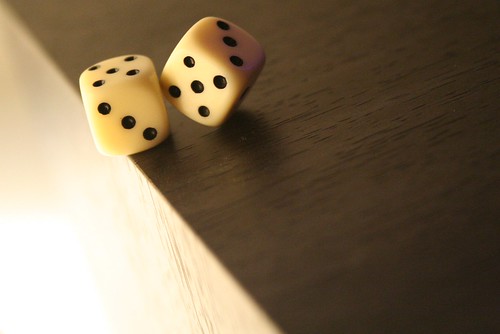
Plinky asked: "Is it always better to know the truth, even when it hurts?"
Not always. Sometimes (excuse the expression) you can't handle the truth. Are you going to tell a five-year-old that his mommy was raped and dismembered in Central Park? When Grandma has Alzheimer's in the nursing home and every day forgets that Grandpa died five years ago are you going to break her heart every day so she isn't misinformed? What about if you've just moved in with someone, and maybe life isn't that grand because you have to scrape for rent and food but you're happy, but if you tell your dad he'll sweep in and take you away and you'll spend the rest of your life being mollycoddled?
The easiest answer is "yes, the truth is always the best," but that seems very monochromatic to me. Shades of grey means that nothing's easy. Besides (and I promise I'll restrain from expanding on this) but what is the truth? Something you may see as absolute truth - for instance that it is time for you to move away from your family and start your own life - may not be absolute for someone else - like your little sister, who draws strength from your closeness and appreciates that you don't leave her to deal with mom and dad all alone.
The truth can limit a person, too. Sometimes, if you don't know the truth (for instance, your friend's truth that your artwork is dull and unoriginal) it turns out not to be the truth (when you end up having a show in a gallery in SoHo). Truth is inconstant, and as a species we give it way too much credit.

Tuesday, January 4, 2011
A Lack of Dentary Sagacity: Are Wisdom Teeth Wise?
Got my wisdom teeth out yesterday. Frickin' wisdom teeth; nothing wise about 'em. An artifact of evolution. Adult humans have 32 teeth (including the wisdom teeth). These wisdom teeth are presumably so-named because they erupt around the late teens, when humans supposedly become "wise" or some such thing. Maybe naming them that is some sort of wry humor, a rite of passage, as only those with forbearance enough to survive to that [in some eras and some cultures, advanced] age deserve to gain the "wisdom" teeth.
At any rate, they're pretty useless, even detrimental. For instance, the biggest factor in my finally getting mine out was that my dentist informed me that the lower teeth, now peeking through, left nooks and crannies where food could get stuck and promote an abscess.
The reason they couldn't make it all the way through and make it to the normal, un-threatening teeth stage? Because I, like the majority of modern humans, don't have a long enough jaw to accomodate them. "Then why are they there?" you inquire. Well, they're there because evolution is a process, not a guide; there is no "invisible hand" with some sort of foresight seeing the probability that our faces would get shorter and spontaneously ridding us of those annoying third molars that don't fit. Some thousands of years ago, those third molars did fit. Think of a dog's jaw, or some similarly-snouted animal. 32 human-sized teeth in the jaw of a dog with vaguely similar cranial measurements would fit nicely (an oversimplification, I know, but bear with me). And the dog would have space for those 28 teeth, plus those blasted wisdom teeth because... (wait for it)... he has a long muzzle. Might not seem like much but consider this: we have the shortest faces of any in the vertebrates (I would venture) and we are the only ones with extra teeth. Wait, let me check that... yeah, pretty much. Most telling is that other vertebrates have these same third molars but they fit. A distinguishing characteristic of primates is the shortened face, especially as you move into the apes.
Just a quick aside; this is not (gods forbid) to cast humans or apes in any sort of "superior" role with respect to the rest of Animalia. This is simply an academic distinction between mammalian/vertebrate/chordate/animal lineages and one of them just happens to be Homo sapiens.
Still with me? Good. In that vein I would like to address creationism (more like rip it apart into itty bitty pieces but ah well, we can't have everything). I just have one point to make at this juncture: why would an intelligent designer give us these pointless, potentially harmful teeth? Among other things [that identify us as humans]... bigger brains means bigger skulls, leading to more hazardous childbirth; standing on two legs leads to numerous lower body joint problems, especially spine problems; a specialized laryngeal apparatus grants the power of speech but greatly increases the risk of choking, necessitating the chewing of food which in its turn causes myriad jaw problems, and now we're back to teeth.
So all this boils down to one thing: my mouth hurts and I'm pissed.
At any rate, they're pretty useless, even detrimental. For instance, the biggest factor in my finally getting mine out was that my dentist informed me that the lower teeth, now peeking through, left nooks and crannies where food could get stuck and promote an abscess.
The reason they couldn't make it all the way through and make it to the normal, un-threatening teeth stage? Because I, like the majority of modern humans, don't have a long enough jaw to accomodate them. "Then why are they there?" you inquire. Well, they're there because evolution is a process, not a guide; there is no "invisible hand" with some sort of foresight seeing the probability that our faces would get shorter and spontaneously ridding us of those annoying third molars that don't fit. Some thousands of years ago, those third molars did fit. Think of a dog's jaw, or some similarly-snouted animal. 32 human-sized teeth in the jaw of a dog with vaguely similar cranial measurements would fit nicely (an oversimplification, I know, but bear with me). And the dog would have space for those 28 teeth, plus those blasted wisdom teeth because... (wait for it)... he has a long muzzle. Might not seem like much but consider this: we have the shortest faces of any in the vertebrates (I would venture) and we are the only ones with extra teeth. Wait, let me check that... yeah, pretty much. Most telling is that other vertebrates have these same third molars but they fit. A distinguishing characteristic of primates is the shortened face, especially as you move into the apes.
Just a quick aside; this is not (gods forbid) to cast humans or apes in any sort of "superior" role with respect to the rest of Animalia. This is simply an academic distinction between mammalian/vertebrate/chordate/animal lineages and one of them just happens to be Homo sapiens.
Still with me? Good. In that vein I would like to address creationism (more like rip it apart into itty bitty pieces but ah well, we can't have everything). I just have one point to make at this juncture: why would an intelligent designer give us these pointless, potentially harmful teeth? Among other things [that identify us as humans]... bigger brains means bigger skulls, leading to more hazardous childbirth; standing on two legs leads to numerous lower body joint problems, especially spine problems; a specialized laryngeal apparatus grants the power of speech but greatly increases the risk of choking, necessitating the chewing of food which in its turn causes myriad jaw problems, and now we're back to teeth.
So all this boils down to one thing: my mouth hurts and I'm pissed.
Tuesday, November 30, 2010
Hubris, aka We Humans Really Do Give Ourselves Too Much Credit
I worry that my faith is changing, and that my main ideas are just becoming a diatribe against religions in general and Christianity in particular. I really don't know why I hate them so much; this must be what they feel. So actually, and sort of ironically, I pretty much know exactly where they are coming from. But I cling to the fact that I came to my faith of my own volition; I wasn't born into it or raised in its presence, and I started forming my ideas when I was still quite young and didn't have this mysterious animosity toward Christians.
I remember when I was four or five and in kindergarten, I had this friend, Erica, who was a Christian. Nothing special; most of my friends were probably Christians in the sense that their parents had said "you are Christian."♦ Even then I realized the sanctity of the earth and nature, and I did not relish the idea of humans as the masters of the world. One day (or over the course of a few days) we had a discussion involving the Christian god♥, my Mother earth (reminiscent of Native American religions), and the creation of the earth and humankind. I was still willing to "play nice" with Christians at that point, as she was willing to with me; also important to note is that I had not defined myself as anything other than Christian at that point, although I did not see myself as one of that religion and did not follow its tenets (church, prayer, etc). Erica and I eventually decided that my Mother had made the earth, including the land, the oceans, and all the animals and plants, and that her god had made the humans. I would have to say I got the better deal. My personal feelings aside, I find it interesting that we would compromise so, and I am extremely curious as to how we would deal with it now. Perhaps that is the mindset that I seek to return to.
I don't want to hate people just because of what they believe; that in itself is sort of against my ideas. I don't want to have a double standard and think myself and my faith above criticism. But that is the direction that I find myself moving in; I think that conservative Christians are so idiotic for believing such ridiculous fairytales as the bible, but I believe things that could be described as "fanciful" and "ludicrous."
The key for me is to be humble; nothing and no one is above the scrutiny of the living, and so I should be used to being tossed aside like so much ridiculous trash. As long as I can think they're morons; but then I am in danger of falling into that trap of the double standard… I do hate the double standard, and Christians (and really most recognized religions, especially the monotheistic ones) are shameless perpetrators of this hubris.♣
♦ I also remember asking my mother, and my friends asking their mothers, "What are we?" As in, what religion are we? This in itself is utter folly, because any faith or religion must be reached by yourself, in my opinion. Religion is totally your own, so children having religion is ridiculous.
♥ You will never see me call the Judeo-Christian deity "God" because I am insulted by the inference that he is the only god. Being a polytheist of a sort I recognize the existence of many divine forces, though I may not recognize their sovereignty. Hence my use of "JCgod."
♣ Hubris is commonly used to describe a mortal who thinks he is equal to a god, but I propose that it also describes religions/faiths and followers of religions/faiths that consider themselves above other religions/faiths, or, more importantly, consider themselves above scrutiny. No thing in the universe is above scrutiny.
I remember when I was four or five and in kindergarten, I had this friend, Erica, who was a Christian. Nothing special; most of my friends were probably Christians in the sense that their parents had said "you are Christian."♦ Even then I realized the sanctity of the earth and nature, and I did not relish the idea of humans as the masters of the world. One day (or over the course of a few days) we had a discussion involving the Christian god♥, my Mother earth (reminiscent of Native American religions), and the creation of the earth and humankind. I was still willing to "play nice" with Christians at that point, as she was willing to with me; also important to note is that I had not defined myself as anything other than Christian at that point, although I did not see myself as one of that religion and did not follow its tenets (church, prayer, etc). Erica and I eventually decided that my Mother had made the earth, including the land, the oceans, and all the animals and plants, and that her god had made the humans. I would have to say I got the better deal. My personal feelings aside, I find it interesting that we would compromise so, and I am extremely curious as to how we would deal with it now. Perhaps that is the mindset that I seek to return to.
I don't want to hate people just because of what they believe; that in itself is sort of against my ideas. I don't want to have a double standard and think myself and my faith above criticism. But that is the direction that I find myself moving in; I think that conservative Christians are so idiotic for believing such ridiculous fairytales as the bible, but I believe things that could be described as "fanciful" and "ludicrous."
The key for me is to be humble; nothing and no one is above the scrutiny of the living, and so I should be used to being tossed aside like so much ridiculous trash. As long as I can think they're morons; but then I am in danger of falling into that trap of the double standard… I do hate the double standard, and Christians (and really most recognized religions, especially the monotheistic ones) are shameless perpetrators of this hubris.♣
♦ I also remember asking my mother, and my friends asking their mothers, "What are we?" As in, what religion are we? This in itself is utter folly, because any faith or religion must be reached by yourself, in my opinion. Religion is totally your own, so children having religion is ridiculous.
♥ You will never see me call the Judeo-Christian deity "God" because I am insulted by the inference that he is the only god. Being a polytheist of a sort I recognize the existence of many divine forces, though I may not recognize their sovereignty. Hence my use of "JCgod."
♣ Hubris is commonly used to describe a mortal who thinks he is equal to a god, but I propose that it also describes religions/faiths and followers of religions/faiths that consider themselves above other religions/faiths, or, more importantly, consider themselves above scrutiny. No thing in the universe is above scrutiny.
Monday, November 29, 2010
Subscribe to:
Posts (Atom)
