I've started watching Dexter again. I don't know why I ever stopped; it's such a fascinating study in human nature. Or... something else... I guess Dexter would describe himself as other-than-human, but what is it that makes us human? If it is the physical condition of being human (born human, of humans, in humanity, with the same genetic makeup as humans and the same material needs) then Dexter is most certainly human. And he's not a sociopath, as I've heard suggested. He displays some sociapathic characteristics, but he wouldn't care about all these people, even Harry, if he was. And he does care, and that's why the show's interesting.
I've watched all the usual crime/forensics/police dramas: CSI (in its many incarnations), Law & Order (in its ever-more-numerous masques), Bones, Inspector Lynley, and such, and I feel this has made me better able to appreciate Dexter. I do not mean to suggest that any of these are realistic (I have come to realize over the years that many are far from accurate, most notably CSI (in which techs are given guns and the lab rats go into the field). I think maybe this innacuracy allows me to juxtapose CSI (which, I must admit, is probably the worst perpetrator) with Dexter. But knowing these shows allows me to ignore all the forensics and police procedural part. I imagine Dexter's as accurate perhaps as L & O, but the point is not accuracy, precisely. The other route a show like this usually goes is invariably the drama route, which I suppose they are, deep down inside, but Dexter doesn't even really land there. Sure there's the family drama, with his sister and his father and his girlfriend and her kids. But it's not really about these people; it's all about him.
At the core, every story is very specific; it's about one or a few people and the world's relationship with them. That's what a main character is: a focus, a thumbtack on a map with strings radiating. It seems simple, even simplistic when I say it like that. Oh, well.
On the surface Dexter looks like another fascinatingly twisted string of executions that draw us in a mob to the gallows (everybody likes a good beheading). But I think underneath it's a more subtle weaving pushing common ideals--such as the morals we're taught when we're three and too young to think--and challenging our senses of ourselves. Actually, I think that most people who watch it tend to ignore that bit, and that's why it's survived so long. People feel gratified to watch Dex fulfill their needs for justice (even though justice resides in a different realm and looks not at all like what we think justice should), but they don't examine why. I've long given up trying to be disgusted at the revenge-fantasy this heroic vigilante-ism brings to the surface in me. I'm comfortable with my amygdala; are you?
I like Dexter.
Showing posts with label Law. Show all posts
Showing posts with label Law. Show all posts
Sunday, March 27, 2011

Tuesday, March 22, 2011
Something important to talk about: the fraudulent link between the MMR vaccine and autism, and a mini-lesson on vaccines..
Okay, here's something for me to talk about: measles.
The WHO (World Health Organization) factsheet on measles starts out with the key points. The first key point is:
Yeah, you heard it: encephalitis.
Here's an article from Medical News Today about how much of a stir the disease causes even in "developed" countries like the US.
Good news! It's covered under the MMR (Measles/Mumps/Rubella) vaccine, usually given to young kids, which confers lifelong immunity!
You may have been hearing about this lately, because it's rumored to "cause" autism. Okay, that's unfair; mostly people who are proponents of this theory are saying MMR and autism are "linked." Only slightly better, since word choice doesn't change that it's a load of crap. Okay, I guess that's unfair, too, because [as a reasonable, thinking scientific person] I would approach it as a possibility. Pertinent: a possibility and no more. There's literally no scientific evidence that even remotely suggests such a connection.
Finally, here's the CDC page addressing this precise topic. Guess what?
The worst part is that lives were worsened because of Wakefield's irresponsible idiocy. This is an article by the parent of an autistic child who suffered under the false claims of a connection between autism and MMR.
Oh wait, maybe the worst part is that lives are in danger because of Wakefield's irresponsible idiocy. Like most vaccines, the MMR depends heavily on "herd immunity," which is the idea that if the majority of the members of a population are vaccinated and are therefore immune to the disease, the few members of the population that can't be vaccinated for whatever reason (immunocompromised, allergies, etc) are protected. Maybe there isn't a 100% guarantee that they won't contract the disease they can't be vaccinated against, but the un-vaccinated members of a population are normally few enough that a disease can't just leapfrog between populations.
I feel the need to explain herd immunity farther (here begins the mini-lesson on vaccines and epidemiology). Think about a hypothetical situation in which there are three populations of about a hundred members, and there's a communicable pathogen--for simplicity, we'll just stick with measles. If you plotted the locations of the populations on a map, they would roughly form a line; let's call them A (western-most), B (middle), and C (eastern-most).
Okay, in this figure the measles virus is not present in any of the populations (A, B, and C). Now imagine that red means the virus is present (most/all members of the population are infected/infective), blue means that most/all of the members of the population has been vaccinated (immune, or resistant) and green means most/all members of a population have not been vaccinated but don't have the disease (susceptible). (For those of you keeping track, I'm simplifying the terms "infected," "resistant," and "susceptible." You can decide for yourself if you want [I'm using the SIR model].)
I've simplified transmission a bit using geographic location (putting B between A and C) but you get the idea, right? The virus could not physically get to C to infect it because it can't even get a foothold in the B population because they're immune. Now consider this: C might not have been vaccinated for some random reason, like they just never got around to it, or it could be because C couldn't be vaccinated.
What if C is allergic to something in the vaccine? There are lots of things in vaccines that aren't the actual "active ingredient," things like antibiotics to prevent bacterial contamination, that people can be allergic to. Here's an info sheet (PDF) about what's in a vaccine from the American Association of Pediatricians.
Another possibility: C could have a weakened immune system. Maybe C has cancer and is undergoing radiation or chemotherapy, or has an autoimmune disorder (eg rheumatoid arthritis) and takes immunosuppressant drugs to keep their symptoms in check. C could also take immunosuppressants because they recieved an organ transplant and need to keep their body from rejecting the foreign cells of the organ. C could have HIV or AIDS. It's extremely dangerous to give many vaccines to people with compromised immune systems, because many vaccines are what's known as attenuated vaccines (they contain only weakened viruses, not completely killed). Why would we do this, purposely expose someone to a potentially infective organism? Because sometimes that's the only way to get the body to react enough to make the vaccine work (look for the blue highlighting). It also has the added benefit of triggering a longer-lasting (in some cases, lifelong) immunity. But if someone has a weakened immune system, even the extremely weakened virus in the vaccine could produce disease symptoms. So we can't vaccinate them. (Actually, I know I already linked to this ("react... work") but it's a really good primer on vaccines.)
Back to my story: for some reason (which isn't important here) C cannot be vaccinated. Well, guess what happens if B isn't vaccinated because his parents didn't know about herd immunity (among other reasons)...
The virus has unfettered access to population C, and so everyone's infected. Whoop-dee-doo. Now, this would be bad enough if C had a regular, healthy immune system to begin with, but remember how we said earlier that C had a lowered immune system? The upshoot is that not only could C not be vaccinated and protected, but now C is going to suffer more from the disease than either A or B. Kinda blows, huh?
These diagrams and explanations can also be applied to a three-person system (as in A, B, and C are just people). So let's look at another system.
In this seven-person model, A is infected/infective, B is vaccinated = immune, and C is not vaccinated = susceptible. Statistically, C can only get the virus from six people (A and 5 B's); C has one-in-six chance of contacting an infective person. Now if B isn't vaccinated...
 C has a six-in-six (aka 100%) chance of contacting an infective person, ie a much greater probability of being infected and developing symptoms. And C is immunocompromised, so the disease will be worse for C than for either A or the B's. Sucks to be C.
In short: not vaccinating your children because of lies spun by a morally-bankrupt "scientist" is irresponsible and potentially injurious to: a) your children, because it is far more likely that no vaccination will lead to potentially life-threatening (and preventable) illness than vaccination will lead to autism, and b) to the your community, both local and larger, because you risk upsetting the balance and benefit of herd immunity.
Please: vaccinate your kids.
 |
| Graph from WHO showing the estimated childhood death toll worldwide. (Measles is red.) |
"Measles is one of the leading causes of death among young children even though a safe and cost-effective vaccine is available."Another point is:
"Measles vaccination resulted in a 78% drop in measles deaths between 2000 and 2008 worldwide."Here's the CDC (Centers for Disease Control and Prevention) page on possible complications of measles. Okay, pneumonia (what else is new), ear infections, diarrhea... whoa, wait. SSPE (Subacute Sclerosing Panencephalitis)? "Rare, but fatal" encephalitis?
Yeah, you heard it: encephalitis.
Here's an article from Medical News Today about how much of a stir the disease causes even in "developed" countries like the US.
Good news! It's covered under the MMR (Measles/Mumps/Rubella) vaccine, usually given to young kids, which confers lifelong immunity!
You may have been hearing about this lately, because it's rumored to "cause" autism. Okay, that's unfair; mostly people who are proponents of this theory are saying MMR and autism are "linked." Only slightly better, since word choice doesn't change that it's a load of crap. Okay, I guess that's unfair, too, because [as a reasonable, thinking scientific person] I would approach it as a possibility. Pertinent: a possibility and no more. There's literally no scientific evidence that even remotely suggests such a connection.
Finally, here's the CDC page addressing this precise topic. Guess what?
"To date, the studies continue to show that vaccines are not associated with [Autism Spectrum Disorders]."(That emphasis on "not" is theirs.) In the meantime panicked parents and fear-mongers (who we sometimes refer to as "the media" when we're feeling charitable) are using falsified information from a 30-year-old study by some British physician. Oh yeah, and the study was found to be fraudulent. Made-up. Hogwash. This physician, Andrew Wakefield, was subsequently found guilty of several conflicts of interest and professional misconduct by the General Medical Council of the UK and they basically kicked him out, disallowing him from ever practicing medicine again in the UK (not that anyone else would have him, either). The article was originally published in The Lancet, a prestigious medical journal in 1998, but when they found out he screwed with the data they retracted it, even going so far as publishing a statement (you can get a free Lancet account to see the whole thing, but it basically lists the allegations against Wakefield) distancing themselves from Wakefield and his bunk study (NB couldn't even find the study on TheLancet.com, though I did find Wakefield's response to the retraction). Even after all this the MMR vaccine controversy goes on (1, 2, 3, 4, 5). *sigh*
The worst part is that lives were worsened because of Wakefield's irresponsible idiocy. This is an article by the parent of an autistic child who suffered under the false claims of a connection between autism and MMR.
Oh wait, maybe the worst part is that lives are in danger because of Wakefield's irresponsible idiocy. Like most vaccines, the MMR depends heavily on "herd immunity," which is the idea that if the majority of the members of a population are vaccinated and are therefore immune to the disease, the few members of the population that can't be vaccinated for whatever reason (immunocompromised, allergies, etc) are protected. Maybe there isn't a 100% guarantee that they won't contract the disease they can't be vaccinated against, but the un-vaccinated members of a population are normally few enough that a disease can't just leapfrog between populations.
I feel the need to explain herd immunity farther (here begins the mini-lesson on vaccines and epidemiology). Think about a hypothetical situation in which there are three populations of about a hundred members, and there's a communicable pathogen--for simplicity, we'll just stick with measles. If you plotted the locations of the populations on a map, they would roughly form a line; let's call them A (western-most), B (middle), and C (eastern-most).
 | |
| Excuse my handwriting, but I thought I could explain it better with a figure. |
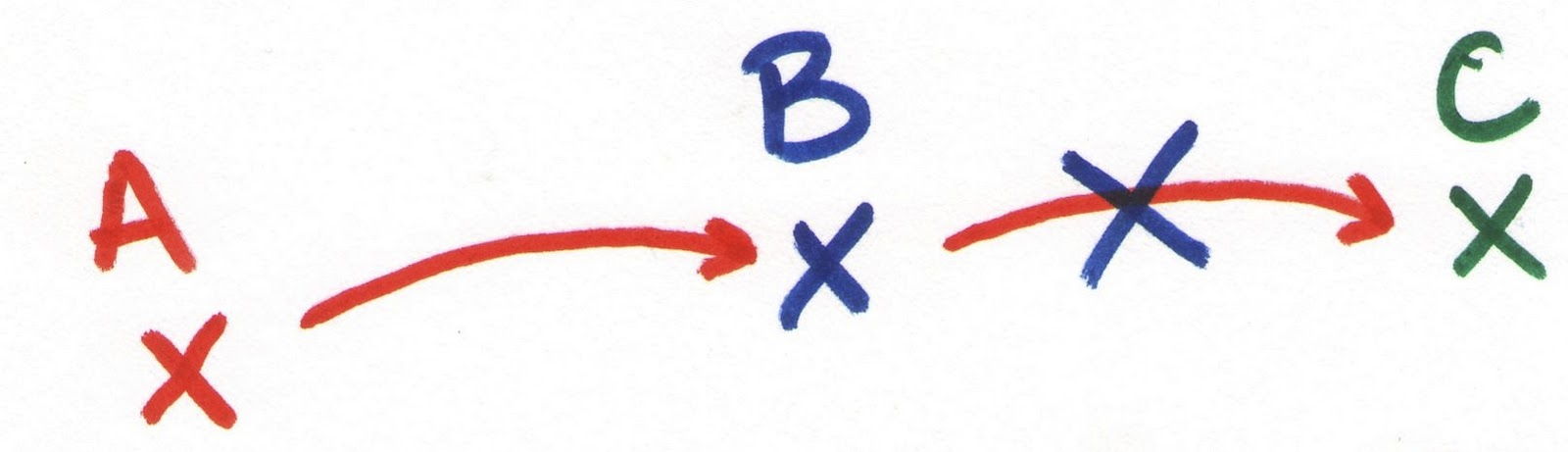 |
| Pop A is infected (either partially or wholly), B has been vaccinated (either partially or wholly), and C has been protected from the spread of the virus (red arrow) by the vaccine (blue X) even though they haven't been vaccinated. |
What if C is allergic to something in the vaccine? There are lots of things in vaccines that aren't the actual "active ingredient," things like antibiotics to prevent bacterial contamination, that people can be allergic to. Here's an info sheet (PDF) about what's in a vaccine from the American Association of Pediatricians.
Another possibility: C could have a weakened immune system. Maybe C has cancer and is undergoing radiation or chemotherapy, or has an autoimmune disorder (eg rheumatoid arthritis) and takes immunosuppressant drugs to keep their symptoms in check. C could also take immunosuppressants because they recieved an organ transplant and need to keep their body from rejecting the foreign cells of the organ. C could have HIV or AIDS. It's extremely dangerous to give many vaccines to people with compromised immune systems, because many vaccines are what's known as attenuated vaccines (they contain only weakened viruses, not completely killed). Why would we do this, purposely expose someone to a potentially infective organism? Because sometimes that's the only way to get the body to react enough to make the vaccine work (look for the blue highlighting). It also has the added benefit of triggering a longer-lasting (in some cases, lifelong) immunity. But if someone has a weakened immune system, even the extremely weakened virus in the vaccine could produce disease symptoms. So we can't vaccinate them. (Actually, I know I already linked to this ("react... work") but it's a really good primer on vaccines.)
Back to my story: for some reason (which isn't important here) C cannot be vaccinated. Well, guess what happens if B isn't vaccinated because his parents didn't know about herd immunity (among other reasons)...
 |
| Look'a that: everyone's infected. |
These diagrams and explanations can also be applied to a three-person system (as in A, B, and C are just people). So let's look at another system.
 |
| The colors mean the same thing; red is infected, blue is resistant, and green is susceptible. |

In short: not vaccinating your children because of lies spun by a morally-bankrupt "scientist" is irresponsible and potentially injurious to: a) your children, because it is far more likely that no vaccination will lead to potentially life-threatening (and preventable) illness than vaccination will lead to autism, and b) to the your community, both local and larger, because you risk upsetting the balance and benefit of herd immunity.
Please: vaccinate your kids.
Wednesday, March 16, 2011
Playing god and other human pursuits.
Today I'm thinking about euthanasia. Alternately, murder. I don't know.
Up until a few years ago I was set on a career in veterinary medicine. I wanted, needed to be a veterinarian. I... honestly, I don't really know why it was so important to me. At first I suppose it was just like, "Oh I love animals, and I want to work in the sciences, and I want to help the animals that live with us." I have always liked animals more than humans to some extent; as I've aged it's shifted from disgust with the human race and reverence of non-human animals to, well, I'm still pretty disgusted with humans, but it's less of a generalization and more on a case-by-case basis. So when I was little I deemed non-human animals more deserving of medical care. I counter any protests of "But you're human, and our pets need humans to provide that care," with "I was, like, six years old." Six-year-olds aren't known for their expansive considerations of reality (ie how the world works).
As I got older I developed more concrete reasons for becoming a vet. I started feeling that pulling at my heart when I thought of animals suffering illness or mistreatment. I realized that I felt personally obligated to do whatever I could to help them, for they could not help themselves. I still feel that obligation, but I realize now that your life's work should also be something that is fascinating to me, and my fascination is not in veterinary medicine.
My career plans are not the point. So what is? you ask. The point: one disparity between medicine for humans and non-humans is at the end of medicine. By that I mean, of course, how and when death comes.
The very simple fact is: humans often choose when an animal will die. Another simple fact: it is illegal and usually considered amoral for humans to choose when a human will die (with exceptions and/or loopholes). Why? If you ask someone that question, chances are they will have a hard time with a solid answer. I've thought about this question a lot, and I've come to the conclusion that the law is as it is because there is an inherent assumption that humans are more important than non-humans. I wouldn't expect an easy answer out of anyone to this question, either, even though it's basically a yes/no question.
My take is that it's something that people believe deeply--perhaps subconsciously--but are uncomfortable voicing aloud. But shouldn't a person be able to say what she thinks? Also, this belief in human superiority is probably widely-held, so speaking it aloud would place one squarely within the clear--albeit close-mouthed--majority.
I will speak: I do not agree with the statement that humans are more important than non-humans. I strongly believe that humans are of equal importance with non-humans. Who knows, maybe I'll change my mind in a few years; I did start out believing that non-humans were of more importance than humans.
The most trouble I have with that statement is the use of "important." Calling something important implies that there is a purpose for it, and we've already said there is no purpose for living things, nor even for living. Actually, Oxford English Dictionary defines important as "of great significance or value; likely to have a profound effect on success, survival, or well-being." You could argue that because of the inclusion of "profound effect on... survival" it might have bearing on the relationship between these two things (humans and non-humans); actually there is no relevance to this comparison because the it is not comparing to methods of finding food or shelter or anything like that, so there is no element of survival. It is not calling into question the survival skills of either being, but comparing them as if they were instrumental to some sort of universal scheme, which smacks of monotheism (and actually most religions with divinity/-ies).
So the natural next question is "Why then do we decide when animals die and not when humans die?" When we can't easily answer that one, we might go to "Why is it socially acceptable to decide for animals and not humans?" or even "Is it right?" And then we get to right vs wrong, my least favorite dichotomy of all time (and I can even say with confidence that I will never meet another dichotomy that I loathe more).
It's been a hard week.
Up until a few years ago I was set on a career in veterinary medicine. I wanted, needed to be a veterinarian. I... honestly, I don't really know why it was so important to me. At first I suppose it was just like, "Oh I love animals, and I want to work in the sciences, and I want to help the animals that live with us." I have always liked animals more than humans to some extent; as I've aged it's shifted from disgust with the human race and reverence of non-human animals to, well, I'm still pretty disgusted with humans, but it's less of a generalization and more on a case-by-case basis. So when I was little I deemed non-human animals more deserving of medical care. I counter any protests of "But you're human, and our pets need humans to provide that care," with "I was, like, six years old." Six-year-olds aren't known for their expansive considerations of reality (ie how the world works).
As I got older I developed more concrete reasons for becoming a vet. I started feeling that pulling at my heart when I thought of animals suffering illness or mistreatment. I realized that I felt personally obligated to do whatever I could to help them, for they could not help themselves. I still feel that obligation, but I realize now that your life's work should also be something that is fascinating to me, and my fascination is not in veterinary medicine.
My career plans are not the point. So what is? you ask. The point: one disparity between medicine for humans and non-humans is at the end of medicine. By that I mean, of course, how and when death comes.
The very simple fact is: humans often choose when an animal will die. Another simple fact: it is illegal and usually considered amoral for humans to choose when a human will die (with exceptions and/or loopholes). Why? If you ask someone that question, chances are they will have a hard time with a solid answer. I've thought about this question a lot, and I've come to the conclusion that the law is as it is because there is an inherent assumption that humans are more important than non-humans. I wouldn't expect an easy answer out of anyone to this question, either, even though it's basically a yes/no question.
My take is that it's something that people believe deeply--perhaps subconsciously--but are uncomfortable voicing aloud. But shouldn't a person be able to say what she thinks? Also, this belief in human superiority is probably widely-held, so speaking it aloud would place one squarely within the clear--albeit close-mouthed--majority.
I will speak: I do not agree with the statement that humans are more important than non-humans. I strongly believe that humans are of equal importance with non-humans. Who knows, maybe I'll change my mind in a few years; I did start out believing that non-humans were of more importance than humans.
The most trouble I have with that statement is the use of "important." Calling something important implies that there is a purpose for it, and we've already said there is no purpose for living things, nor even for living. Actually, Oxford English Dictionary defines important as "of great significance or value; likely to have a profound effect on success, survival, or well-being." You could argue that because of the inclusion of "profound effect on... survival" it might have bearing on the relationship between these two things (humans and non-humans); actually there is no relevance to this comparison because the it is not comparing to methods of finding food or shelter or anything like that, so there is no element of survival. It is not calling into question the survival skills of either being, but comparing them as if they were instrumental to some sort of universal scheme, which smacks of monotheism (and actually most religions with divinity/-ies).
So the natural next question is "Why then do we decide when animals die and not when humans die?" When we can't easily answer that one, we might go to "Why is it socially acceptable to decide for animals and not humans?" or even "Is it right?" And then we get to right vs wrong, my least favorite dichotomy of all time (and I can even say with confidence that I will never meet another dichotomy that I loathe more).
It's been a hard week.
Monday, January 31, 2011
A family is more than the sum of its parts, or the relative densities of blood and water.
I'm pretty much thinking I never want to have kids. And, while this is personal choice, I also believe it is a matter of faith. I believe very strongly in zero population growth, even the negative population growth that comes from having no biological children of your own. The least you could do with all the poverty and homelessness in the world is to adopt children who need families, and then you're not adding to the overall population of the world anyway.
In the event this raises questions in the validity of a family with adopted children, I would like to point out that family is not confined to your blood relatives; rather, it's a shared experience of living. I live with three other girls, and I would consider them as much my sisters as my biological sisters (had I any). But it doesn't even have to be the shared experience of living together; when I worked backstage in high school, I had a family in the people I worked with, spent time with, shared joy and frustration with. Family is much more than a nuclear unit of Mom, Dad, Jane, and Billy.
I don't think it's responsible to suggest that some people you live with would have the same rights to you, your possessions, and your life as the family you grew up with. I suppose that's the defining factor: growing up and coming of age. Yes, there are all the legal definitions that [necessarily] allocate resources and responsibilities. Those are important, too, in our society.
I write this thinking about families I know with adopted children. It's no big secret to them, and as far as I know my friend has always known she was adopted. She has had contact with her biological mother, starting when she was 18 (which I believe was the mother's stipulation). And that's that. The two other children in the family are biological, but she has no less claim to her parents' affection.

In the event this raises questions in the validity of a family with adopted children, I would like to point out that family is not confined to your blood relatives; rather, it's a shared experience of living. I live with three other girls, and I would consider them as much my sisters as my biological sisters (had I any). But it doesn't even have to be the shared experience of living together; when I worked backstage in high school, I had a family in the people I worked with, spent time with, shared joy and frustration with. Family is much more than a nuclear unit of Mom, Dad, Jane, and Billy.
I don't think it's responsible to suggest that some people you live with would have the same rights to you, your possessions, and your life as the family you grew up with. I suppose that's the defining factor: growing up and coming of age. Yes, there are all the legal definitions that [necessarily] allocate resources and responsibilities. Those are important, too, in our society.
I write this thinking about families I know with adopted children. It's no big secret to them, and as far as I know my friend has always known she was adopted. She has had contact with her biological mother, starting when she was 18 (which I believe was the mother's stipulation). And that's that. The two other children in the family are biological, but she has no less claim to her parents' affection.
Thursday, November 11, 2010
The Empty Room Accepts Your Apologies, But Do I?
Today I read something at The Wild Hunt that got me thinking. Well, Wild Hunt always makes me think, but today I feel like writing about it. It's the last section, "Medicine Man Confidentiality" of today's post. It addresses equal rights for non-Christian religions to have a sort of "confessional confidentiality." You know how if a murderer confesses his crime to a priest in confession it's considered sacred and the police can't force the priest to tell them? Yeah, I think it's bullshit too. And here's why:
I think why Christians are so okay with this is because their central dogma revolves around the spiritual world (the "next world") and the fact that this, physical world is fleeting. Unimportant. Basically, they're saying it doesn't matter what happens in "this" world, because it's all gonna come out right in the end. Hey, the evil will be punished eternally and the virtuous will party in heaven and everyone's happy, right?
Dear gods, NO! Are they HEARING themselves? (I'm sorry, this really gets me.) Oh, it doesn't matter that the murderer confessed to the priest but is still out on the streets to kill more people, and their families will be torn apart by grief and uncertainty for years and years to come, because he confessed his sins and he'll be punished in hell for all eternity when he dies. Which could be after he kills twenty more people, or whatever. Or no wait, doesn't confession mean he's absolved? So you mean to tell me that he's "not guilty" anymore in your estimation because he's "seen the error of his ways" and confessed to the priest? Oh, so that time he dismembered some random hooker in a dark alley and threw the parts in the East River was just an "oopsie" and didn't really count? (Why yes, I do get a lot of my material from L&O…) Oh, yeah, it does count, but kiss a string of beads a few hundred times and apologize to an empty room, or better yet, a manmade symbol, and all will be forgiven. I'm sorry: WHAT? What are you on? And this is written into our LEGAL SYSTEM.
"This" world matters. I understand that there's a historical precedent for this. But here's the bottom line: while you have a right to believe in such things as the Invisible Pink Unicorn, you DO NOT have the right to subject me to your beliefs. This is relevant when the victim and the victim's family are not of the same persuasion as you. If a Catholic murdered a Hindu, then went to confession and told the priest all the gory details, should the victim's family (not being of the belief that JCgod will judge everyone at the end of days and everyone will be allotted their deserved space in heaven/hell) be content with the priest clamming up? No, the priest is then complicit in the crime. The priest should GO TO JAIL (DO NOT pass go, DO NOT collect $200). The American legal system recognizing the confidentiality of Catholic confession (etc) impinges on MY rights to MY OWN beliefs: that everyone should be held accountable (assuming we are actually pursuing justice) in "this" world because there is no "next" world (what is this "next world" of which you speak of) where some "higher power" is going to do it for us.
And if you think that argument (yeah, that one ^ right up there) is an impingement on separation of church and state, just turn right around and consider that, in this case, our legal system is already taking cues from religious beliefs.
And if you're like Christine O'Donnell, who denies the validity of the interpretation of the second Amendment to the Constitution as "separation of church and state," then you should have no problem with the [slightly] religious nature of my argument.
So the article at Wild Hunt doesn't deal with Catholic confession; it's about equal rights for other faiths, namely native American faiths. Up in Canada there's a murder trial going on, and as I understand it the suspect (being an adherent to a native American faith) may have said some things to a medicine man and the court is hemming and hawing about the legality of entering confessions to a spiritual leader into evidence. Can you see where I'm going with this?
Okay, now I've had a few hours to cool down about this, but I still vehemently oppose this unconstitutional practice of the law. I have two more points to make:
There might be a historical precedent for respecting the confidentiality of confession, but we don't live in the past. Our society is much larger and communication over long distances and to a lot of people is much easier, so do we really want to send a message (that will be heard by millions, if not billions of people around the country and the world) that we don't punish "good Christians?"
And what's to say that certain unscrupulous elements (as criminals are wont to be) won't take advantage of this loophole in the legal system? Are we really saying that a priest won't be fooled by a seasoned con artist or a pathological liar?
This chance for criminals to slide by the legal system in our country needs to be addressed. The article may have been about events in Canada, but it just got me thinking about our own country (and how much confession confidentiality peeves me on L&O). Sorry for all the vitriol, but I feel that it needs to be said.
Thoughts?
I think why Christians are so okay with this is because their central dogma revolves around the spiritual world (the "next world") and the fact that this, physical world is fleeting. Unimportant. Basically, they're saying it doesn't matter what happens in "this" world, because it's all gonna come out right in the end. Hey, the evil will be punished eternally and the virtuous will party in heaven and everyone's happy, right?
Dear gods, NO! Are they HEARING themselves? (I'm sorry, this really gets me.) Oh, it doesn't matter that the murderer confessed to the priest but is still out on the streets to kill more people, and their families will be torn apart by grief and uncertainty for years and years to come, because he confessed his sins and he'll be punished in hell for all eternity when he dies. Which could be after he kills twenty more people, or whatever. Or no wait, doesn't confession mean he's absolved? So you mean to tell me that he's "not guilty" anymore in your estimation because he's "seen the error of his ways" and confessed to the priest? Oh, so that time he dismembered some random hooker in a dark alley and threw the parts in the East River was just an "oopsie" and didn't really count? (Why yes, I do get a lot of my material from L&O…) Oh, yeah, it does count, but kiss a string of beads a few hundred times and apologize to an empty room, or better yet, a manmade symbol, and all will be forgiven. I'm sorry: WHAT? What are you on? And this is written into our LEGAL SYSTEM.
"This" world matters. I understand that there's a historical precedent for this. But here's the bottom line: while you have a right to believe in such things as the Invisible Pink Unicorn, you DO NOT have the right to subject me to your beliefs. This is relevant when the victim and the victim's family are not of the same persuasion as you. If a Catholic murdered a Hindu, then went to confession and told the priest all the gory details, should the victim's family (not being of the belief that JCgod will judge everyone at the end of days and everyone will be allotted their deserved space in heaven/hell) be content with the priest clamming up? No, the priest is then complicit in the crime. The priest should GO TO JAIL (DO NOT pass go, DO NOT collect $200). The American legal system recognizing the confidentiality of Catholic confession (etc) impinges on MY rights to MY OWN beliefs: that everyone should be held accountable (assuming we are actually pursuing justice) in "this" world because there is no "next" world (what is this "next world" of which you speak of) where some "higher power" is going to do it for us.
And if you think that argument (yeah, that one ^ right up there) is an impingement on separation of church and state, just turn right around and consider that, in this case, our legal system is already taking cues from religious beliefs.
And if you're like Christine O'Donnell, who denies the validity of the interpretation of the second Amendment to the Constitution as "separation of church and state," then you should have no problem with the [slightly] religious nature of my argument.
So the article at Wild Hunt doesn't deal with Catholic confession; it's about equal rights for other faiths, namely native American faiths. Up in Canada there's a murder trial going on, and as I understand it the suspect (being an adherent to a native American faith) may have said some things to a medicine man and the court is hemming and hawing about the legality of entering confessions to a spiritual leader into evidence. Can you see where I'm going with this?
~~~~~
Okay, now I've had a few hours to cool down about this, but I still vehemently oppose this unconstitutional practice of the law. I have two more points to make:
There might be a historical precedent for respecting the confidentiality of confession, but we don't live in the past. Our society is much larger and communication over long distances and to a lot of people is much easier, so do we really want to send a message (that will be heard by millions, if not billions of people around the country and the world) that we don't punish "good Christians?"
And what's to say that certain unscrupulous elements (as criminals are wont to be) won't take advantage of this loophole in the legal system? Are we really saying that a priest won't be fooled by a seasoned con artist or a pathological liar?
This chance for criminals to slide by the legal system in our country needs to be addressed. The article may have been about events in Canada, but it just got me thinking about our own country (and how much confession confidentiality peeves me on L&O). Sorry for all the vitriol, but I feel that it needs to be said.
Thoughts?
Subscribe to:
Posts (Atom)
