So, every time I ask my roommates what I should write a blog post on, my one roommate L says "peptidoglycan." Since it was her birthday this week, I'm going to write about peptidoglycan (not too much I promise, as she is the only person I've ever met that thinks it's interesting).
I know there are some of you who are staring at the computer screen right now, eyes slowly glazing over, saying to yourself "what the heck is peptidoglycan?" Peptidoglycan is a carbohydrate-protein scaffolding (called a polymer) that is a major component of some bacterial cell walls. All living things are made up of cells, and animal cells are different from plant cells are different from bacterial cells, and so on. One [of the many] major differences between animal cells and bacterial cells is that bacteria have what is called a cell wall, which is pretty much exactly what it sounds like: it's a stiff boundary that surrounds the cell and helps it keep its shape. That's why we animals are so squishy, our cells don't have walls, they only have membranes which are fluid (bacteria also have cell membranes, in addition to the wall).
Peptidoglycan isn't very exciting on the whole, except for one thing: penicillin. You may know parts of this already, but a quick refresher: penicillin is an antibiotic, meaning it kills bacteria. Actually, it's kind of THE antibiotic, because it was the first substance used therapeutically (medically, to treat disease) as an antibiotic, and the story is a study in serendipity. In 1928, Scottish scientist Alexander Fleming was culturing some bacteria. When you culture bacteria, you coat the bottom of Petri dish with a medium like agar (something with sugars and other nutrients in it that growing bacteria need) and then you spread bacteria from somewhere--another culture, some lake water, your mouth--over the medium with a Qtip or a plastic rod or something. Then you stick it in an incubator (many bacteria require temperatures similar to body temperature to grow) and wait a while. But when Fleming came back and took his plates out of the incubator, he noticed far less bacteria growing than he'd expected. He also noticed that there were spots of fungus growing on the plates, and there was a circle around the fungus where no bacteria were growing. Voila; penicillin! The fungus was Penicillium notatum, and he found that when it was grown under the right conditions it secreted a substance that acts as an antibiotic; he called it penicillin.
Nowadays, the term is used to describe a group of naturally derived antibiotics, so when the doctor asks if you're allergic to penicillin she's actually asking if you are allergic to the fungus P. notatum and/or substances derived from it. What does this have to do with peptidoglycan? you ask (and if you weren't asking it just pretend you were). Glad you asked.
Penicillin is antibiotic because it inhibits the formation of the peptidoglycan wall. It stops links from forming between individual peptidoglycan subunits and results in an overall weakening of the wall and even holes in places. Because bacteria are constantly remodeling and repairing their cell walls, penicillin acts pretty quickly, stopping the individual parts from linking up.
Remember how I said that the wall helps the cell retain its shape? Cells are basically bags of fluid and protein and sugars, and they're surrounded by more fluid and protein and sugar. At all times, the weights of the water inside and outside the cell are fighting. Think of when you swim all the way to the bottom of the pool and you can feel the water squeezing you harder the deeper you go. It's a complicated and dynamic process, keeping enough water pressure inside the cell to keep it from collapsing, and at the same time having little enough pressure that the cell doesn't burst, and the cell wall makes it a little bit easier, itself pushing both in and out. But when the wall is weak, the cell is not equipped to handle all those conflicting pressures by itself, so it bursts. Peptidoglycan has, however indirectly, killed the cell.
So that's the main reason for focusing on peptidoglycan. We're always looking for faster, better, easier ways to rid people of disease. Not all bacteria contain peptidoglycan cell walls, but knowing about the penicillin mechanism offers new ways to go about looking at other potential systems for killing bacteria in our water, our waste, and in our bodies.
There's peptidoglycan in a nutshell. Happy birthday, L!
Showing posts with label Infectious Disease. Show all posts
Showing posts with label Infectious Disease. Show all posts
Friday, March 25, 2011

Tuesday, March 22, 2011
Something important to talk about: the fraudulent link between the MMR vaccine and autism, and a mini-lesson on vaccines..
Okay, here's something for me to talk about: measles.
The WHO (World Health Organization) factsheet on measles starts out with the key points. The first key point is:
Yeah, you heard it: encephalitis.
Here's an article from Medical News Today about how much of a stir the disease causes even in "developed" countries like the US.
Good news! It's covered under the MMR (Measles/Mumps/Rubella) vaccine, usually given to young kids, which confers lifelong immunity!
You may have been hearing about this lately, because it's rumored to "cause" autism. Okay, that's unfair; mostly people who are proponents of this theory are saying MMR and autism are "linked." Only slightly better, since word choice doesn't change that it's a load of crap. Okay, I guess that's unfair, too, because [as a reasonable, thinking scientific person] I would approach it as a possibility. Pertinent: a possibility and no more. There's literally no scientific evidence that even remotely suggests such a connection.
Finally, here's the CDC page addressing this precise topic. Guess what?
The worst part is that lives were worsened because of Wakefield's irresponsible idiocy. This is an article by the parent of an autistic child who suffered under the false claims of a connection between autism and MMR.
Oh wait, maybe the worst part is that lives are in danger because of Wakefield's irresponsible idiocy. Like most vaccines, the MMR depends heavily on "herd immunity," which is the idea that if the majority of the members of a population are vaccinated and are therefore immune to the disease, the few members of the population that can't be vaccinated for whatever reason (immunocompromised, allergies, etc) are protected. Maybe there isn't a 100% guarantee that they won't contract the disease they can't be vaccinated against, but the un-vaccinated members of a population are normally few enough that a disease can't just leapfrog between populations.
I feel the need to explain herd immunity farther (here begins the mini-lesson on vaccines and epidemiology). Think about a hypothetical situation in which there are three populations of about a hundred members, and there's a communicable pathogen--for simplicity, we'll just stick with measles. If you plotted the locations of the populations on a map, they would roughly form a line; let's call them A (western-most), B (middle), and C (eastern-most).
Okay, in this figure the measles virus is not present in any of the populations (A, B, and C). Now imagine that red means the virus is present (most/all members of the population are infected/infective), blue means that most/all of the members of the population has been vaccinated (immune, or resistant) and green means most/all members of a population have not been vaccinated but don't have the disease (susceptible). (For those of you keeping track, I'm simplifying the terms "infected," "resistant," and "susceptible." You can decide for yourself if you want [I'm using the SIR model].)
I've simplified transmission a bit using geographic location (putting B between A and C) but you get the idea, right? The virus could not physically get to C to infect it because it can't even get a foothold in the B population because they're immune. Now consider this: C might not have been vaccinated for some random reason, like they just never got around to it, or it could be because C couldn't be vaccinated.
What if C is allergic to something in the vaccine? There are lots of things in vaccines that aren't the actual "active ingredient," things like antibiotics to prevent bacterial contamination, that people can be allergic to. Here's an info sheet (PDF) about what's in a vaccine from the American Association of Pediatricians.
Another possibility: C could have a weakened immune system. Maybe C has cancer and is undergoing radiation or chemotherapy, or has an autoimmune disorder (eg rheumatoid arthritis) and takes immunosuppressant drugs to keep their symptoms in check. C could also take immunosuppressants because they recieved an organ transplant and need to keep their body from rejecting the foreign cells of the organ. C could have HIV or AIDS. It's extremely dangerous to give many vaccines to people with compromised immune systems, because many vaccines are what's known as attenuated vaccines (they contain only weakened viruses, not completely killed). Why would we do this, purposely expose someone to a potentially infective organism? Because sometimes that's the only way to get the body to react enough to make the vaccine work (look for the blue highlighting). It also has the added benefit of triggering a longer-lasting (in some cases, lifelong) immunity. But if someone has a weakened immune system, even the extremely weakened virus in the vaccine could produce disease symptoms. So we can't vaccinate them. (Actually, I know I already linked to this ("react... work") but it's a really good primer on vaccines.)
Back to my story: for some reason (which isn't important here) C cannot be vaccinated. Well, guess what happens if B isn't vaccinated because his parents didn't know about herd immunity (among other reasons)...
The virus has unfettered access to population C, and so everyone's infected. Whoop-dee-doo. Now, this would be bad enough if C had a regular, healthy immune system to begin with, but remember how we said earlier that C had a lowered immune system? The upshoot is that not only could C not be vaccinated and protected, but now C is going to suffer more from the disease than either A or B. Kinda blows, huh?
These diagrams and explanations can also be applied to a three-person system (as in A, B, and C are just people). So let's look at another system.
In this seven-person model, A is infected/infective, B is vaccinated = immune, and C is not vaccinated = susceptible. Statistically, C can only get the virus from six people (A and 5 B's); C has one-in-six chance of contacting an infective person. Now if B isn't vaccinated...
 C has a six-in-six (aka 100%) chance of contacting an infective person, ie a much greater probability of being infected and developing symptoms. And C is immunocompromised, so the disease will be worse for C than for either A or the B's. Sucks to be C.
In short: not vaccinating your children because of lies spun by a morally-bankrupt "scientist" is irresponsible and potentially injurious to: a) your children, because it is far more likely that no vaccination will lead to potentially life-threatening (and preventable) illness than vaccination will lead to autism, and b) to the your community, both local and larger, because you risk upsetting the balance and benefit of herd immunity.
Please: vaccinate your kids.
 |
| Graph from WHO showing the estimated childhood death toll worldwide. (Measles is red.) |
"Measles is one of the leading causes of death among young children even though a safe and cost-effective vaccine is available."Another point is:
"Measles vaccination resulted in a 78% drop in measles deaths between 2000 and 2008 worldwide."Here's the CDC (Centers for Disease Control and Prevention) page on possible complications of measles. Okay, pneumonia (what else is new), ear infections, diarrhea... whoa, wait. SSPE (Subacute Sclerosing Panencephalitis)? "Rare, but fatal" encephalitis?
Yeah, you heard it: encephalitis.
Here's an article from Medical News Today about how much of a stir the disease causes even in "developed" countries like the US.
Good news! It's covered under the MMR (Measles/Mumps/Rubella) vaccine, usually given to young kids, which confers lifelong immunity!
You may have been hearing about this lately, because it's rumored to "cause" autism. Okay, that's unfair; mostly people who are proponents of this theory are saying MMR and autism are "linked." Only slightly better, since word choice doesn't change that it's a load of crap. Okay, I guess that's unfair, too, because [as a reasonable, thinking scientific person] I would approach it as a possibility. Pertinent: a possibility and no more. There's literally no scientific evidence that even remotely suggests such a connection.
Finally, here's the CDC page addressing this precise topic. Guess what?
"To date, the studies continue to show that vaccines are not associated with [Autism Spectrum Disorders]."(That emphasis on "not" is theirs.) In the meantime panicked parents and fear-mongers (who we sometimes refer to as "the media" when we're feeling charitable) are using falsified information from a 30-year-old study by some British physician. Oh yeah, and the study was found to be fraudulent. Made-up. Hogwash. This physician, Andrew Wakefield, was subsequently found guilty of several conflicts of interest and professional misconduct by the General Medical Council of the UK and they basically kicked him out, disallowing him from ever practicing medicine again in the UK (not that anyone else would have him, either). The article was originally published in The Lancet, a prestigious medical journal in 1998, but when they found out he screwed with the data they retracted it, even going so far as publishing a statement (you can get a free Lancet account to see the whole thing, but it basically lists the allegations against Wakefield) distancing themselves from Wakefield and his bunk study (NB couldn't even find the study on TheLancet.com, though I did find Wakefield's response to the retraction). Even after all this the MMR vaccine controversy goes on (1, 2, 3, 4, 5). *sigh*
The worst part is that lives were worsened because of Wakefield's irresponsible idiocy. This is an article by the parent of an autistic child who suffered under the false claims of a connection between autism and MMR.
Oh wait, maybe the worst part is that lives are in danger because of Wakefield's irresponsible idiocy. Like most vaccines, the MMR depends heavily on "herd immunity," which is the idea that if the majority of the members of a population are vaccinated and are therefore immune to the disease, the few members of the population that can't be vaccinated for whatever reason (immunocompromised, allergies, etc) are protected. Maybe there isn't a 100% guarantee that they won't contract the disease they can't be vaccinated against, but the un-vaccinated members of a population are normally few enough that a disease can't just leapfrog between populations.
I feel the need to explain herd immunity farther (here begins the mini-lesson on vaccines and epidemiology). Think about a hypothetical situation in which there are three populations of about a hundred members, and there's a communicable pathogen--for simplicity, we'll just stick with measles. If you plotted the locations of the populations on a map, they would roughly form a line; let's call them A (western-most), B (middle), and C (eastern-most).
 | |
| Excuse my handwriting, but I thought I could explain it better with a figure. |
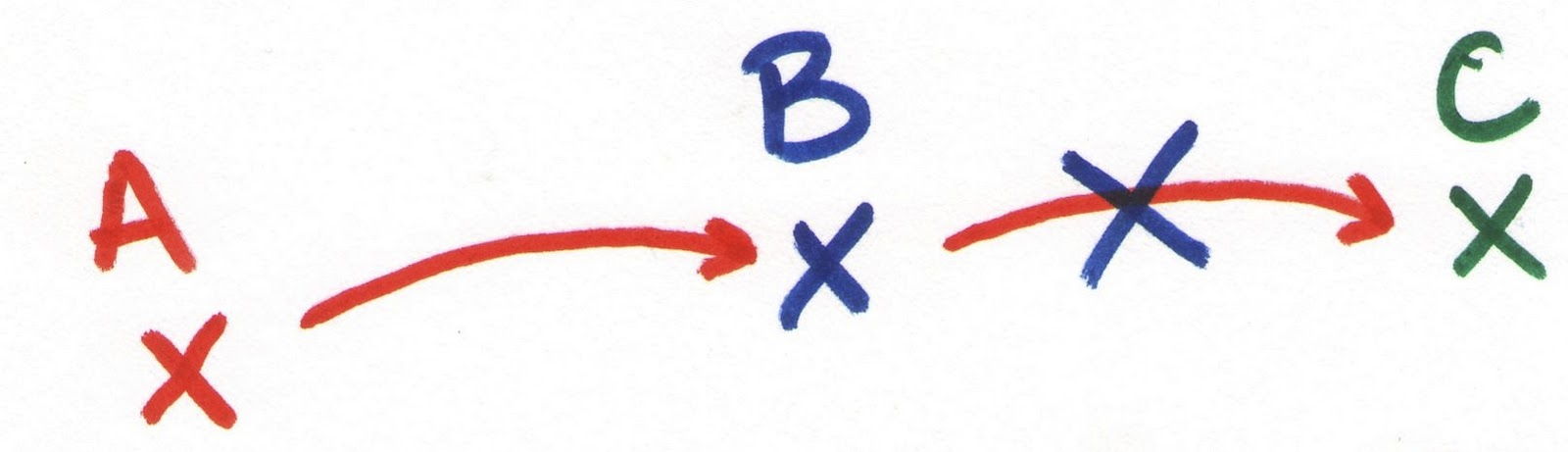 |
| Pop A is infected (either partially or wholly), B has been vaccinated (either partially or wholly), and C has been protected from the spread of the virus (red arrow) by the vaccine (blue X) even though they haven't been vaccinated. |
What if C is allergic to something in the vaccine? There are lots of things in vaccines that aren't the actual "active ingredient," things like antibiotics to prevent bacterial contamination, that people can be allergic to. Here's an info sheet (PDF) about what's in a vaccine from the American Association of Pediatricians.
Another possibility: C could have a weakened immune system. Maybe C has cancer and is undergoing radiation or chemotherapy, or has an autoimmune disorder (eg rheumatoid arthritis) and takes immunosuppressant drugs to keep their symptoms in check. C could also take immunosuppressants because they recieved an organ transplant and need to keep their body from rejecting the foreign cells of the organ. C could have HIV or AIDS. It's extremely dangerous to give many vaccines to people with compromised immune systems, because many vaccines are what's known as attenuated vaccines (they contain only weakened viruses, not completely killed). Why would we do this, purposely expose someone to a potentially infective organism? Because sometimes that's the only way to get the body to react enough to make the vaccine work (look for the blue highlighting). It also has the added benefit of triggering a longer-lasting (in some cases, lifelong) immunity. But if someone has a weakened immune system, even the extremely weakened virus in the vaccine could produce disease symptoms. So we can't vaccinate them. (Actually, I know I already linked to this ("react... work") but it's a really good primer on vaccines.)
Back to my story: for some reason (which isn't important here) C cannot be vaccinated. Well, guess what happens if B isn't vaccinated because his parents didn't know about herd immunity (among other reasons)...
 |
| Look'a that: everyone's infected. |
These diagrams and explanations can also be applied to a three-person system (as in A, B, and C are just people). So let's look at another system.
 |
| The colors mean the same thing; red is infected, blue is resistant, and green is susceptible. |

In short: not vaccinating your children because of lies spun by a morally-bankrupt "scientist" is irresponsible and potentially injurious to: a) your children, because it is far more likely that no vaccination will lead to potentially life-threatening (and preventable) illness than vaccination will lead to autism, and b) to the your community, both local and larger, because you risk upsetting the balance and benefit of herd immunity.
Please: vaccinate your kids.
Subscribe to:
Posts (Atom)
