I figured it was time I started posting again. Y'know, it's time... So now, some updates:
I found a bunch of Wiccans in town. They're pretty cool... for Wiccans... No, but really, I have a soul family now and it's wonderful! I feel accepted and loved, and that's something of a new-ish feeling. So: Huzzah! I have been taking classes (Wicca 101) for a few months, because really a lot of what they study is similar, at least, to what I need to study. But actually, last night after class my teacher (M) and I had a discussion, and we decided that while the classes were good for me initially, now they're not helping. I actually feel bound when I'm sitting in the class, maybe partially because our book is by Silver Ravenwolf and she's awfully preachy sometimes, but also because there's just too much ceremony, just to many steps that are just so, in Wicca. So I move on.
When she said I could gracefully bow out of classes, I felt the lead slip off my shoulders. The room was suddenly brighter, my friends' faces clearer, the lights not so glaring and critical. Thank you, M.
In light of recent developments, combined with a long-held wish to find my own, I am seeking out a Grove. For those of you who have- oh, screw it, most of y'all don't know too much about Druids. Well, a Grove is like a coven of Druids. *When I stop capitalizing those words, just envision them with the power of the capital, and don't begrudge me my laziness.* Anyway, finding the local grove *see there I go* is easier said than done. Wiccans are somewhat scarce, but druids are a little bit like needles in haystacks. Really big friggin' haystacks. But we're really shiny needles. Anyway, I started at the Ancient Order of Druids in America (AODA) site. I like the message they send, and I am planning to study with them. Eventually. So I looked up their various groves around the country, and lo and behold! Nothing really near me. Drat. So I went to the Ár nDraíocht Féin (ADF) site. They don't really have any groves close to me, either. However, the closest one is... a day trip away, I suppose. And I'm going to join them for Mabon! I'm so excited!
I mentioned this to my Wiccan friends (who I'll call "my coven") and they were very supportive and excited for me. This does mean that I will not be spending Mabon with my coven, but my closest sisters agree with me that I need to find a grove and other druids, and I need to see how they do stuff, rituals and the like.
But M said to me, "This does not mean you are not part of our family anymore. You still have a place here."
That means more than she knows.
So that's a quick update. Other stuff is going ok: I have an off-campus apartment and I'm learning to live [actually] on my own, because a dorm isn't really on your own; I have a job at the campus bookstore, and of course it's not what I want to do for the rest of my life it's a pretty good job, with good hours, convenient location, nice management, and awesome coworkers. I'm going to be posting (/trying to post) more regularly again, because stuff is happening!
As the last, I want to share with you my new personal motto: "When they laugh at you, laugh with them." And that, mi amici, is all for now.
Showing posts with label Ramblings. Show all posts
Showing posts with label Ramblings. Show all posts
Tuesday, August 16, 2011

Wednesday, April 20, 2011
Daily Silver: A little bit of paganism for you today
I'm sorry I haven't written lately; my life just got complicated for a while. Anyway, Cyanide and Happiness today. Enjoy!
 |
| http://www.explosm.net/db/files/Comics/Kris/coins.png |
Saturday, April 9, 2011
Daily Silver: Remember when the weekend was actually a time to relax?
Not anymore... Well, maybe it's just a college thing.
My beef with weekends:
My beef with weekends:
- The next week looms: many of my friends actually use the weekends as time to work all day long. Sometimes straight from Friday night into Saturday and on til Sunday night. That way they can do other stuff (like human/living stuff) during the week. Not that they do necessarily.
- They inspire laziness: all I want to do all weekend is sit around in my pj's and watch movies on my computer.
- Guilt: the logical conclusion from the two preceding bullets is that I end up doing a whole lotta nothin' on my weekends (I do work, just somehow not as much as some of my friends (I swear, she's gotta make stuff up to do)) while other people spend their waking hours nose-deep in a textbook. I'm the kind of person who feels incredibly (inCREDibly) guilty in a situation like this, even if someone is literally making shit up to study. So I spend the whole weekend feeling like worthless crap. Woohoo.
- Mondays: enough said.
Sunday, April 3, 2011
The nature of the Beast (the Beast being Beauty, of course).
No, I'm not writing for Disney now.
Today A said to me (paraphrased), "I'm creating beauty." Something to that effect. And I (being me) thought, what is beauty? Because I can never let these things go... sorry, A...
I immediately thought of some possibilties (which have the added bonus of framing my question): Is beauty sort of like energy, something that is imbued upon an object? Keeping in mind "the eye of the beholder," is it something that only exists in the beholder's mind[/perception/reality]? Is beauty intrinsic in the object (ie a quality belonging to the object)? And in all of these situations, is finite or infinite or something else (eg spanning space and time and able to exist in multiplicity)?
When I voiced these questions, A (quite understandably) was a bit confused. I have to admit that I didn't present these questions quite so eloquently then, not that they necessarily make sense now. But here goes...
I think beauty intrinsic in the object. But that sort of absolute makes me squirm, so I will quickly clarify that I think beauty is not a quality or a characteristic set in stone (measurable) but a potential. Of course I'm tempted to go with "beauty is an adjective only, belonging to the viewer," because at first glance that seems to fit best with the whole perception-is-reality-and-truth-does-not-exist theory, but I'm feeling slightly rebellious today. What's the point of thinking if we don't sometimes challenge our own ideas?
Really, beauty as a potential and inherent in the object makes the most sense, after all. This is a pared-down version of my idea of beauty: think of beauty as a scale. Several scales, actually. Every object, every thing has its own scale; that scale measures its beauty as percieved and assigned by a viewer (a percieved-beauty scale, PBS). Also, every object with the ability to assign beauty (namely humans) has another scale that ranks all percieved objects by beauty (a ranking scale, RS). Okay, so I'm back to the perception-reality model; so sue me. Let's think of three objects: a flower, a tree, and a stone. Each has a PBS from 1 to 100; however, their 100's may not be the same on an individual's RS (ie the flower has more ability to be beautiful, and therefore a higher max than the stone). A human (called Bob) percieves the three objects. Bob has a RS in his head. Let's say that Bob thinks the flower is really pretty, and he gives it a 74 [on the flower's PBS]. He thinks the tree is pretty, too, so he gives it an 80 [on the tree's PBS]. The stone is ugly to Bob (it's green and slimy with pond muck) so he gives it 26 [on the stone's PBS]. Now for Bob's RS; the flower's PBS is lower than the tree's, but on Bob's RS the flower is higher than the tree, say 63 vs 48. This means that he thinks the flower is fairly pretty for a flower and the tree is pretty for a tree, but as far as beautiful goes they're not as beautiful as other things (for instance he ranks his wife as a 92). Does that make sense? A PBS is comparing one object to other like objects, and an individual RS is comparing one object percieved by a person to all the other objects the person has ever percieved.
I'm using "object" fairly loosely, because by "object" I mean "pretty much anything" including humans, other animals, plants, inanimate objects, ideas, paintings, relationships, love, situations, anything you might ever refer to as beautiful.
Ask me questions! I know I've probably confused a lot of you (truthfully I haven't chewed out all the details yet), but if you are willing to read to this very sentence at the end of the post, you probably would like to understand (I hope). So ask away! Ciao!
Today A said to me (paraphrased), "I'm creating beauty." Something to that effect. And I (being me) thought, what is beauty? Because I can never let these things go... sorry, A...
I immediately thought of some possibilties (which have the added bonus of framing my question): Is beauty sort of like energy, something that is imbued upon an object? Keeping in mind "the eye of the beholder," is it something that only exists in the beholder's mind[/perception/reality]? Is beauty intrinsic in the object (ie a quality belonging to the object)? And in all of these situations, is finite or infinite or something else (eg spanning space and time and able to exist in multiplicity)?
When I voiced these questions, A (quite understandably) was a bit confused. I have to admit that I didn't present these questions quite so eloquently then, not that they necessarily make sense now. But here goes...
I think beauty intrinsic in the object. But that sort of absolute makes me squirm, so I will quickly clarify that I think beauty is not a quality or a characteristic set in stone (measurable) but a potential. Of course I'm tempted to go with "beauty is an adjective only, belonging to the viewer," because at first glance that seems to fit best with the whole perception-is-reality-and-truth-does-not-exist theory, but I'm feeling slightly rebellious today. What's the point of thinking if we don't sometimes challenge our own ideas?
Really, beauty as a potential and inherent in the object makes the most sense, after all. This is a pared-down version of my idea of beauty: think of beauty as a scale. Several scales, actually. Every object, every thing has its own scale; that scale measures its beauty as percieved and assigned by a viewer (a percieved-beauty scale, PBS). Also, every object with the ability to assign beauty (namely humans) has another scale that ranks all percieved objects by beauty (a ranking scale, RS). Okay, so I'm back to the perception-reality model; so sue me. Let's think of three objects: a flower, a tree, and a stone. Each has a PBS from 1 to 100; however, their 100's may not be the same on an individual's RS (ie the flower has more ability to be beautiful, and therefore a higher max than the stone). A human (called Bob) percieves the three objects. Bob has a RS in his head. Let's say that Bob thinks the flower is really pretty, and he gives it a 74 [on the flower's PBS]. He thinks the tree is pretty, too, so he gives it an 80 [on the tree's PBS]. The stone is ugly to Bob (it's green and slimy with pond muck) so he gives it 26 [on the stone's PBS]. Now for Bob's RS; the flower's PBS is lower than the tree's, but on Bob's RS the flower is higher than the tree, say 63 vs 48. This means that he thinks the flower is fairly pretty for a flower and the tree is pretty for a tree, but as far as beautiful goes they're not as beautiful as other things (for instance he ranks his wife as a 92). Does that make sense? A PBS is comparing one object to other like objects, and an individual RS is comparing one object percieved by a person to all the other objects the person has ever percieved.
I'm using "object" fairly loosely, because by "object" I mean "pretty much anything" including humans, other animals, plants, inanimate objects, ideas, paintings, relationships, love, situations, anything you might ever refer to as beautiful.
Ask me questions! I know I've probably confused a lot of you (truthfully I haven't chewed out all the details yet), but if you are willing to read to this very sentence at the end of the post, you probably would like to understand (I hope). So ask away! Ciao!
Friday, April 1, 2011
Oh, April Fools' Day...
Have you ever heard that "the truth is stranger than fiction?" Okay; close your eyes right now and think of (I know it's painful, but bear with me) Sarah Palin. I wish that on April Fools' Day, at least for 24 hours, these things could be a joke. You know, like for 24 hours they weren't real, and the world made a little more sense and stuff. But no, crazy people have to come out with this. I'm afraid this is real. Yes, I'm very, very afraid.
If you are interested in more interesting links (ie where I got this one) go to The House of Vines (btw when he says he's a year-round joker, it's because he worships Dionysus). Have a joyful April Fools' and don't let anyone try to convince you that the Earth is flat or that life was created by some supreme being, because that's just silly! Ciao!
If you are interested in more interesting links (ie where I got this one) go to The House of Vines (btw when he says he's a year-round joker, it's because he worships Dionysus). Have a joyful April Fools' and don't let anyone try to convince you that the Earth is flat or that life was created by some supreme being, because that's just silly! Ciao!
Sunday, March 27, 2011
Good and bad and everything in between.
I've started watching Dexter again. I don't know why I ever stopped; it's such a fascinating study in human nature. Or... something else... I guess Dexter would describe himself as other-than-human, but what is it that makes us human? If it is the physical condition of being human (born human, of humans, in humanity, with the same genetic makeup as humans and the same material needs) then Dexter is most certainly human. And he's not a sociopath, as I've heard suggested. He displays some sociapathic characteristics, but he wouldn't care about all these people, even Harry, if he was. And he does care, and that's why the show's interesting.
I've watched all the usual crime/forensics/police dramas: CSI (in its many incarnations), Law & Order (in its ever-more-numerous masques), Bones, Inspector Lynley, and such, and I feel this has made me better able to appreciate Dexter. I do not mean to suggest that any of these are realistic (I have come to realize over the years that many are far from accurate, most notably CSI (in which techs are given guns and the lab rats go into the field). I think maybe this innacuracy allows me to juxtapose CSI (which, I must admit, is probably the worst perpetrator) with Dexter. But knowing these shows allows me to ignore all the forensics and police procedural part. I imagine Dexter's as accurate perhaps as L & O, but the point is not accuracy, precisely. The other route a show like this usually goes is invariably the drama route, which I suppose they are, deep down inside, but Dexter doesn't even really land there. Sure there's the family drama, with his sister and his father and his girlfriend and her kids. But it's not really about these people; it's all about him.
At the core, every story is very specific; it's about one or a few people and the world's relationship with them. That's what a main character is: a focus, a thumbtack on a map with strings radiating. It seems simple, even simplistic when I say it like that. Oh, well.
On the surface Dexter looks like another fascinatingly twisted string of executions that draw us in a mob to the gallows (everybody likes a good beheading). But I think underneath it's a more subtle weaving pushing common ideals--such as the morals we're taught when we're three and too young to think--and challenging our senses of ourselves. Actually, I think that most people who watch it tend to ignore that bit, and that's why it's survived so long. People feel gratified to watch Dex fulfill their needs for justice (even though justice resides in a different realm and looks not at all like what we think justice should), but they don't examine why. I've long given up trying to be disgusted at the revenge-fantasy this heroic vigilante-ism brings to the surface in me. I'm comfortable with my amygdala; are you?
I like Dexter.
I've watched all the usual crime/forensics/police dramas: CSI (in its many incarnations), Law & Order (in its ever-more-numerous masques), Bones, Inspector Lynley, and such, and I feel this has made me better able to appreciate Dexter. I do not mean to suggest that any of these are realistic (I have come to realize over the years that many are far from accurate, most notably CSI (in which techs are given guns and the lab rats go into the field). I think maybe this innacuracy allows me to juxtapose CSI (which, I must admit, is probably the worst perpetrator) with Dexter. But knowing these shows allows me to ignore all the forensics and police procedural part. I imagine Dexter's as accurate perhaps as L & O, but the point is not accuracy, precisely. The other route a show like this usually goes is invariably the drama route, which I suppose they are, deep down inside, but Dexter doesn't even really land there. Sure there's the family drama, with his sister and his father and his girlfriend and her kids. But it's not really about these people; it's all about him.
At the core, every story is very specific; it's about one or a few people and the world's relationship with them. That's what a main character is: a focus, a thumbtack on a map with strings radiating. It seems simple, even simplistic when I say it like that. Oh, well.
On the surface Dexter looks like another fascinatingly twisted string of executions that draw us in a mob to the gallows (everybody likes a good beheading). But I think underneath it's a more subtle weaving pushing common ideals--such as the morals we're taught when we're three and too young to think--and challenging our senses of ourselves. Actually, I think that most people who watch it tend to ignore that bit, and that's why it's survived so long. People feel gratified to watch Dex fulfill their needs for justice (even though justice resides in a different realm and looks not at all like what we think justice should), but they don't examine why. I've long given up trying to be disgusted at the revenge-fantasy this heroic vigilante-ism brings to the surface in me. I'm comfortable with my amygdala; are you?
I like Dexter.
Friday, March 25, 2011
Daily Silver: Here I am writing about peptidoglycan for my roommate.
So, every time I ask my roommates what I should write a blog post on, my one roommate L says "peptidoglycan." Since it was her birthday this week, I'm going to write about peptidoglycan (not too much I promise, as she is the only person I've ever met that thinks it's interesting).
I know there are some of you who are staring at the computer screen right now, eyes slowly glazing over, saying to yourself "what the heck is peptidoglycan?" Peptidoglycan is a carbohydrate-protein scaffolding (called a polymer) that is a major component of some bacterial cell walls. All living things are made up of cells, and animal cells are different from plant cells are different from bacterial cells, and so on. One [of the many] major differences between animal cells and bacterial cells is that bacteria have what is called a cell wall, which is pretty much exactly what it sounds like: it's a stiff boundary that surrounds the cell and helps it keep its shape. That's why we animals are so squishy, our cells don't have walls, they only have membranes which are fluid (bacteria also have cell membranes, in addition to the wall).
Peptidoglycan isn't very exciting on the whole, except for one thing: penicillin. You may know parts of this already, but a quick refresher: penicillin is an antibiotic, meaning it kills bacteria. Actually, it's kind of THE antibiotic, because it was the first substance used therapeutically (medically, to treat disease) as an antibiotic, and the story is a study in serendipity. In 1928, Scottish scientist Alexander Fleming was culturing some bacteria. When you culture bacteria, you coat the bottom of Petri dish with a medium like agar (something with sugars and other nutrients in it that growing bacteria need) and then you spread bacteria from somewhere--another culture, some lake water, your mouth--over the medium with a Qtip or a plastic rod or something. Then you stick it in an incubator (many bacteria require temperatures similar to body temperature to grow) and wait a while. But when Fleming came back and took his plates out of the incubator, he noticed far less bacteria growing than he'd expected. He also noticed that there were spots of fungus growing on the plates, and there was a circle around the fungus where no bacteria were growing. Voila; penicillin! The fungus was Penicillium notatum, and he found that when it was grown under the right conditions it secreted a substance that acts as an antibiotic; he called it penicillin.
Nowadays, the term is used to describe a group of naturally derived antibiotics, so when the doctor asks if you're allergic to penicillin she's actually asking if you are allergic to the fungus P. notatum and/or substances derived from it. What does this have to do with peptidoglycan? you ask (and if you weren't asking it just pretend you were). Glad you asked.
Penicillin is antibiotic because it inhibits the formation of the peptidoglycan wall. It stops links from forming between individual peptidoglycan subunits and results in an overall weakening of the wall and even holes in places. Because bacteria are constantly remodeling and repairing their cell walls, penicillin acts pretty quickly, stopping the individual parts from linking up.
Remember how I said that the wall helps the cell retain its shape? Cells are basically bags of fluid and protein and sugars, and they're surrounded by more fluid and protein and sugar. At all times, the weights of the water inside and outside the cell are fighting. Think of when you swim all the way to the bottom of the pool and you can feel the water squeezing you harder the deeper you go. It's a complicated and dynamic process, keeping enough water pressure inside the cell to keep it from collapsing, and at the same time having little enough pressure that the cell doesn't burst, and the cell wall makes it a little bit easier, itself pushing both in and out. But when the wall is weak, the cell is not equipped to handle all those conflicting pressures by itself, so it bursts. Peptidoglycan has, however indirectly, killed the cell.
So that's the main reason for focusing on peptidoglycan. We're always looking for faster, better, easier ways to rid people of disease. Not all bacteria contain peptidoglycan cell walls, but knowing about the penicillin mechanism offers new ways to go about looking at other potential systems for killing bacteria in our water, our waste, and in our bodies.
There's peptidoglycan in a nutshell. Happy birthday, L!
I know there are some of you who are staring at the computer screen right now, eyes slowly glazing over, saying to yourself "what the heck is peptidoglycan?" Peptidoglycan is a carbohydrate-protein scaffolding (called a polymer) that is a major component of some bacterial cell walls. All living things are made up of cells, and animal cells are different from plant cells are different from bacterial cells, and so on. One [of the many] major differences between animal cells and bacterial cells is that bacteria have what is called a cell wall, which is pretty much exactly what it sounds like: it's a stiff boundary that surrounds the cell and helps it keep its shape. That's why we animals are so squishy, our cells don't have walls, they only have membranes which are fluid (bacteria also have cell membranes, in addition to the wall).
Peptidoglycan isn't very exciting on the whole, except for one thing: penicillin. You may know parts of this already, but a quick refresher: penicillin is an antibiotic, meaning it kills bacteria. Actually, it's kind of THE antibiotic, because it was the first substance used therapeutically (medically, to treat disease) as an antibiotic, and the story is a study in serendipity. In 1928, Scottish scientist Alexander Fleming was culturing some bacteria. When you culture bacteria, you coat the bottom of Petri dish with a medium like agar (something with sugars and other nutrients in it that growing bacteria need) and then you spread bacteria from somewhere--another culture, some lake water, your mouth--over the medium with a Qtip or a plastic rod or something. Then you stick it in an incubator (many bacteria require temperatures similar to body temperature to grow) and wait a while. But when Fleming came back and took his plates out of the incubator, he noticed far less bacteria growing than he'd expected. He also noticed that there were spots of fungus growing on the plates, and there was a circle around the fungus where no bacteria were growing. Voila; penicillin! The fungus was Penicillium notatum, and he found that when it was grown under the right conditions it secreted a substance that acts as an antibiotic; he called it penicillin.
Nowadays, the term is used to describe a group of naturally derived antibiotics, so when the doctor asks if you're allergic to penicillin she's actually asking if you are allergic to the fungus P. notatum and/or substances derived from it. What does this have to do with peptidoglycan? you ask (and if you weren't asking it just pretend you were). Glad you asked.
Penicillin is antibiotic because it inhibits the formation of the peptidoglycan wall. It stops links from forming between individual peptidoglycan subunits and results in an overall weakening of the wall and even holes in places. Because bacteria are constantly remodeling and repairing their cell walls, penicillin acts pretty quickly, stopping the individual parts from linking up.
Remember how I said that the wall helps the cell retain its shape? Cells are basically bags of fluid and protein and sugars, and they're surrounded by more fluid and protein and sugar. At all times, the weights of the water inside and outside the cell are fighting. Think of when you swim all the way to the bottom of the pool and you can feel the water squeezing you harder the deeper you go. It's a complicated and dynamic process, keeping enough water pressure inside the cell to keep it from collapsing, and at the same time having little enough pressure that the cell doesn't burst, and the cell wall makes it a little bit easier, itself pushing both in and out. But when the wall is weak, the cell is not equipped to handle all those conflicting pressures by itself, so it bursts. Peptidoglycan has, however indirectly, killed the cell.
So that's the main reason for focusing on peptidoglycan. We're always looking for faster, better, easier ways to rid people of disease. Not all bacteria contain peptidoglycan cell walls, but knowing about the penicillin mechanism offers new ways to go about looking at other potential systems for killing bacteria in our water, our waste, and in our bodies.
There's peptidoglycan in a nutshell. Happy birthday, L!
Tuesday, March 22, 2011
Something important to talk about: the fraudulent link between the MMR vaccine and autism, and a mini-lesson on vaccines..
Okay, here's something for me to talk about: measles.
The WHO (World Health Organization) factsheet on measles starts out with the key points. The first key point is:
Yeah, you heard it: encephalitis.
Here's an article from Medical News Today about how much of a stir the disease causes even in "developed" countries like the US.
Good news! It's covered under the MMR (Measles/Mumps/Rubella) vaccine, usually given to young kids, which confers lifelong immunity!
You may have been hearing about this lately, because it's rumored to "cause" autism. Okay, that's unfair; mostly people who are proponents of this theory are saying MMR and autism are "linked." Only slightly better, since word choice doesn't change that it's a load of crap. Okay, I guess that's unfair, too, because [as a reasonable, thinking scientific person] I would approach it as a possibility. Pertinent: a possibility and no more. There's literally no scientific evidence that even remotely suggests such a connection.
Finally, here's the CDC page addressing this precise topic. Guess what?
The worst part is that lives were worsened because of Wakefield's irresponsible idiocy. This is an article by the parent of an autistic child who suffered under the false claims of a connection between autism and MMR.
Oh wait, maybe the worst part is that lives are in danger because of Wakefield's irresponsible idiocy. Like most vaccines, the MMR depends heavily on "herd immunity," which is the idea that if the majority of the members of a population are vaccinated and are therefore immune to the disease, the few members of the population that can't be vaccinated for whatever reason (immunocompromised, allergies, etc) are protected. Maybe there isn't a 100% guarantee that they won't contract the disease they can't be vaccinated against, but the un-vaccinated members of a population are normally few enough that a disease can't just leapfrog between populations.
I feel the need to explain herd immunity farther (here begins the mini-lesson on vaccines and epidemiology). Think about a hypothetical situation in which there are three populations of about a hundred members, and there's a communicable pathogen--for simplicity, we'll just stick with measles. If you plotted the locations of the populations on a map, they would roughly form a line; let's call them A (western-most), B (middle), and C (eastern-most).
Okay, in this figure the measles virus is not present in any of the populations (A, B, and C). Now imagine that red means the virus is present (most/all members of the population are infected/infective), blue means that most/all of the members of the population has been vaccinated (immune, or resistant) and green means most/all members of a population have not been vaccinated but don't have the disease (susceptible). (For those of you keeping track, I'm simplifying the terms "infected," "resistant," and "susceptible." You can decide for yourself if you want [I'm using the SIR model].)
I've simplified transmission a bit using geographic location (putting B between A and C) but you get the idea, right? The virus could not physically get to C to infect it because it can't even get a foothold in the B population because they're immune. Now consider this: C might not have been vaccinated for some random reason, like they just never got around to it, or it could be because C couldn't be vaccinated.
What if C is allergic to something in the vaccine? There are lots of things in vaccines that aren't the actual "active ingredient," things like antibiotics to prevent bacterial contamination, that people can be allergic to. Here's an info sheet (PDF) about what's in a vaccine from the American Association of Pediatricians.
Another possibility: C could have a weakened immune system. Maybe C has cancer and is undergoing radiation or chemotherapy, or has an autoimmune disorder (eg rheumatoid arthritis) and takes immunosuppressant drugs to keep their symptoms in check. C could also take immunosuppressants because they recieved an organ transplant and need to keep their body from rejecting the foreign cells of the organ. C could have HIV or AIDS. It's extremely dangerous to give many vaccines to people with compromised immune systems, because many vaccines are what's known as attenuated vaccines (they contain only weakened viruses, not completely killed). Why would we do this, purposely expose someone to a potentially infective organism? Because sometimes that's the only way to get the body to react enough to make the vaccine work (look for the blue highlighting). It also has the added benefit of triggering a longer-lasting (in some cases, lifelong) immunity. But if someone has a weakened immune system, even the extremely weakened virus in the vaccine could produce disease symptoms. So we can't vaccinate them. (Actually, I know I already linked to this ("react... work") but it's a really good primer on vaccines.)
Back to my story: for some reason (which isn't important here) C cannot be vaccinated. Well, guess what happens if B isn't vaccinated because his parents didn't know about herd immunity (among other reasons)...
The virus has unfettered access to population C, and so everyone's infected. Whoop-dee-doo. Now, this would be bad enough if C had a regular, healthy immune system to begin with, but remember how we said earlier that C had a lowered immune system? The upshoot is that not only could C not be vaccinated and protected, but now C is going to suffer more from the disease than either A or B. Kinda blows, huh?
These diagrams and explanations can also be applied to a three-person system (as in A, B, and C are just people). So let's look at another system.
In this seven-person model, A is infected/infective, B is vaccinated = immune, and C is not vaccinated = susceptible. Statistically, C can only get the virus from six people (A and 5 B's); C has one-in-six chance of contacting an infective person. Now if B isn't vaccinated...
 C has a six-in-six (aka 100%) chance of contacting an infective person, ie a much greater probability of being infected and developing symptoms. And C is immunocompromised, so the disease will be worse for C than for either A or the B's. Sucks to be C.
In short: not vaccinating your children because of lies spun by a morally-bankrupt "scientist" is irresponsible and potentially injurious to: a) your children, because it is far more likely that no vaccination will lead to potentially life-threatening (and preventable) illness than vaccination will lead to autism, and b) to the your community, both local and larger, because you risk upsetting the balance and benefit of herd immunity.
Please: vaccinate your kids.
 |
| Graph from WHO showing the estimated childhood death toll worldwide. (Measles is red.) |
"Measles is one of the leading causes of death among young children even though a safe and cost-effective vaccine is available."Another point is:
"Measles vaccination resulted in a 78% drop in measles deaths between 2000 and 2008 worldwide."Here's the CDC (Centers for Disease Control and Prevention) page on possible complications of measles. Okay, pneumonia (what else is new), ear infections, diarrhea... whoa, wait. SSPE (Subacute Sclerosing Panencephalitis)? "Rare, but fatal" encephalitis?
Yeah, you heard it: encephalitis.
Here's an article from Medical News Today about how much of a stir the disease causes even in "developed" countries like the US.
Good news! It's covered under the MMR (Measles/Mumps/Rubella) vaccine, usually given to young kids, which confers lifelong immunity!
You may have been hearing about this lately, because it's rumored to "cause" autism. Okay, that's unfair; mostly people who are proponents of this theory are saying MMR and autism are "linked." Only slightly better, since word choice doesn't change that it's a load of crap. Okay, I guess that's unfair, too, because [as a reasonable, thinking scientific person] I would approach it as a possibility. Pertinent: a possibility and no more. There's literally no scientific evidence that even remotely suggests such a connection.
Finally, here's the CDC page addressing this precise topic. Guess what?
"To date, the studies continue to show that vaccines are not associated with [Autism Spectrum Disorders]."(That emphasis on "not" is theirs.) In the meantime panicked parents and fear-mongers (who we sometimes refer to as "the media" when we're feeling charitable) are using falsified information from a 30-year-old study by some British physician. Oh yeah, and the study was found to be fraudulent. Made-up. Hogwash. This physician, Andrew Wakefield, was subsequently found guilty of several conflicts of interest and professional misconduct by the General Medical Council of the UK and they basically kicked him out, disallowing him from ever practicing medicine again in the UK (not that anyone else would have him, either). The article was originally published in The Lancet, a prestigious medical journal in 1998, but when they found out he screwed with the data they retracted it, even going so far as publishing a statement (you can get a free Lancet account to see the whole thing, but it basically lists the allegations against Wakefield) distancing themselves from Wakefield and his bunk study (NB couldn't even find the study on TheLancet.com, though I did find Wakefield's response to the retraction). Even after all this the MMR vaccine controversy goes on (1, 2, 3, 4, 5). *sigh*
The worst part is that lives were worsened because of Wakefield's irresponsible idiocy. This is an article by the parent of an autistic child who suffered under the false claims of a connection between autism and MMR.
Oh wait, maybe the worst part is that lives are in danger because of Wakefield's irresponsible idiocy. Like most vaccines, the MMR depends heavily on "herd immunity," which is the idea that if the majority of the members of a population are vaccinated and are therefore immune to the disease, the few members of the population that can't be vaccinated for whatever reason (immunocompromised, allergies, etc) are protected. Maybe there isn't a 100% guarantee that they won't contract the disease they can't be vaccinated against, but the un-vaccinated members of a population are normally few enough that a disease can't just leapfrog between populations.
I feel the need to explain herd immunity farther (here begins the mini-lesson on vaccines and epidemiology). Think about a hypothetical situation in which there are three populations of about a hundred members, and there's a communicable pathogen--for simplicity, we'll just stick with measles. If you plotted the locations of the populations on a map, they would roughly form a line; let's call them A (western-most), B (middle), and C (eastern-most).
 | |
| Excuse my handwriting, but I thought I could explain it better with a figure. |
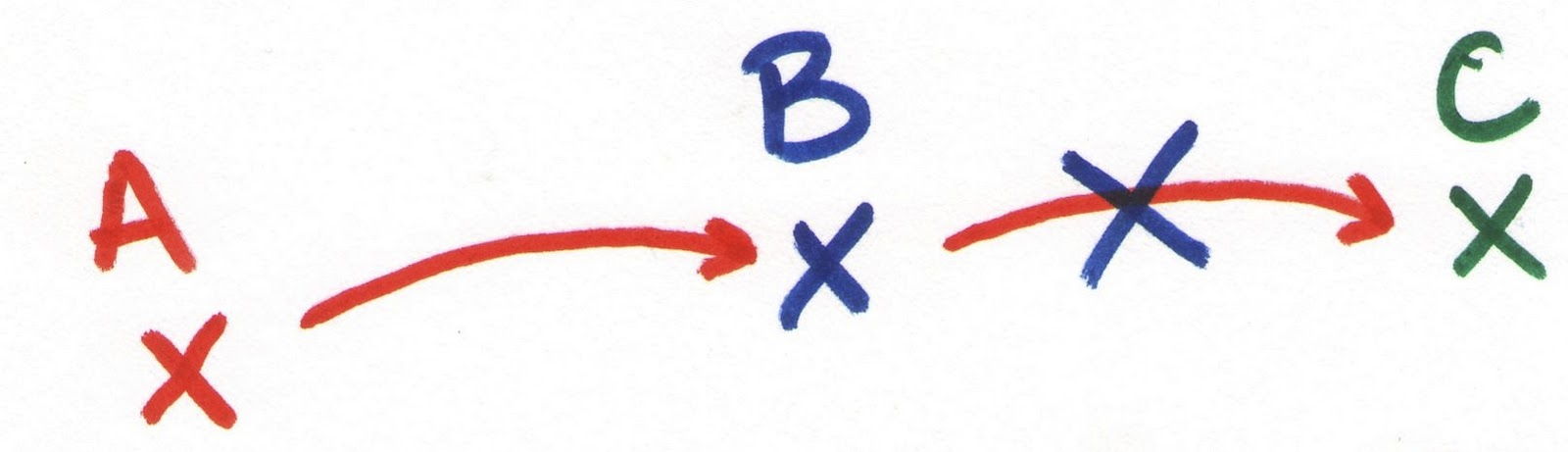 |
| Pop A is infected (either partially or wholly), B has been vaccinated (either partially or wholly), and C has been protected from the spread of the virus (red arrow) by the vaccine (blue X) even though they haven't been vaccinated. |
What if C is allergic to something in the vaccine? There are lots of things in vaccines that aren't the actual "active ingredient," things like antibiotics to prevent bacterial contamination, that people can be allergic to. Here's an info sheet (PDF) about what's in a vaccine from the American Association of Pediatricians.
Another possibility: C could have a weakened immune system. Maybe C has cancer and is undergoing radiation or chemotherapy, or has an autoimmune disorder (eg rheumatoid arthritis) and takes immunosuppressant drugs to keep their symptoms in check. C could also take immunosuppressants because they recieved an organ transplant and need to keep their body from rejecting the foreign cells of the organ. C could have HIV or AIDS. It's extremely dangerous to give many vaccines to people with compromised immune systems, because many vaccines are what's known as attenuated vaccines (they contain only weakened viruses, not completely killed). Why would we do this, purposely expose someone to a potentially infective organism? Because sometimes that's the only way to get the body to react enough to make the vaccine work (look for the blue highlighting). It also has the added benefit of triggering a longer-lasting (in some cases, lifelong) immunity. But if someone has a weakened immune system, even the extremely weakened virus in the vaccine could produce disease symptoms. So we can't vaccinate them. (Actually, I know I already linked to this ("react... work") but it's a really good primer on vaccines.)
Back to my story: for some reason (which isn't important here) C cannot be vaccinated. Well, guess what happens if B isn't vaccinated because his parents didn't know about herd immunity (among other reasons)...
 |
| Look'a that: everyone's infected. |
These diagrams and explanations can also be applied to a three-person system (as in A, B, and C are just people). So let's look at another system.
 |
| The colors mean the same thing; red is infected, blue is resistant, and green is susceptible. |

In short: not vaccinating your children because of lies spun by a morally-bankrupt "scientist" is irresponsible and potentially injurious to: a) your children, because it is far more likely that no vaccination will lead to potentially life-threatening (and preventable) illness than vaccination will lead to autism, and b) to the your community, both local and larger, because you risk upsetting the balance and benefit of herd immunity.
Please: vaccinate your kids.
Wednesday, March 16, 2011
Playing god and other human pursuits.
Today I'm thinking about euthanasia. Alternately, murder. I don't know.
Up until a few years ago I was set on a career in veterinary medicine. I wanted, needed to be a veterinarian. I... honestly, I don't really know why it was so important to me. At first I suppose it was just like, "Oh I love animals, and I want to work in the sciences, and I want to help the animals that live with us." I have always liked animals more than humans to some extent; as I've aged it's shifted from disgust with the human race and reverence of non-human animals to, well, I'm still pretty disgusted with humans, but it's less of a generalization and more on a case-by-case basis. So when I was little I deemed non-human animals more deserving of medical care. I counter any protests of "But you're human, and our pets need humans to provide that care," with "I was, like, six years old." Six-year-olds aren't known for their expansive considerations of reality (ie how the world works).
As I got older I developed more concrete reasons for becoming a vet. I started feeling that pulling at my heart when I thought of animals suffering illness or mistreatment. I realized that I felt personally obligated to do whatever I could to help them, for they could not help themselves. I still feel that obligation, but I realize now that your life's work should also be something that is fascinating to me, and my fascination is not in veterinary medicine.
My career plans are not the point. So what is? you ask. The point: one disparity between medicine for humans and non-humans is at the end of medicine. By that I mean, of course, how and when death comes.
The very simple fact is: humans often choose when an animal will die. Another simple fact: it is illegal and usually considered amoral for humans to choose when a human will die (with exceptions and/or loopholes). Why? If you ask someone that question, chances are they will have a hard time with a solid answer. I've thought about this question a lot, and I've come to the conclusion that the law is as it is because there is an inherent assumption that humans are more important than non-humans. I wouldn't expect an easy answer out of anyone to this question, either, even though it's basically a yes/no question.
My take is that it's something that people believe deeply--perhaps subconsciously--but are uncomfortable voicing aloud. But shouldn't a person be able to say what she thinks? Also, this belief in human superiority is probably widely-held, so speaking it aloud would place one squarely within the clear--albeit close-mouthed--majority.
I will speak: I do not agree with the statement that humans are more important than non-humans. I strongly believe that humans are of equal importance with non-humans. Who knows, maybe I'll change my mind in a few years; I did start out believing that non-humans were of more importance than humans.
The most trouble I have with that statement is the use of "important." Calling something important implies that there is a purpose for it, and we've already said there is no purpose for living things, nor even for living. Actually, Oxford English Dictionary defines important as "of great significance or value; likely to have a profound effect on success, survival, or well-being." You could argue that because of the inclusion of "profound effect on... survival" it might have bearing on the relationship between these two things (humans and non-humans); actually there is no relevance to this comparison because the it is not comparing to methods of finding food or shelter or anything like that, so there is no element of survival. It is not calling into question the survival skills of either being, but comparing them as if they were instrumental to some sort of universal scheme, which smacks of monotheism (and actually most religions with divinity/-ies).
So the natural next question is "Why then do we decide when animals die and not when humans die?" When we can't easily answer that one, we might go to "Why is it socially acceptable to decide for animals and not humans?" or even "Is it right?" And then we get to right vs wrong, my least favorite dichotomy of all time (and I can even say with confidence that I will never meet another dichotomy that I loathe more).
It's been a hard week.
Up until a few years ago I was set on a career in veterinary medicine. I wanted, needed to be a veterinarian. I... honestly, I don't really know why it was so important to me. At first I suppose it was just like, "Oh I love animals, and I want to work in the sciences, and I want to help the animals that live with us." I have always liked animals more than humans to some extent; as I've aged it's shifted from disgust with the human race and reverence of non-human animals to, well, I'm still pretty disgusted with humans, but it's less of a generalization and more on a case-by-case basis. So when I was little I deemed non-human animals more deserving of medical care. I counter any protests of "But you're human, and our pets need humans to provide that care," with "I was, like, six years old." Six-year-olds aren't known for their expansive considerations of reality (ie how the world works).
As I got older I developed more concrete reasons for becoming a vet. I started feeling that pulling at my heart when I thought of animals suffering illness or mistreatment. I realized that I felt personally obligated to do whatever I could to help them, for they could not help themselves. I still feel that obligation, but I realize now that your life's work should also be something that is fascinating to me, and my fascination is not in veterinary medicine.
My career plans are not the point. So what is? you ask. The point: one disparity between medicine for humans and non-humans is at the end of medicine. By that I mean, of course, how and when death comes.
The very simple fact is: humans often choose when an animal will die. Another simple fact: it is illegal and usually considered amoral for humans to choose when a human will die (with exceptions and/or loopholes). Why? If you ask someone that question, chances are they will have a hard time with a solid answer. I've thought about this question a lot, and I've come to the conclusion that the law is as it is because there is an inherent assumption that humans are more important than non-humans. I wouldn't expect an easy answer out of anyone to this question, either, even though it's basically a yes/no question.
My take is that it's something that people believe deeply--perhaps subconsciously--but are uncomfortable voicing aloud. But shouldn't a person be able to say what she thinks? Also, this belief in human superiority is probably widely-held, so speaking it aloud would place one squarely within the clear--albeit close-mouthed--majority.
I will speak: I do not agree with the statement that humans are more important than non-humans. I strongly believe that humans are of equal importance with non-humans. Who knows, maybe I'll change my mind in a few years; I did start out believing that non-humans were of more importance than humans.
The most trouble I have with that statement is the use of "important." Calling something important implies that there is a purpose for it, and we've already said there is no purpose for living things, nor even for living. Actually, Oxford English Dictionary defines important as "of great significance or value; likely to have a profound effect on success, survival, or well-being." You could argue that because of the inclusion of "profound effect on... survival" it might have bearing on the relationship between these two things (humans and non-humans); actually there is no relevance to this comparison because the it is not comparing to methods of finding food or shelter or anything like that, so there is no element of survival. It is not calling into question the survival skills of either being, but comparing them as if they were instrumental to some sort of universal scheme, which smacks of monotheism (and actually most religions with divinity/-ies).
So the natural next question is "Why then do we decide when animals die and not when humans die?" When we can't easily answer that one, we might go to "Why is it socially acceptable to decide for animals and not humans?" or even "Is it right?" And then we get to right vs wrong, my least favorite dichotomy of all time (and I can even say with confidence that I will never meet another dichotomy that I loathe more).
It's been a hard week.
Sunday, March 13, 2011
More thoughts on morality, along the lines of "Why?"
The Quest of Dr. Paul Farmer : NPR
In a way it articulates what I have been trying to say: "charity" as such is beyond the scope of what [I would suggest] most of us concieve of as charity. Charity is self-sacrifice but not in the sense that there is sacrifice. I look at Farmer because he is an example near-at-hand, and I see that he sacrificed time and money to help the poor of Haiti. More significantly, perhaps, is that he sacrificed that staple of American life: comfort. In the excerpt from Mountains, Kidder tells of how he met Farmer and came to learn about his life. He writes:
But is charity such ignorant sacrifice? ("Sacrifice" here meaning something that takes from the one who gives it.) And is sacrifice charity? I guess the question is not if we should redefine something but what we should redefine? I think we've pretty clearly got the meaning of "sacrifice" down here, but I think we've got a bit more difficulty in "charity."
I felt as though, in Farmer, I'd been offered another way of thinking about a place like Haiti. But his way would be hard to share, because it implied such an extreme definition of a term like "doing one's best."This is an excerpt from a piece on the NPR site (which is actually an excerpt from Mountains Beyond Mountains) about Paul Farmer, the guy I was talking about in my last post.
In a way it articulates what I have been trying to say: "charity" as such is beyond the scope of what [I would suggest] most of us concieve of as charity. Charity is self-sacrifice but not in the sense that there is sacrifice. I look at Farmer because he is an example near-at-hand, and I see that he sacrificed time and money to help the poor of Haiti. More significantly, perhaps, is that he sacrificed that staple of American life: comfort. In the excerpt from Mountains, Kidder tells of how he met Farmer and came to learn about his life. He writes:
He worked in Boston four months of the year, living in a church rectory in a slum. The rest of the year he worked without pay in Haiti, mainly doctoring peasants who had lost their land to a hydroelectric dam.Yet Kidder noted as they had dinner in Miami:
He clearly liked the fancy restaurant, the heavy cloth napkins, the good bottle of wine. What struck me that evening was how happy he seemed with his life.While we can't get into Farmer's mind, it seems to me that he would have to view his work in Haiti as anything but a sacrifice in order to keep up this hectic lifestyle.
But is charity such ignorant sacrifice? ("Sacrifice" here meaning something that takes from the one who gives it.) And is sacrifice charity? I guess the question is not if we should redefine something but what we should redefine? I think we've pretty clearly got the meaning of "sacrifice" down here, but I think we've got a bit more difficulty in "charity."
Friday, March 11, 2011
The Evolution of a Sort of Moral Code; A Belief in Ethics, If You Will.
Ethics and morality are slippery and always-controversial subjects. I often avoid them for that very reason, but I find that I cannot always stand quietly by in the shadows. I need for my voice to be heard.
I'm reading Pathologies of Power by Paul Farmer, a fairly well-known medical anthropologist. You may have heard of Tracy Kidder's book Mountains Beyond Mountains, which is about Farmer's quest for global health. I don't mean the sort of global health that is tracking who gets sick and where so disease can be controlled and contained, I mean global health in the sense that the whole world, everyone in the world has access to such resources that might keep or make them healthy.
I just have a quick note (because I've only just started the book) about my thoughts on charity and morality, actually.
"The ends justify the means." When Machiavelli wrote that, he was thinking and writing of governments and rulers, not the rights and freedoms of the ruled; in fact, I've heard it argued that he was thinking the opposite, and many commonly define his "ends" as a total subjugation of the people. I believe that, whatever the original ideas behind the statement, it can be applied to my concept of charity and morality. The end in this case is the improvement of living conditions and quality of life for a people, and the means are all the charities that funnel money and labor into this project, and all the donations by the well-off to those charities.
The first part (of two) of Farmer's book is titled "Bearing Witness;" the first part of the first part--a sort of prologue to the part--is an elaboration on that title. Farmer says he is anxious about the title and a reason he gives is that he is apprehensive of misrepresenting the poor.
I want to emphasize that I don't think that charity and such is "bad," I just think it's maybe not as truthful as we'd like it to be.
I'm having trouble forming coherent sentences, so I think I'm going to go to sleep now. But as I read the book, I'm sure I'll have a lot more to say. Thanks for listening!
I'm reading Pathologies of Power by Paul Farmer, a fairly well-known medical anthropologist. You may have heard of Tracy Kidder's book Mountains Beyond Mountains, which is about Farmer's quest for global health. I don't mean the sort of global health that is tracking who gets sick and where so disease can be controlled and contained, I mean global health in the sense that the whole world, everyone in the world has access to such resources that might keep or make them healthy.
I just have a quick note (because I've only just started the book) about my thoughts on charity and morality, actually.
"The ends justify the means." When Machiavelli wrote that, he was thinking and writing of governments and rulers, not the rights and freedoms of the ruled; in fact, I've heard it argued that he was thinking the opposite, and many commonly define his "ends" as a total subjugation of the people. I believe that, whatever the original ideas behind the statement, it can be applied to my concept of charity and morality. The end in this case is the improvement of living conditions and quality of life for a people, and the means are all the charities that funnel money and labor into this project, and all the donations by the well-off to those charities.
The first part (of two) of Farmer's book is titled "Bearing Witness;" the first part of the first part--a sort of prologue to the part--is an elaboration on that title. Farmer says he is anxious about the title and a reason he gives is that he is apprehensive of misrepresenting the poor.
"Some of my anxiety has legitimate sources: the boundary between bearing witness and disrespectful (or self-interested) rooting is not always evident, even to those seeking to be discerning."This is his way of saying "morality" for its own sake is not morality. I use "morality" here to represent many of the good-samaritan acts or charity projects that the well-off do for the worse-off.
I want to emphasize that I don't think that charity and such is "bad," I just think it's maybe not as truthful as we'd like it to be.
I'm having trouble forming coherent sentences, so I think I'm going to go to sleep now. But as I read the book, I'm sure I'll have a lot more to say. Thanks for listening!
Wednesday, March 9, 2011
Silver (theoretically "Daily"): Maybe I should rename it "Periodic Silver?"
But that sounds like it's the physical element Ag (silver)... Nonetheless, my posts display a sort of periodicity, do they not?
Anyway: the news. The new is... it's almost spring break! The other day one of my profs asked the class if anyone was going anywhere nice over break. There were the usual "Florida"s and stuff, so I said "the dentist." Don't think that qualifies as "nice," though.
In other news, I'm applying for a paid internship studying parasites and energy cycling in the ecosystem in Indiana, and I am so excited. I just sent in my application today; wish me luck!
In still other news, I haven't been doing much of anything lately, except working on my application. I guess that isn't really news, but it's happening, soooo...
That's really all I have for now. I'm in total hunched-over-waiting-for-break/nice-weather-mode. It's possible that I'm actually comatose, like, right now, as I'm writing this... Next week I'll have all the time in the world to read and blog and spend exorbitant amounts of time playing computer solitaire! Ciao!
Anyway: the news. The new is... it's almost spring break! The other day one of my profs asked the class if anyone was going anywhere nice over break. There were the usual "Florida"s and stuff, so I said "the dentist." Don't think that qualifies as "nice," though.
In other news, I'm applying for a paid internship studying parasites and energy cycling in the ecosystem in Indiana, and I am so excited. I just sent in my application today; wish me luck!
In still other news, I haven't been doing much of anything lately, except working on my application. I guess that isn't really news, but it's happening, soooo...
That's really all I have for now. I'm in total hunched-over-waiting-for-break/nice-weather-mode. It's possible that I'm actually comatose, like, right now, as I'm writing this... Next week I'll have all the time in the world to read and blog and spend exorbitant amounts of time playing computer solitaire! Ciao!
Wednesday, March 2, 2011
Daily Silver: New directions for earth-based faiths.
Today's Silver is brief; I just want to share this article I read at The Juggler (the Pagan Newswire Collective culture blog). It's called "Toward a Pagan Critical Theory: Introduction."
Also, I apologize for being elusive this week. I have two big tests tomorrow, and I honestly haven't been that much fun this week as of yet. I will attempt to emerge and write more this weekend and next week. Ciao!
Also, I apologize for being elusive this week. I have two big tests tomorrow, and I honestly haven't been that much fun this week as of yet. I will attempt to emerge and write more this weekend and next week. Ciao!
Saturday, February 26, 2011
Daily Silver: A recap of stuff I haven't told you yet. And "the weather isn't evil, it just wants a hug."
Can I write Friday's Daily Silver even though it's technically Saturday? Of course I can! I'm running the show. (bwahahahahahahahaha!!!)
What can I tell you about Friday. Other than "TGIF" or rather, TGIWF (Thank Gods It Was Friday). Oh, well it snowed a bit up here in the wild wild North (better known as Western NY). Lessee... oh, we have an accumulation of about 8 or 9 inches, and it was all melted two days ago. So not overnight, but pretty good. Actually, snow on the ground is okay. It's when it's blowing in your face that's not so cool. Hot. Whatever. Today I got up and (mistake #1) did not look out the window. I had no idea what it was like outside, but I assumed that it would be much like yesterday: sunny and clear with snow on the ground but none in the sky. As I was preparing to leave for class, still not looking out the window, I (almost mistake #2) debated putting on my winter hat or my baseball cap. I luckily chose the winter hat and opened the door (surprise!). The snow was coming down at about a 45deg slant, and they were fat, slushy flakes, the kind that can sting in a sudden [sadistic] gust of wind but then will accumulate on your hat and coat and any exposed skin and make you shed water when you walk inside like molting snakeskin. Except cold and wet.
In other news, I'm taking a practice GRE tomorrow. I'm excited about the future (Ooooh, the future...) but I'm not excited about getting up on a Saturday. Ah, the sleep I sacrifice...
Speaking of sleep: I think I'll pretend to go to sleep now. I say pretend because I'll end up laying in bed staring at the ceiling. Or the wall. I've become sort of attached to staring at the wall lately. Buonanotte!
 |
| Now make it 50-80degF colder and dump some ice water on him. |
Speaking of sleep: I think I'll pretend to go to sleep now. I say pretend because I'll end up laying in bed staring at the ceiling. Or the wall. I've become sort of attached to staring at the wall lately. Buonanotte!
Thursday, February 24, 2011
I have to say I'm kind of sad that I won't see 2100...
Ever since I was little, I've thought about mortality. Yes, in a morbid-fearful-squeamish sense, but also in a more... limiting sense. Well, I don't know if "limiting" is the word I'm looking for; I'm trying to describe the sadness--disappointment, really--in the knowledge that I will not live to see the future. I'm not talking flying cars and androids and living on other planets necessarily (although probably within our grasp now or in the near future) but more about the progression of life and the world and all that.
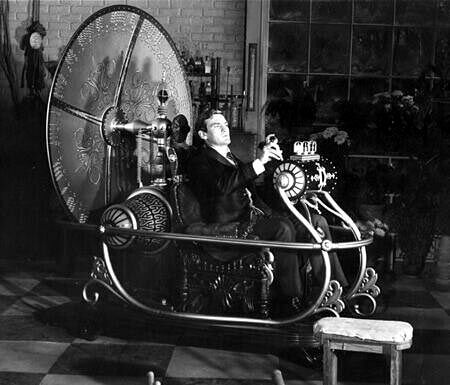
When I was little I did think more along those lines; I envisioned a future that I now recognize as some variation on steampunk, full of Wells-ian time machines

Now, I'd like to imagine I'm more realistic, and my conjured images include cures for African sleeping sickness (alternatively, effective treatments [read section "treatment"] that aren't as deadly as the disease) and music players that read your mind and time machines.
When I was little I did think more along those lines; I envisioned a future that I now recognize as some variation on steampunk, full of Wells-ian time machines
 |
| Oooh, flying cars! |
 |
| gotta love time machines |
All these fantasies and imaginings and ideas are a source of woe for me. Because I probably won't live to see them.
Granted, the things I just described that I dream of now (in my 20s) may be close enough that they'll happen in the next decade or so, but of course I've no way of knowing. No one knows. It just makes me sad that I won't be around for new things. I'm not planning on checking out anytime soon (at least for the next 80 or so years), but even if I make it to 100 I won't see the year 2100.
I think all this stuff about chronological milestones (the decade, the century, the millenium) hits people alive now with more oomph. We all lived through the turn of the millenium (unless you're under 10, then you're SOL). That's friggin' huge. That's only happened 3 times in recorded history (I start counting with the Romans, maybe the Greeks and Egyptians so 4). It makes me feel like I have a place in history sort of. 'Course everything's history when you get right down to it, but we as humans feel the need to ascribe particular significance to certain events, and the turn of the millenium was one of them.
The prospect of a human living to see 2 century-changes is fairly slim, and that occurs to me more clearly than I suppose it would to someone born in 1918 who lived to 77. We're so damn close to surviving two century-turns! Ah, pointless frustration! Perhaps at some point humans will be able to live that long; I seriously doubt it, as aging seems to be in the framework of our cells and scientists are having little success with "anti-aging" treatments.
I seriously doubt that I will see another millenium. Though you never know...
Wednesday, February 23, 2011
Daily Silver: Oh darn, zombies ate my roommates.
No, not really (well maybe in the few hours I've been working alone in my room...) but I went out to dinner tonight and when I came back no one was in the living room, but I saw their shoes and coats. Logical conclusion: zombies ate my roommates.
You can imagine how relieved I was when I crept downstairs (ready to kick some zombie butt if it came to that) and found them quietly studying in their rooms. No, I was not relieved that they were quietly studying in their rooms; in fact that was somewhat distressing in itself. Ours is a house of proud procrastination! (*dons viking helmet and shakes hammer at sky*)
So today's Silver is just more a trick to get me to write, and in the true spirit of writing, I am... going to bed.
Wait, that didn't make sense.
Well, if I'm to the point of not making sense anymore it really is time for me to go to bed.
And in the spirit of perpetual curiosity (meo--) I will share with you a new blog I've discovered and a good article. It's interesting; it's a science blog, but the issue discussed here is sort of philosophical. I like it!
You can imagine how relieved I was when I crept downstairs (ready to kick some zombie butt if it came to that) and found them quietly studying in their rooms. No, I was not relieved that they were quietly studying in their rooms; in fact that was somewhat distressing in itself. Ours is a house of proud procrastination! (*dons viking helmet and shakes hammer at sky*)
 |
| Yeah, kinda like that. And yes, my hammer glows, too. Duh. |
Wait, that didn't make sense.
Well, if I'm to the point of not making sense anymore it really is time for me to go to bed.
And in the spirit of perpetual curiosity (meo--) I will share with you a new blog I've discovered and a good article. It's interesting; it's a science blog, but the issue discussed here is sort of philosophical. I like it!
Tuesday, February 22, 2011
Daily Silver: The future looms, but I think I'm seeing tropical medicine through the fog.
Today's thoughts are on graduate school. I know that I want to get my master's degree, and I'm thinking public health. I have to do a little looking around... Then I want to get my Ph.D. But that's farther in the future than I'm willing to consider at the moment.
The career path I'm looking at right now is getting my Ph.D in parasitology or tropical medicine and working in a hospital as a specialist. Maybe public health, though, and I could work with a Health Dept. and do some more epidemiological things...
The career path I'm looking at right now is getting my Ph.D in parasitology or tropical medicine and working in a hospital as a specialist. Maybe public health, though, and I could work with a Health Dept. and do some more epidemiological things...
Monday, February 21, 2011
Daily Silver: In fact, I do still exist, I merely spent yesterday in the real world.
What a tedious place the real world is. I was writing the essay that I told you about not writing on Saturday in a rush of inspiration! Yeah, if having it due the next morning can be termed "inspiration." Anyway, it's done and I'm pretty happy with it, and now I can blog again! For a while, at least...
So today was un-extraordinary. Neurobiology this morning was pretty cool, because it's always cool when you understand the material. Also, His Vexing-ness (you know, that kid in class that has to show off everything he knows and it turns out he just read the text but didn't understand the concepts?) was relatively quiet today. Also, my friends and I asked a bunch of relevant, well-considered questions which is always a plus. All in all, a good day in the field of Molecular Neurobiology.
Abnormal Psych was pretty ho-hum. Not that it's a bad thing; certain classes, you just pray they're ho-hum. Not that I don't like psychology (although see here and here) but this class is... I don't really know why, but I didn't expect it to be a study in suffering. That's all it is, really; I'm not saying that's bad, necessarily, because my area of interest, parasitology and tropical medicine, is also full of such reflection. The only way we can change our world is if we can understand it; the only way to help people suffering from blood flukes or from bipolar disorder is if we understand these afflictions. I just... didn't realize it would be so depressing. I really don't know why; I'm intimately familiar with many of the faces of mental disorders, but I guess I thought learning clinically about them could distance me or something? Hmmm... Anyway, today we watched a video, actually two videos featuring a woman with bipolar disorder, and pretty severe at that. In the first she was in a depressive episode, and she had been hospitalized because she'd assaulted a little girl (we didn't hear the details) because the voices had told her to. (NB I'm sure schizophrenia presents a very different clinical picture, but at this point I couldn't tell them apart except that our professor told us she had bipolar disorder.) She was suffering from psychomotor retardation, which is when someone thinks, moves, and talks slowly, and she looked like she was going to fall asleep and go right off her chair. But the combination of this movie and the next one was what was really disturbing. In the next one, the same woman in the throes of a manic episode(a week later or so) was chewing bubble gum and blowing bubbles, all while she was a spy for Jesus Christ and could call up wind, rain, or sunshine at will. She reminded me of a happy-go-lucky thirteen-year-old girl, and she had that look on her face, the one of blank, almost fake happiness, just utterly pleased with herself. It was disturbing on such a visceral level... you could just tell that something was wrong, could almost tell that this mania wasn't going to last and she was going to plummet deep, deep into the hellish vice of depression.
Sorry for the flowery language; it's late and you know what that means..! (It means I start writing like a Renaissance poet.) Mi apologia.
So that's it for today. I do have to admit that somedays (usually concordant with large academic projects and looming due dates) I might not write. I'll try, but it just might not happen. In the meantime, I plan to be writing every day this week, because I don't have any papers due for a while! (Huzzah!) Buonanotte!
So today was un-extraordinary. Neurobiology this morning was pretty cool, because it's always cool when you understand the material. Also, His Vexing-ness (you know, that kid in class that has to show off everything he knows and it turns out he just read the text but didn't understand the concepts?) was relatively quiet today. Also, my friends and I asked a bunch of relevant, well-considered questions which is always a plus. All in all, a good day in the field of Molecular Neurobiology.
Abnormal Psych was pretty ho-hum. Not that it's a bad thing; certain classes, you just pray they're ho-hum. Not that I don't like psychology (although see here and here) but this class is... I don't really know why, but I didn't expect it to be a study in suffering. That's all it is, really; I'm not saying that's bad, necessarily, because my area of interest, parasitology and tropical medicine, is also full of such reflection. The only way we can change our world is if we can understand it; the only way to help people suffering from blood flukes or from bipolar disorder is if we understand these afflictions. I just... didn't realize it would be so depressing. I really don't know why; I'm intimately familiar with many of the faces of mental disorders, but I guess I thought learning clinically about them could distance me or something? Hmmm... Anyway, today we watched a video, actually two videos featuring a woman with bipolar disorder, and pretty severe at that. In the first she was in a depressive episode, and she had been hospitalized because she'd assaulted a little girl (we didn't hear the details) because the voices had told her to. (NB I'm sure schizophrenia presents a very different clinical picture, but at this point I couldn't tell them apart except that our professor told us she had bipolar disorder.) She was suffering from psychomotor retardation, which is when someone thinks, moves, and talks slowly, and she looked like she was going to fall asleep and go right off her chair. But the combination of this movie and the next one was what was really disturbing. In the next one, the same woman in the throes of a manic episode(a week later or so) was chewing bubble gum and blowing bubbles, all while she was a spy for Jesus Christ and could call up wind, rain, or sunshine at will. She reminded me of a happy-go-lucky thirteen-year-old girl, and she had that look on her face, the one of blank, almost fake happiness, just utterly pleased with herself. It was disturbing on such a visceral level... you could just tell that something was wrong, could almost tell that this mania wasn't going to last and she was going to plummet deep, deep into the hellish vice of depression.
Sorry for the flowery language; it's late and you know what that means..! (It means I start writing like a Renaissance poet.) Mi apologia.
So that's it for today. I do have to admit that somedays (usually concordant with large academic projects and looming due dates) I might not write. I'll try, but it just might not happen. In the meantime, I plan to be writing every day this week, because I don't have any papers due for a while! (Huzzah!) Buonanotte!
Saturday, February 19, 2011
Daily Silver: "The weather did a complete 180" and other greatest hits.
As you have probably gathered from the title, the weather is no longer gorgeous. In fact, I believe this phenomenon is known in certain scientific circles as "anti-gorgeous." Like other "anti-" things, no one can actually come to a conclusion about whether it exists or not, but I'd venture today is a pretty convincing "for." The kind of convincing that blasts you in the face with flying slush and sends it running down your back under your shirt in rivulets because it can. The "convincing" also happens when pushes up under the hems of your pant legs and sloshes down your bare ankles and into your unwisely-chosen low-top sneakers. Rawr.

Anyway, this glorious proof of... well, weather only touched me once today (actually more like thrice), when I went out to do laundry (blast you, laundry! *shakes fist at menacing sky*) because someone thought it would be a grand old idea to put the laundry for the campus townhouses in an entirely separate building. In Geneseo. ie 50ish miles south of Lake Ontario. Ah, but life goes on and the laundry is never done...
I would like to point out that I am still in my pajamas. Granted, I re-donned them after coming back from my latest laundry trek, but before I changed into more suitable winterwear I had been in my pj's all day. Hear that: all frickin' day! (eat it, slushy snowfall!) It's one of those days, y'know? So yeah, I woke up at a reasonable time (10:30) and proceeded to twitter (I know it's bad for me, Mommy, but it's just so good!) and Google Reader and all the goodness of internet procrastination (remember I was going to write an essay today?). I watched some streaming Netflix (Mythbusters!) and spent hours playing with Chrome extensions... oh, and I did some laundry. Actually, am in the process of doing some laundry--it's almost time for me to slog out for the last time to bring home my clothes all clean & dry!
Before I sign off, I'd like to say that my day was pretty ok. I'm not a fan of staying in my pj's all day, but you gotta do what you gotta do. Arrivederci! *looks out window, sighs, and puts on outdoor-clothes*
PS For your viewing pleasure... MYTHBUSTERS!
Friday, February 18, 2011
Daily Silver: Friday!!!
Today's silver is brief: it's Friday! And it's nice out! I am excited at the prospect of sleeping in tomorrow, but I am not excited about writing my humanities essay (due Monday morning). My assignment is to write about how I think two authors (out of five or so choices) would react to people flying planes into IRS buildings. Specifically Andrew Joseph Stack. It won't necessarily be a hard write, it's just tedious and not what I want to be doing/writing about.
But about the weather: it's gorgeous! If you're not from upstate NY or similar climes you may not understand my amazement at 50degF, but it's 50 freaking degrees in February. This is a big thing, like jump-and-shout-and walk-around-in-shorts-and-a-tshirt-because-you-don't-have-to-worry-about-frostbite big. The fields outside my window are green. It's crazy.
So I leave you now to walk in the balmy spring breezes and cavort in the sun, because it's been a long winter (actually it's been a winter of average length, but you get the idea).

But about the weather: it's gorgeous! If you're not from upstate NY or similar climes you may not understand my amazement at 50degF, but it's 50 freaking degrees in February. This is a big thing, like jump-and-shout-and walk-around-in-shorts-and-a-tshirt-because-you-don't-have-to-worry-about-frostbite big. The fields outside my window are green. It's crazy.
So I leave you now to walk in the balmy spring breezes and cavort in the sun, because it's been a long winter (actually it's been a winter of average length, but you get the idea).
Subscribe to:
Posts (Atom)
