No, I'm not writing for Disney now.
Today A said to me (paraphrased), "I'm creating beauty." Something to that effect. And I (being me) thought, what is beauty? Because I can never let these things go... sorry, A...
I immediately thought of some possibilties (which have the added bonus of framing my question): Is beauty sort of like energy, something that is imbued upon an object? Keeping in mind "the eye of the beholder," is it something that only exists in the beholder's mind[/perception/reality]? Is beauty intrinsic in the object (ie a quality belonging to the object)? And in all of these situations, is finite or infinite or something else (eg spanning space and time and able to exist in multiplicity)?
When I voiced these questions, A (quite understandably) was a bit confused. I have to admit that I didn't present these questions quite so eloquently then, not that they necessarily make sense now. But here goes...
I think beauty intrinsic in the object. But that sort of absolute makes me squirm, so I will quickly clarify that I think beauty is not a quality or a characteristic set in stone (measurable) but a potential. Of course I'm tempted to go with "beauty is an adjective only, belonging to the viewer," because at first glance that seems to fit best with the whole perception-is-reality-and-truth-does-not-exist theory, but I'm feeling slightly rebellious today. What's the point of thinking if we don't sometimes challenge our own ideas?
Really, beauty as a potential and inherent in the object makes the most sense, after all. This is a pared-down version of my idea of beauty: think of beauty as a scale. Several scales, actually. Every object, every thing has its own scale; that scale measures its beauty as percieved and assigned by a viewer (a percieved-beauty scale, PBS). Also, every object with the ability to assign beauty (namely humans) has another scale that ranks all percieved objects by beauty (a ranking scale, RS). Okay, so I'm back to the perception-reality model; so sue me. Let's think of three objects: a flower, a tree, and a stone. Each has a PBS from 1 to 100; however, their 100's may not be the same on an individual's RS (ie the flower has more ability to be beautiful, and therefore a higher max than the stone). A human (called Bob) percieves the three objects. Bob has a RS in his head. Let's say that Bob thinks the flower is really pretty, and he gives it a 74 [on the flower's PBS]. He thinks the tree is pretty, too, so he gives it an 80 [on the tree's PBS]. The stone is ugly to Bob (it's green and slimy with pond muck) so he gives it 26 [on the stone's PBS]. Now for Bob's RS; the flower's PBS is lower than the tree's, but on Bob's RS the flower is higher than the tree, say 63 vs 48. This means that he thinks the flower is fairly pretty for a flower and the tree is pretty for a tree, but as far as beautiful goes they're not as beautiful as other things (for instance he ranks his wife as a 92). Does that make sense? A PBS is comparing one object to other like objects, and an individual RS is comparing one object percieved by a person to all the other objects the person has ever percieved.
I'm using "object" fairly loosely, because by "object" I mean "pretty much anything" including humans, other animals, plants, inanimate objects, ideas, paintings, relationships, love, situations, anything you might ever refer to as beautiful.
Ask me questions! I know I've probably confused a lot of you (truthfully I haven't chewed out all the details yet), but if you are willing to read to this very sentence at the end of the post, you probably would like to understand (I hope). So ask away! Ciao!
Showing posts with label Perception. Show all posts
Showing posts with label Perception. Show all posts
Sunday, April 3, 2011

Thursday, March 31, 2011
"Leaving" implies both something being left and something else being reached.
Death. The soul leaves the body. The body is a shell, nothing more than a vessel for the soul, the fifth, transient element. For example, we call your body "yours." Like a possession. Not yourself. Do you see what I mean? "Self" is personality and thought and memories (not memory). And what is personality and thought and memory? Chemicals in your brain. But not even that. The way those chemicals come together, with the physical tissue of your brain and its orientation in space and time. But these things, personality and thought and memory, self, are not physical, nor would we ever presume to describe them as such. Really, how would we describe them? Abstractions. Not matter, but abstractions. It's a small step from abstractions to energy. After all, how would you describe energy? Try; it's really damn hard. Okay, you can say "I don't know" now. Self is so amorphous, indescribable, intangible, abstract… you get the picture.
Death. I keep wandering away from it (intentionally, perhaps..?). Body is a possession, a vessel, a shell. Even when you're alive. But it's a possession like a home. A house or an apartment. It's very personal, very you. Still, when the soul leaves, it's just a fallen log, a discarded muffin in a muddy parking lot (don't ask), a footprint in wet sand. It's the physical manifestation of memory, a dead body is. I want to be cremated. I want my body to go to the fire. Well, actually it's between cremation or just being left out for the animals and the plants and the elements. Air (the great oxidizer) and water (the great eroder) and earth (the great consumer) and fire (the great equalizer) and life. Other life: dogs and raccoons and birds and worms and beetles and trees and fungi and soil bacteria. Either way I am returned; even if I was embalmed and locked in a metal box and buried (*shudder shudder*) I would eventually return to the universe as organic molecules and even atoms. It would just take longer. Much longer.
One thing about my faith is that it's not particularly comforting. But that's the thing: that's because it's realistic. The world is not "made" for us. We are not "supposed" to be able to survive, thrive in it.
The "meaning" of life is that it works. There is no great reason.
The soul is recyclable, but not always recycled. Yes, reincarnation is in here somewhere, but I've got my own bent on it.
But I do know what happens when you die by a hand or a force other than your own. Sort of. Obviously I don't know, really. I mean, no one does. If only we could remember… Think of the first law of thermodynamics; conservation of energy and matter. Add up all the energy and mass on both sides of the chemical equation and they'll match. Mostly. I'm not going there, at least in this paragraph. Besides, I forget what the principle or whatever is called. Well, what is a soul but… something. I mean, there aren't specifics, but souls are like the gods; they have to be made of something. And there's only two things in the universe (don't you even think about it): matter and energy. Personally I'm leaning toward energy, and it makes sense/sounds good: heat energy, light energy, life energy. You know? But the point of this whole idea is that souls can neither be created nor destroyed (perhaps they can be converted, but not going there right now). Anyway, this means they have to be re-used, and I think they come out the other side looking pretty much the way they did. It's, like, hard to change energy, man…
Whoa, I just started making sense! Like, trippy, right? Betcha didn't see that one coming, huh?
So, souls survive the journey from one body (the deceased) to another (the newly born) pretty much unchanged. I have no thoughts on the actual method of the journey at this moment; I will just say that Death is neutral among divines (I'm not even sure he qualifies as a divine) and men, and there are Angels [of Death] and Reapers involved. What; you thought I didn't have a theory? Silly, silly; you don't know me yet, do ye? Actually, have you been, like, paying attention?
BTW: I've been writing this to myself. Because I talk to myself. I know, circular, but I get hold of an idea and I'm like a terrier with a bone. Never let it go. Just sayin'.
So, I don't really know the mechanism, and the importance of that statement is that I don't know why we don't know who/what we were. I think that now would be the time to point out that souls are present in all living things, so species, even kingdom, is sort of a nonissue.
Death. I keep wandering away from it (intentionally, perhaps..?). Body is a possession, a vessel, a shell. Even when you're alive. But it's a possession like a home. A house or an apartment. It's very personal, very you. Still, when the soul leaves, it's just a fallen log, a discarded muffin in a muddy parking lot (don't ask), a footprint in wet sand. It's the physical manifestation of memory, a dead body is. I want to be cremated. I want my body to go to the fire. Well, actually it's between cremation or just being left out for the animals and the plants and the elements. Air (the great oxidizer) and water (the great eroder) and earth (the great consumer) and fire (the great equalizer) and life. Other life: dogs and raccoons and birds and worms and beetles and trees and fungi and soil bacteria. Either way I am returned; even if I was embalmed and locked in a metal box and buried (*shudder shudder*) I would eventually return to the universe as organic molecules and even atoms. It would just take longer. Much longer.
One thing about my faith is that it's not particularly comforting. But that's the thing: that's because it's realistic. The world is not "made" for us. We are not "supposed" to be able to survive, thrive in it.
The "meaning" of life is that it works. There is no great reason.
The soul is recyclable, but not always recycled. Yes, reincarnation is in here somewhere, but I've got my own bent on it.
But I do know what happens when you die by a hand or a force other than your own. Sort of. Obviously I don't know, really. I mean, no one does. If only we could remember… Think of the first law of thermodynamics; conservation of energy and matter. Add up all the energy and mass on both sides of the chemical equation and they'll match. Mostly. I'm not going there, at least in this paragraph. Besides, I forget what the principle or whatever is called. Well, what is a soul but… something. I mean, there aren't specifics, but souls are like the gods; they have to be made of something. And there's only two things in the universe (don't you even think about it): matter and energy. Personally I'm leaning toward energy, and it makes sense/sounds good: heat energy, light energy, life energy. You know? But the point of this whole idea is that souls can neither be created nor destroyed (perhaps they can be converted, but not going there right now). Anyway, this means they have to be re-used, and I think they come out the other side looking pretty much the way they did. It's, like, hard to change energy, man…
Whoa, I just started making sense! Like, trippy, right? Betcha didn't see that one coming, huh?
So, souls survive the journey from one body (the deceased) to another (the newly born) pretty much unchanged. I have no thoughts on the actual method of the journey at this moment; I will just say that Death is neutral among divines (I'm not even sure he qualifies as a divine) and men, and there are Angels [of Death] and Reapers involved. What; you thought I didn't have a theory? Silly, silly; you don't know me yet, do ye? Actually, have you been, like, paying attention?
BTW: I've been writing this to myself. Because I talk to myself. I know, circular, but I get hold of an idea and I'm like a terrier with a bone. Never let it go. Just sayin'.
So, I don't really know the mechanism, and the importance of that statement is that I don't know why we don't know who/what we were. I think that now would be the time to point out that souls are present in all living things, so species, even kingdom, is sort of a nonissue.
Sunday, March 27, 2011
Good and bad and everything in between.
I've started watching Dexter again. I don't know why I ever stopped; it's such a fascinating study in human nature. Or... something else... I guess Dexter would describe himself as other-than-human, but what is it that makes us human? If it is the physical condition of being human (born human, of humans, in humanity, with the same genetic makeup as humans and the same material needs) then Dexter is most certainly human. And he's not a sociopath, as I've heard suggested. He displays some sociapathic characteristics, but he wouldn't care about all these people, even Harry, if he was. And he does care, and that's why the show's interesting.
I've watched all the usual crime/forensics/police dramas: CSI (in its many incarnations), Law & Order (in its ever-more-numerous masques), Bones, Inspector Lynley, and such, and I feel this has made me better able to appreciate Dexter. I do not mean to suggest that any of these are realistic (I have come to realize over the years that many are far from accurate, most notably CSI (in which techs are given guns and the lab rats go into the field). I think maybe this innacuracy allows me to juxtapose CSI (which, I must admit, is probably the worst perpetrator) with Dexter. But knowing these shows allows me to ignore all the forensics and police procedural part. I imagine Dexter's as accurate perhaps as L & O, but the point is not accuracy, precisely. The other route a show like this usually goes is invariably the drama route, which I suppose they are, deep down inside, but Dexter doesn't even really land there. Sure there's the family drama, with his sister and his father and his girlfriend and her kids. But it's not really about these people; it's all about him.
At the core, every story is very specific; it's about one or a few people and the world's relationship with them. That's what a main character is: a focus, a thumbtack on a map with strings radiating. It seems simple, even simplistic when I say it like that. Oh, well.
On the surface Dexter looks like another fascinatingly twisted string of executions that draw us in a mob to the gallows (everybody likes a good beheading). But I think underneath it's a more subtle weaving pushing common ideals--such as the morals we're taught when we're three and too young to think--and challenging our senses of ourselves. Actually, I think that most people who watch it tend to ignore that bit, and that's why it's survived so long. People feel gratified to watch Dex fulfill their needs for justice (even though justice resides in a different realm and looks not at all like what we think justice should), but they don't examine why. I've long given up trying to be disgusted at the revenge-fantasy this heroic vigilante-ism brings to the surface in me. I'm comfortable with my amygdala; are you?
I like Dexter.
I've watched all the usual crime/forensics/police dramas: CSI (in its many incarnations), Law & Order (in its ever-more-numerous masques), Bones, Inspector Lynley, and such, and I feel this has made me better able to appreciate Dexter. I do not mean to suggest that any of these are realistic (I have come to realize over the years that many are far from accurate, most notably CSI (in which techs are given guns and the lab rats go into the field). I think maybe this innacuracy allows me to juxtapose CSI (which, I must admit, is probably the worst perpetrator) with Dexter. But knowing these shows allows me to ignore all the forensics and police procedural part. I imagine Dexter's as accurate perhaps as L & O, but the point is not accuracy, precisely. The other route a show like this usually goes is invariably the drama route, which I suppose they are, deep down inside, but Dexter doesn't even really land there. Sure there's the family drama, with his sister and his father and his girlfriend and her kids. But it's not really about these people; it's all about him.
At the core, every story is very specific; it's about one or a few people and the world's relationship with them. That's what a main character is: a focus, a thumbtack on a map with strings radiating. It seems simple, even simplistic when I say it like that. Oh, well.
On the surface Dexter looks like another fascinatingly twisted string of executions that draw us in a mob to the gallows (everybody likes a good beheading). But I think underneath it's a more subtle weaving pushing common ideals--such as the morals we're taught when we're three and too young to think--and challenging our senses of ourselves. Actually, I think that most people who watch it tend to ignore that bit, and that's why it's survived so long. People feel gratified to watch Dex fulfill their needs for justice (even though justice resides in a different realm and looks not at all like what we think justice should), but they don't examine why. I've long given up trying to be disgusted at the revenge-fantasy this heroic vigilante-ism brings to the surface in me. I'm comfortable with my amygdala; are you?
I like Dexter.
Wednesday, March 16, 2011
Playing god and other human pursuits.
Today I'm thinking about euthanasia. Alternately, murder. I don't know.
Up until a few years ago I was set on a career in veterinary medicine. I wanted, needed to be a veterinarian. I... honestly, I don't really know why it was so important to me. At first I suppose it was just like, "Oh I love animals, and I want to work in the sciences, and I want to help the animals that live with us." I have always liked animals more than humans to some extent; as I've aged it's shifted from disgust with the human race and reverence of non-human animals to, well, I'm still pretty disgusted with humans, but it's less of a generalization and more on a case-by-case basis. So when I was little I deemed non-human animals more deserving of medical care. I counter any protests of "But you're human, and our pets need humans to provide that care," with "I was, like, six years old." Six-year-olds aren't known for their expansive considerations of reality (ie how the world works).
As I got older I developed more concrete reasons for becoming a vet. I started feeling that pulling at my heart when I thought of animals suffering illness or mistreatment. I realized that I felt personally obligated to do whatever I could to help them, for they could not help themselves. I still feel that obligation, but I realize now that your life's work should also be something that is fascinating to me, and my fascination is not in veterinary medicine.
My career plans are not the point. So what is? you ask. The point: one disparity between medicine for humans and non-humans is at the end of medicine. By that I mean, of course, how and when death comes.
The very simple fact is: humans often choose when an animal will die. Another simple fact: it is illegal and usually considered amoral for humans to choose when a human will die (with exceptions and/or loopholes). Why? If you ask someone that question, chances are they will have a hard time with a solid answer. I've thought about this question a lot, and I've come to the conclusion that the law is as it is because there is an inherent assumption that humans are more important than non-humans. I wouldn't expect an easy answer out of anyone to this question, either, even though it's basically a yes/no question.
My take is that it's something that people believe deeply--perhaps subconsciously--but are uncomfortable voicing aloud. But shouldn't a person be able to say what she thinks? Also, this belief in human superiority is probably widely-held, so speaking it aloud would place one squarely within the clear--albeit close-mouthed--majority.
I will speak: I do not agree with the statement that humans are more important than non-humans. I strongly believe that humans are of equal importance with non-humans. Who knows, maybe I'll change my mind in a few years; I did start out believing that non-humans were of more importance than humans.
The most trouble I have with that statement is the use of "important." Calling something important implies that there is a purpose for it, and we've already said there is no purpose for living things, nor even for living. Actually, Oxford English Dictionary defines important as "of great significance or value; likely to have a profound effect on success, survival, or well-being." You could argue that because of the inclusion of "profound effect on... survival" it might have bearing on the relationship between these two things (humans and non-humans); actually there is no relevance to this comparison because the it is not comparing to methods of finding food or shelter or anything like that, so there is no element of survival. It is not calling into question the survival skills of either being, but comparing them as if they were instrumental to some sort of universal scheme, which smacks of monotheism (and actually most religions with divinity/-ies).
So the natural next question is "Why then do we decide when animals die and not when humans die?" When we can't easily answer that one, we might go to "Why is it socially acceptable to decide for animals and not humans?" or even "Is it right?" And then we get to right vs wrong, my least favorite dichotomy of all time (and I can even say with confidence that I will never meet another dichotomy that I loathe more).
It's been a hard week.
Up until a few years ago I was set on a career in veterinary medicine. I wanted, needed to be a veterinarian. I... honestly, I don't really know why it was so important to me. At first I suppose it was just like, "Oh I love animals, and I want to work in the sciences, and I want to help the animals that live with us." I have always liked animals more than humans to some extent; as I've aged it's shifted from disgust with the human race and reverence of non-human animals to, well, I'm still pretty disgusted with humans, but it's less of a generalization and more on a case-by-case basis. So when I was little I deemed non-human animals more deserving of medical care. I counter any protests of "But you're human, and our pets need humans to provide that care," with "I was, like, six years old." Six-year-olds aren't known for their expansive considerations of reality (ie how the world works).
As I got older I developed more concrete reasons for becoming a vet. I started feeling that pulling at my heart when I thought of animals suffering illness or mistreatment. I realized that I felt personally obligated to do whatever I could to help them, for they could not help themselves. I still feel that obligation, but I realize now that your life's work should also be something that is fascinating to me, and my fascination is not in veterinary medicine.
My career plans are not the point. So what is? you ask. The point: one disparity between medicine for humans and non-humans is at the end of medicine. By that I mean, of course, how and when death comes.
The very simple fact is: humans often choose when an animal will die. Another simple fact: it is illegal and usually considered amoral for humans to choose when a human will die (with exceptions and/or loopholes). Why? If you ask someone that question, chances are they will have a hard time with a solid answer. I've thought about this question a lot, and I've come to the conclusion that the law is as it is because there is an inherent assumption that humans are more important than non-humans. I wouldn't expect an easy answer out of anyone to this question, either, even though it's basically a yes/no question.
My take is that it's something that people believe deeply--perhaps subconsciously--but are uncomfortable voicing aloud. But shouldn't a person be able to say what she thinks? Also, this belief in human superiority is probably widely-held, so speaking it aloud would place one squarely within the clear--albeit close-mouthed--majority.
I will speak: I do not agree with the statement that humans are more important than non-humans. I strongly believe that humans are of equal importance with non-humans. Who knows, maybe I'll change my mind in a few years; I did start out believing that non-humans were of more importance than humans.
The most trouble I have with that statement is the use of "important." Calling something important implies that there is a purpose for it, and we've already said there is no purpose for living things, nor even for living. Actually, Oxford English Dictionary defines important as "of great significance or value; likely to have a profound effect on success, survival, or well-being." You could argue that because of the inclusion of "profound effect on... survival" it might have bearing on the relationship between these two things (humans and non-humans); actually there is no relevance to this comparison because the it is not comparing to methods of finding food or shelter or anything like that, so there is no element of survival. It is not calling into question the survival skills of either being, but comparing them as if they were instrumental to some sort of universal scheme, which smacks of monotheism (and actually most religions with divinity/-ies).
So the natural next question is "Why then do we decide when animals die and not when humans die?" When we can't easily answer that one, we might go to "Why is it socially acceptable to decide for animals and not humans?" or even "Is it right?" And then we get to right vs wrong, my least favorite dichotomy of all time (and I can even say with confidence that I will never meet another dichotomy that I loathe more).
It's been a hard week.
Wednesday, March 2, 2011
Daily Silver: New directions for earth-based faiths.
Today's Silver is brief; I just want to share this article I read at The Juggler (the Pagan Newswire Collective culture blog). It's called "Toward a Pagan Critical Theory: Introduction."
Also, I apologize for being elusive this week. I have two big tests tomorrow, and I honestly haven't been that much fun this week as of yet. I will attempt to emerge and write more this weekend and next week. Ciao!
Also, I apologize for being elusive this week. I have two big tests tomorrow, and I honestly haven't been that much fun this week as of yet. I will attempt to emerge and write more this weekend and next week. Ciao!
Saturday, February 26, 2011
Daily Silver: A recap of stuff I haven't told you yet. And "the weather isn't evil, it just wants a hug."
Can I write Friday's Daily Silver even though it's technically Saturday? Of course I can! I'm running the show. (bwahahahahahahahaha!!!)
What can I tell you about Friday. Other than "TGIF" or rather, TGIWF (Thank Gods It Was Friday). Oh, well it snowed a bit up here in the wild wild North (better known as Western NY). Lessee... oh, we have an accumulation of about 8 or 9 inches, and it was all melted two days ago. So not overnight, but pretty good. Actually, snow on the ground is okay. It's when it's blowing in your face that's not so cool. Hot. Whatever. Today I got up and (mistake #1) did not look out the window. I had no idea what it was like outside, but I assumed that it would be much like yesterday: sunny and clear with snow on the ground but none in the sky. As I was preparing to leave for class, still not looking out the window, I (almost mistake #2) debated putting on my winter hat or my baseball cap. I luckily chose the winter hat and opened the door (surprise!). The snow was coming down at about a 45deg slant, and they were fat, slushy flakes, the kind that can sting in a sudden [sadistic] gust of wind but then will accumulate on your hat and coat and any exposed skin and make you shed water when you walk inside like molting snakeskin. Except cold and wet.
In other news, I'm taking a practice GRE tomorrow. I'm excited about the future (Ooooh, the future...) but I'm not excited about getting up on a Saturday. Ah, the sleep I sacrifice...
Speaking of sleep: I think I'll pretend to go to sleep now. I say pretend because I'll end up laying in bed staring at the ceiling. Or the wall. I've become sort of attached to staring at the wall lately. Buonanotte!
 |
| Now make it 50-80degF colder and dump some ice water on him. |
Speaking of sleep: I think I'll pretend to go to sleep now. I say pretend because I'll end up laying in bed staring at the ceiling. Or the wall. I've become sort of attached to staring at the wall lately. Buonanotte!
Thursday, February 24, 2011
I have to say I'm kind of sad that I won't see 2100...
Ever since I was little, I've thought about mortality. Yes, in a morbid-fearful-squeamish sense, but also in a more... limiting sense. Well, I don't know if "limiting" is the word I'm looking for; I'm trying to describe the sadness--disappointment, really--in the knowledge that I will not live to see the future. I'm not talking flying cars and androids and living on other planets necessarily (although probably within our grasp now or in the near future) but more about the progression of life and the world and all that.
When I was little I did think more along those lines; I envisioned a future that I now recognize as some variation on steampunk, full of Wells-ian time machines

Now, I'd like to imagine I'm more realistic, and my conjured images include cures for African sleeping sickness (alternatively, effective treatments [read section "treatment"] that aren't as deadly as the disease) and music players that read your mind and time machines.
When I was little I did think more along those lines; I envisioned a future that I now recognize as some variation on steampunk, full of Wells-ian time machines
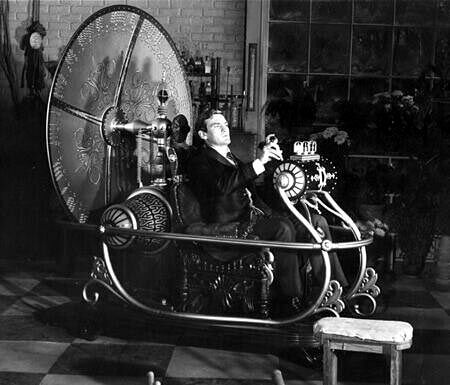
 |
| Oooh, flying cars! |
 |
| gotta love time machines |
All these fantasies and imaginings and ideas are a source of woe for me. Because I probably won't live to see them.
Granted, the things I just described that I dream of now (in my 20s) may be close enough that they'll happen in the next decade or so, but of course I've no way of knowing. No one knows. It just makes me sad that I won't be around for new things. I'm not planning on checking out anytime soon (at least for the next 80 or so years), but even if I make it to 100 I won't see the year 2100.
I think all this stuff about chronological milestones (the decade, the century, the millenium) hits people alive now with more oomph. We all lived through the turn of the millenium (unless you're under 10, then you're SOL). That's friggin' huge. That's only happened 3 times in recorded history (I start counting with the Romans, maybe the Greeks and Egyptians so 4). It makes me feel like I have a place in history sort of. 'Course everything's history when you get right down to it, but we as humans feel the need to ascribe particular significance to certain events, and the turn of the millenium was one of them.
The prospect of a human living to see 2 century-changes is fairly slim, and that occurs to me more clearly than I suppose it would to someone born in 1918 who lived to 77. We're so damn close to surviving two century-turns! Ah, pointless frustration! Perhaps at some point humans will be able to live that long; I seriously doubt it, as aging seems to be in the framework of our cells and scientists are having little success with "anti-aging" treatments.
I seriously doubt that I will see another millenium. Though you never know...
Monday, February 21, 2011
Daily Silver: In fact, I do still exist, I merely spent yesterday in the real world.
What a tedious place the real world is. I was writing the essay that I told you about not writing on Saturday in a rush of inspiration! Yeah, if having it due the next morning can be termed "inspiration." Anyway, it's done and I'm pretty happy with it, and now I can blog again! For a while, at least...
So today was un-extraordinary. Neurobiology this morning was pretty cool, because it's always cool when you understand the material. Also, His Vexing-ness (you know, that kid in class that has to show off everything he knows and it turns out he just read the text but didn't understand the concepts?) was relatively quiet today. Also, my friends and I asked a bunch of relevant, well-considered questions which is always a plus. All in all, a good day in the field of Molecular Neurobiology.
Abnormal Psych was pretty ho-hum. Not that it's a bad thing; certain classes, you just pray they're ho-hum. Not that I don't like psychology (although see here and here) but this class is... I don't really know why, but I didn't expect it to be a study in suffering. That's all it is, really; I'm not saying that's bad, necessarily, because my area of interest, parasitology and tropical medicine, is also full of such reflection. The only way we can change our world is if we can understand it; the only way to help people suffering from blood flukes or from bipolar disorder is if we understand these afflictions. I just... didn't realize it would be so depressing. I really don't know why; I'm intimately familiar with many of the faces of mental disorders, but I guess I thought learning clinically about them could distance me or something? Hmmm... Anyway, today we watched a video, actually two videos featuring a woman with bipolar disorder, and pretty severe at that. In the first she was in a depressive episode, and she had been hospitalized because she'd assaulted a little girl (we didn't hear the details) because the voices had told her to. (NB I'm sure schizophrenia presents a very different clinical picture, but at this point I couldn't tell them apart except that our professor told us she had bipolar disorder.) She was suffering from psychomotor retardation, which is when someone thinks, moves, and talks slowly, and she looked like she was going to fall asleep and go right off her chair. But the combination of this movie and the next one was what was really disturbing. In the next one, the same woman in the throes of a manic episode(a week later or so) was chewing bubble gum and blowing bubbles, all while she was a spy for Jesus Christ and could call up wind, rain, or sunshine at will. She reminded me of a happy-go-lucky thirteen-year-old girl, and she had that look on her face, the one of blank, almost fake happiness, just utterly pleased with herself. It was disturbing on such a visceral level... you could just tell that something was wrong, could almost tell that this mania wasn't going to last and she was going to plummet deep, deep into the hellish vice of depression.
Sorry for the flowery language; it's late and you know what that means..! (It means I start writing like a Renaissance poet.) Mi apologia.
So that's it for today. I do have to admit that somedays (usually concordant with large academic projects and looming due dates) I might not write. I'll try, but it just might not happen. In the meantime, I plan to be writing every day this week, because I don't have any papers due for a while! (Huzzah!) Buonanotte!
So today was un-extraordinary. Neurobiology this morning was pretty cool, because it's always cool when you understand the material. Also, His Vexing-ness (you know, that kid in class that has to show off everything he knows and it turns out he just read the text but didn't understand the concepts?) was relatively quiet today. Also, my friends and I asked a bunch of relevant, well-considered questions which is always a plus. All in all, a good day in the field of Molecular Neurobiology.
Abnormal Psych was pretty ho-hum. Not that it's a bad thing; certain classes, you just pray they're ho-hum. Not that I don't like psychology (although see here and here) but this class is... I don't really know why, but I didn't expect it to be a study in suffering. That's all it is, really; I'm not saying that's bad, necessarily, because my area of interest, parasitology and tropical medicine, is also full of such reflection. The only way we can change our world is if we can understand it; the only way to help people suffering from blood flukes or from bipolar disorder is if we understand these afflictions. I just... didn't realize it would be so depressing. I really don't know why; I'm intimately familiar with many of the faces of mental disorders, but I guess I thought learning clinically about them could distance me or something? Hmmm... Anyway, today we watched a video, actually two videos featuring a woman with bipolar disorder, and pretty severe at that. In the first she was in a depressive episode, and she had been hospitalized because she'd assaulted a little girl (we didn't hear the details) because the voices had told her to. (NB I'm sure schizophrenia presents a very different clinical picture, but at this point I couldn't tell them apart except that our professor told us she had bipolar disorder.) She was suffering from psychomotor retardation, which is when someone thinks, moves, and talks slowly, and she looked like she was going to fall asleep and go right off her chair. But the combination of this movie and the next one was what was really disturbing. In the next one, the same woman in the throes of a manic episode(a week later or so) was chewing bubble gum and blowing bubbles, all while she was a spy for Jesus Christ and could call up wind, rain, or sunshine at will. She reminded me of a happy-go-lucky thirteen-year-old girl, and she had that look on her face, the one of blank, almost fake happiness, just utterly pleased with herself. It was disturbing on such a visceral level... you could just tell that something was wrong, could almost tell that this mania wasn't going to last and she was going to plummet deep, deep into the hellish vice of depression.
Sorry for the flowery language; it's late and you know what that means..! (It means I start writing like a Renaissance poet.) Mi apologia.
So that's it for today. I do have to admit that somedays (usually concordant with large academic projects and looming due dates) I might not write. I'll try, but it just might not happen. In the meantime, I plan to be writing every day this week, because I don't have any papers due for a while! (Huzzah!) Buonanotte!
Wednesday, February 16, 2011
The Launch of the "Daily Silver," Frankenstein, and Psychology
 So I'm going to try something new, in an attempt to write more often (read: every day). I'm going to do a daily post. Don't worry, I'm not going to write some deep, meaningful novella every day; I seriously doubt that I could pull it off. Actually, I'm positive I couldn't. Anyway, these daily posts will be short, just a list, really, of my (wait for it...) thoughts throughout the day. Yeah, I said it. Bite me. I'm calling it the "Daily Silver" because, well, it's daily, and argent (as in argentwolfwing) is loosely derived from the Latin/Italian for silver. Think of the chemical symbol for silver, Ag, which stands for its Latin name, argentum. So: that's that.
~~~~~
 My next topic is Frankenstein. I'm reading the book for humanities, and it's not all that bad. I mean, I hate Victor with a passion, because he's such a little bitch, but I gather from my friends (who've already read it) that this is a common reaction. He just leaves the poor creature--runs away, in fact (sorry if I just gave it away for you)--to fend for himself, like running away screaming your bloody head off and leaving a giant, hideous, and potentially dangerous two-year-old to the cruel whims of a vicious world. Victor Frankenstein is more repulsive than his creature, especially with his obsession with physical beauty to the point of ignoring personality traits. Which is, of course, his motivation to abandon the creature. His sole motivation.
~~~~~

On the test today was a question about different types of studies conducted by psychologists. It read (paraphrasing, of course) "A researcher wants to learn about treatment and anorexia. She takes a group of women suffering anorexia and divides them arbitrarily into two groups. One group receives psychotherapy and an FDA-approved drug as a pill, and the other group is given no psychotherapy and a sugar pill (a placebo)." I couldn't believe it; my professor, a self-professed (ha, a pun!) scientist had written this question, but he had somehow put in two independent variables. Two freaking independent variables. Undoubtedly most of you my readers will not feel the same incredulity that I do at this [possible] typo. This is like trying to tell me that the earth is flat and 6,000 years old or something (which people, btw, do try). It's like, for lack of a better example, deliberately misquoting my bible. Okay, better example: it's like saying that the earth is the center of the universe. Again, people try. I just shake my head and sigh.
~~~~~
Not all "Daily Silver"s will be this long. I anticipate many bulleted lists in our future. But at least I'll be writing! That's all for today... Ciao!

Saturday, February 5, 2011
What you see when you aren't really looking
Seen from the corner of your eye… Perhaps something's real-er when you see it out of the corner of your eye. Because when you look head-on at something, you don't see everything. Take stars; have you ever been told to look sideways at stars? More importantly, have you ever done it? More stars are visible when you're looking just to the left/to the right/below/above the stars. It has to do with the cornea wearing out or becoming opaque or the photoreceptors at the center of the retina wearing out or something like that. Well, close enough.
Maybe that's why children can see ghosts and monsters and the like. Maybe when you see something out of the corner of your eye, it's real and what you see when you look is not.
Maybe that's why children can see ghosts and monsters and the like. Maybe when you see something out of the corner of your eye, it's real and what you see when you look is not.
Thursday, February 3, 2011
Pondering the soul, and what it means to have one. Also, assuming I do.
All I can see is land and sky. That seems like a lot, even everything, I suppose, but when it's just the land and the sky, a horizon way off as far as I can see, and nothing else, now that's something. Yeah, that's something. No houses, not any buildings to block the skyline, make it irregular. Not even any plants. No trees, or shrubs, or even grasses. I can see forever.
But obviously I can't; if I could see forever I'd see all the buildings and trees on the other side of that horizon. And I can't, because I'm gloriously alone. I can see the sun in the sky; it's big and yellow, hanging there like it's got nowhere else to go. Well, it doesn't really. It's stuck in place, because what's going to move the sun? Objects in motion tend to stay in motion; objects at rest tend to stay at rest, or some such thing. It's sitting in space, a big, fat, lazy ball of simmering plasma, and it's not going to move, dammit.
Every living thing has a… soul… for lack of a better term. The fifth element. Life. We are all made up of the five elements: water is in our blood and our breath and our cells; earth is in our tissues, muscle and bone, tendon and ligament; air is the stuff we breathe, and it fills our bodies, allows them shape; fire is in the chemical processes that keep us alive, in thought and movement. The fifth element, I'll call it the soul, is in everything. Those reactions, that fire, that moves us and keeps us, don't have to work. They do work, but nothing except some force means they have to do so.
If I was so inclined, this is where I'd find God. Or gods. It isn't though; they come in elsewhere. Because they have to be made of something, too, right? Even if they're just some pseudo-corporeal manifestation of energy, like particles of light. Sure, two hydrogens and an oxygen are attracted to each other, and they form this molecule called water, but nothing really says they have to. I mean, why? Why is the question of the hour, isn't it? Sure, glucose goes through the chemical process of respiration, and it involves oxygen, and the atoms and electrons dance and we get ATP, which holds energy in the bonds in its phosphate tail. But why? Ask a biologist, she'll start talking about metabolic pathways and evolution, if she is so incline. Ask a chemist; he'll just go back to electron transfers and oxidation numbers and electronegativity. Ask a physicist; he'll talk about the laws of thermodynamics, and matter and energy. Ask a philosopher; he'll probably spout some nonsense about JCGod or a greater power, or if he's a Marxist he'll probably just say something about the good of the whole (note to self: find a Nihilist and ask about why chemical reactions work). But none of them get to the root of it, and this is where human finds religion.
.
Or faith; I have faith. Religion (see definition #2) is such a deplorable word. Burdened with the pain and hatred and guilt and sorrow and zealotry and filth of ages of men and women. I choose to believe (and I know this is right, but I recognize that my knowledge is reached and accepted in the same way as a priest thumps his JCBible (but he's wrong, I know, for isn't that the basis of faith)) that this fifth element is natural in origin, as the other four. But what is natural? JCGod (the god of Christians and Jews and Muslims, and many others I suppose) is a manmade thing; a creation of short-sighted minds fumbling in the dark abyss of space (where they oughtn't be). They seek an answer where there is not one that is solid, that men can cling to like the slick board tossed in a feral sea.
My fifth element, life, soul, is not concrete in the sense that the JCBible is. Well, to point out the obvious, the JCBible is an actual book, that I can go to Barnes & Noble and purchase and hold in my hands. And, may I point out, write in. But even more than that, there is an intelligence, a design behind those words, those ideas, that I just cannot find in the world. I reach my faith from observation and long hours of introspection, not from the fantastic (albeit entertaining) ramblings of some random dude(s).
I entertained the idea of a "cult" of sorts, mostly to screw with the norm, though. I do think it would be fun, certainly interesting, to tell other people what I know. I mean, I'll tell people what I know, and if they then know it too, that's cool. But I think there should observation and introspection involved in formulating your own faith. Faith is very much an individual thing. That is not saying that there are not aspects for sharing. Feasts and celebrations are great times for sharing, and in this way I understand the attraction of a church. In a church, or a temple, or any other sort of religious community, people can find just that: community. There is a comfort to being with people who believe in the world the same way as do you. I understand that completely; I wish there was just such a community that I could be part of. However, there is one basic difference in the formation of community and shared celebration, and in a church-like community: faith is not at all a group endeavour. Religion is a group endeavor, and, as we have already discussed, I view "religion" as a word not to be spoken without full comprehension of the weight and meaning behind it.
And that's where religion goes wrong; people believe these things that they do not know (and in this statement, I hope you've been paying attention, because in the context of these ramblings of mine, "know," as well as other key words, mean something other than they normally mean in everyday conversation). It's kind of ludicrous. There is no truth but one's own; what may be true for you may not be true for me. This is hard for many to grasp; I myself have struggled a lot with this one. But I have finally come to the conclusion that truth, like time and perception (and because of perception), is relative.

But obviously I can't; if I could see forever I'd see all the buildings and trees on the other side of that horizon. And I can't, because I'm gloriously alone. I can see the sun in the sky; it's big and yellow, hanging there like it's got nowhere else to go. Well, it doesn't really. It's stuck in place, because what's going to move the sun? Objects in motion tend to stay in motion; objects at rest tend to stay at rest, or some such thing. It's sitting in space, a big, fat, lazy ball of simmering plasma, and it's not going to move, dammit.
 |
| Like this guy. |
But me, I move. I move all the time. I can't stay still, and this is not just me. Animals have to move all the time. Stop moving, and you're dead. Not just that you'll die, but a state of immobility is the definition of death. I guess. Yeah, that works; death is just you being still. Your heart doesn't beat, your diaphragm doesn't contract or relax, your blood doesn't circulate, your neurons don't fire and the ions don't dance around the synapses. You're still. Your soul doesn't move you, because it's not there anymore.
Every living thing has a… soul… for lack of a better term. The fifth element. Life. We are all made up of the five elements: water is in our blood and our breath and our cells; earth is in our tissues, muscle and bone, tendon and ligament; air is the stuff we breathe, and it fills our bodies, allows them shape; fire is in the chemical processes that keep us alive, in thought and movement. The fifth element, I'll call it the soul, is in everything. Those reactions, that fire, that moves us and keeps us, don't have to work. They do work, but nothing except some force means they have to do so.
If I was so inclined, this is where I'd find God. Or gods. It isn't though; they come in elsewhere. Because they have to be made of something, too, right? Even if they're just some pseudo-corporeal manifestation of energy, like particles of light. Sure, two hydrogens and an oxygen are attracted to each other, and they form this molecule called water, but nothing really says they have to. I mean, why? Why is the question of the hour, isn't it? Sure, glucose goes through the chemical process of respiration, and it involves oxygen, and the atoms and electrons dance and we get ATP, which holds energy in the bonds in its phosphate tail. But why? Ask a biologist, she'll start talking about metabolic pathways and evolution, if she is so incline. Ask a chemist; he'll just go back to electron transfers and oxidation numbers and electronegativity. Ask a physicist; he'll talk about the laws of thermodynamics, and matter and energy. Ask a philosopher; he'll probably spout some nonsense about JCGod or a greater power, or if he's a Marxist he'll probably just say something about the good of the whole (note to self: find a Nihilist and ask about why chemical reactions work). But none of them get to the root of it, and this is where human finds religion.
.
 |
| Nope, not here. |
My fifth element, life, soul, is not concrete in the sense that the JCBible is. Well, to point out the obvious, the JCBible is an actual book, that I can go to Barnes & Noble and purchase and hold in my hands. And, may I point out, write in. But even more than that, there is an intelligence, a design behind those words, those ideas, that I just cannot find in the world. I reach my faith from observation and long hours of introspection, not from the fantastic (albeit entertaining) ramblings of some random dude(s).
 |
| It's not kool aid; whatever are you talking about? |
And that's where religion goes wrong; people believe these things that they do not know (and in this statement, I hope you've been paying attention, because in the context of these ramblings of mine, "know," as well as other key words, mean something other than they normally mean in everyday conversation). It's kind of ludicrous. There is no truth but one's own; what may be true for you may not be true for me. This is hard for many to grasp; I myself have struggled a lot with this one. But I have finally come to the conclusion that truth, like time and perception (and because of perception), is relative.
Thursday, January 27, 2011
No, you can't blow up pineapples with your mind, but thinking happy thoughts doesn't hurt, either.
I know I just bashed positive thinking, so what I want to talk about today might seem a little hypocritical. I could spend a paragraph (and I just might) telling you about how it's not (hypocritical, that is) but that would be a waste of words. You're going to decide for yourself, whatever I say, and that's the beauty of being an individual. But what are words for if not wasting, so yeah, there's a bit about why this is different than my rant on positive thinking. Just roll with it. Anyway, here I go...
Last night I had what you might call a revelation.
The night began with business as usual; I was lying in bed, staring at the ceiling, unable to find a position that was comfortable for more than two minutes, and generally feeling horrible. While most people (I presume) are able to drift into a vaguely comforting and blissfully thoughtless pre-sleep state in a timely manner (read: not two hours) after they get into bed, "sleepy-time" does not translate for my brain. My thoughts do not slow down and I am not able to turn them to counting sheep or visualizing numbers 1-100 or floating in a void. Most of what I do is worry.
I have resigned myself to the fact that I am a worrier, like my mother and my grandmother. I try not to worry about what I can't control, of course; for the most part it works pretty well. I would even suggest that I sometimes adopt a rather devil-may-care attitude. However, all bets are off when I go to bed. It's not that I worry about things I can do nothing about, but the opposite; I worry about things I would normally have a hand in but don't because I'm trying to go to sleep. Key word: trying. When you're in bed it doesn't do you any good to think of what clothes you're going to wear tomorrow or that the due date for your next tuition payment is coming up or that you have to read 100 pages for class in two days, because you're in bed. It's like these things pounce on me when they see me mentally vulnerable, because there is one thing I worry about that I don't really have control over: getting enough sleep. It's my very own encyclopedia illustration of "The Vicious Cycle."
So I was lying there listening to my classical music when I thought, "what if jI just eliminate "should" from my thoughts?" So I changed every "I have to..." and "I should..." and "I need to..." to "I want." And it worked.
Instead of "I should get up early and go to the gym tomorrow," I thought "I want to get up early and go to the gym tomorrow," and with that small substitution I felt better.
My worry about getting enough sleep was mostly coming from that, so instead of listening to classical because "I should listen to something quiet so I'll go to sleep soon" I changed my ipod to pop rock because "I want to go to sleep but I don't have to so I want to listen to the music I feel like listening to." My mom always says, what's the worst thing that could happen if you don't go to sleep? You're tired the next day. Eventually, you're going to be tired enough (probably the next night) to go to sleep.
I do want to go a little bit into the difference between this and the positive thinking I was talking about earlier. I feel like this whole "power of positive thinking" thing is way out of hand. I see people expecting job prospects and other people's ideas and even actual physical realities to change just because they wish really, really hard on that star or believe everyone is born with an angelic conscience. This is delusional. Jobs will open up to you if you do the legwork, and a lot of the time even after that they don't pan out. You have a chance of changing someone's mind if you argue your case convincingly, but even then it's like that person is an arbitrary judge with the final "yea" or "nay." And influencing physical things with your mind? Even now psychologists and physicians are undecided as to whether your thoughts influence your biochemistry or it's the other way around. Influencing things outside your own body: forget it. Delusional.
But your thoughts are all words; try to think of the last time you didn't have a spastic inner monologue (or dialogue, or poly-logue) continuously running through your mind? Bet you can't. The human experience is defined by language. And before you protest, when you were a baby (without language) your thoughts and experiences were still framed with communication (probably, because it's not something we can really know).
So if words make up your mind and, by extension, your perception (which is really what we're talking about, because perception is reality and experience and emotion and thought), couldn't you affect your own mind through control of words? Words and language have an intimate power, and since emotions are thoughts (perhaps unconsciously) and thoughts are words, then you can control (or at least shape) your emotions with words.
Okay, so in theory it works. Try it with me. (I honestly have no idea if it'll have an effect on you.) Pick something that stresses you out: impending exams; looming bills; that report you have to get to your boss by next week. Phrase it with an "I have to" or an "I should," eg "I should study for my test next week." Ugh, even knowing I don't have a test next week, that makes me feel all slimy inside. Okay, now change it to "I want to." eg "I want to study for my test next week." Maybe add a "because," like "I want to study for my test next week because I want a good grade." Look, another "I want." We're on a roll. Now, does that make you feel better? I feel better. Now, even though my test was hypothetical, I feel better about it and better about hypothetically studying for it.
I just wanted to share this with y'all, because I think it's so awesome. I didn't necessarily go to sleep faster after that, but I am an insomniac...
Anyway, to finish up I just want to emphasize that this is not what I would call "magical" positive thinking. As my parents have always told me, you can't change anyone's mind but your own. In the same vein, you can't get a new car through wishing, Dad's Alzheimer's isn't going to go away even if you pray, and $30,000 isn't going to appear in your bank account just because it would be really, really awesome.
It would be awesome. Oh well.
NB The title reference is from "Accepted." Good movie. I recommend it.
Last night I had what you might call a revelation.
The night began with business as usual; I was lying in bed, staring at the ceiling, unable to find a position that was comfortable for more than two minutes, and generally feeling horrible. While most people (I presume) are able to drift into a vaguely comforting and blissfully thoughtless pre-sleep state in a timely manner (read: not two hours) after they get into bed, "sleepy-time" does not translate for my brain. My thoughts do not slow down and I am not able to turn them to counting sheep or visualizing numbers 1-100 or floating in a void. Most of what I do is worry.
I have resigned myself to the fact that I am a worrier, like my mother and my grandmother. I try not to worry about what I can't control, of course; for the most part it works pretty well. I would even suggest that I sometimes adopt a rather devil-may-care attitude. However, all bets are off when I go to bed. It's not that I worry about things I can do nothing about, but the opposite; I worry about things I would normally have a hand in but don't because I'm trying to go to sleep. Key word: trying. When you're in bed it doesn't do you any good to think of what clothes you're going to wear tomorrow or that the due date for your next tuition payment is coming up or that you have to read 100 pages for class in two days, because you're in bed. It's like these things pounce on me when they see me mentally vulnerable, because there is one thing I worry about that I don't really have control over: getting enough sleep. It's my very own encyclopedia illustration of "The Vicious Cycle."
So I was lying there listening to my classical music when I thought, "what if jI just eliminate "should" from my thoughts?" So I changed every "I have to..." and "I should..." and "I need to..." to "I want." And it worked.
Instead of "I should get up early and go to the gym tomorrow," I thought "I want to get up early and go to the gym tomorrow," and with that small substitution I felt better.
My worry about getting enough sleep was mostly coming from that, so instead of listening to classical because "I should listen to something quiet so I'll go to sleep soon" I changed my ipod to pop rock because "I want to go to sleep but I don't have to so I want to listen to the music I feel like listening to." My mom always says, what's the worst thing that could happen if you don't go to sleep? You're tired the next day. Eventually, you're going to be tired enough (probably the next night) to go to sleep.
I do want to go a little bit into the difference between this and the positive thinking I was talking about earlier. I feel like this whole "power of positive thinking" thing is way out of hand. I see people expecting job prospects and other people's ideas and even actual physical realities to change just because they wish really, really hard on that star or believe everyone is born with an angelic conscience. This is delusional. Jobs will open up to you if you do the legwork, and a lot of the time even after that they don't pan out. You have a chance of changing someone's mind if you argue your case convincingly, but even then it's like that person is an arbitrary judge with the final "yea" or "nay." And influencing physical things with your mind? Even now psychologists and physicians are undecided as to whether your thoughts influence your biochemistry or it's the other way around. Influencing things outside your own body: forget it. Delusional.
But your thoughts are all words; try to think of the last time you didn't have a spastic inner monologue (or dialogue, or poly-logue) continuously running through your mind? Bet you can't. The human experience is defined by language. And before you protest, when you were a baby (without language) your thoughts and experiences were still framed with communication (probably, because it's not something we can really know).
So if words make up your mind and, by extension, your perception (which is really what we're talking about, because perception is reality and experience and emotion and thought), couldn't you affect your own mind through control of words? Words and language have an intimate power, and since emotions are thoughts (perhaps unconsciously) and thoughts are words, then you can control (or at least shape) your emotions with words.
Okay, so in theory it works. Try it with me. (I honestly have no idea if it'll have an effect on you.) Pick something that stresses you out: impending exams; looming bills; that report you have to get to your boss by next week. Phrase it with an "I have to" or an "I should," eg "I should study for my test next week." Ugh, even knowing I don't have a test next week, that makes me feel all slimy inside. Okay, now change it to "I want to." eg "I want to study for my test next week." Maybe add a "because," like "I want to study for my test next week because I want a good grade." Look, another "I want." We're on a roll. Now, does that make you feel better? I feel better. Now, even though my test was hypothetical, I feel better about it and better about hypothetically studying for it.
I just wanted to share this with y'all, because I think it's so awesome. I didn't necessarily go to sleep faster after that, but I am an insomniac...
Anyway, to finish up I just want to emphasize that this is not what I would call "magical" positive thinking. As my parents have always told me, you can't change anyone's mind but your own. In the same vein, you can't get a new car through wishing, Dad's Alzheimer's isn't going to go away even if you pray, and $30,000 isn't going to appear in your bank account just because it would be really, really awesome.
It would be awesome. Oh well.
NB The title reference is from "Accepted." Good movie. I recommend it.
Thursday, January 20, 2011
The Fallibility of Positive Thinking
As expected, school is severely curtailing my writing; be not afraid, because I'm still here! I'll post at least once a week, when I find time. And on that thought...
Words have power, as do emotions and ideas. These things can influence others and even the world around us in ways we cannot comprehend. But wishing will not always make it so.
Along the lines of "Smile or Die," too often we put faith in the power of reason or right. "It'll all work out in the end," we assure ourselves. We (at least, people my age) grew up with Disney princesses who were beautiful and just and always got the guy in the end while saving the kingdom, Power Rangers who were granted magical powers to do righteous battle with the slimy forces of evil, and our parents and teachers telling us "you can be anything you want when you grow up;" even Pokemon is a story about an ordinary kid beating the odds and saving the world from injustice. And because we were kids the adults around us would have been foolish to let on that the world isn't always shiny and fair, because we would have thrown hissy fits.
But now I see people my age and older buying into the childlike delusion that "everything will be alright." I don't mean to sound pessimistic; there is good in the world (I suppose depending on how you define "good"), and most people could benefit from a little positive thinking. I accept the evidence for the placebo effect, and I believe that the right attitude can help you fight disease. Well, its effectiveness has been demonstrated. Many forms of Eastern Asian medicine talk about chi. I call it the fifth element. But if you have chronic bronchitis, or stomach cancer, or hepatitis, it's not a miracle cure. Just thought I'd mention this.
Sometimes, no matter how hard you wish on that shooting star and click your heels together and imagine a better world, the world is not going to get better unless you get up and do something about it.
More thoughts on positive thinking (no pun intended)...
Words have power, as do emotions and ideas. These things can influence others and even the world around us in ways we cannot comprehend. But wishing will not always make it so.
Along the lines of "Smile or Die," too often we put faith in the power of reason or right. "It'll all work out in the end," we assure ourselves. We (at least, people my age) grew up with Disney princesses who were beautiful and just and always got the guy in the end while saving the kingdom, Power Rangers who were granted magical powers to do righteous battle with the slimy forces of evil, and our parents and teachers telling us "you can be anything you want when you grow up;" even Pokemon is a story about an ordinary kid beating the odds and saving the world from injustice. And because we were kids the adults around us would have been foolish to let on that the world isn't always shiny and fair, because we would have thrown hissy fits.
But now I see people my age and older buying into the childlike delusion that "everything will be alright." I don't mean to sound pessimistic; there is good in the world (I suppose depending on how you define "good"), and most people could benefit from a little positive thinking. I accept the evidence for the placebo effect, and I believe that the right attitude can help you fight disease. Well, its effectiveness has been demonstrated. Many forms of Eastern Asian medicine talk about chi. I call it the fifth element. But if you have chronic bronchitis, or stomach cancer, or hepatitis, it's not a miracle cure. Just thought I'd mention this.
Sometimes, no matter how hard you wish on that shooting star and click your heels together and imagine a better world, the world is not going to get better unless you get up and do something about it.
More thoughts on positive thinking (no pun intended)...
Sunday, January 16, 2011
Brought To You by PSY 101
I'm not terribly impressed with the American Psychological Society, and the motives behind its formation. Science is supposed to help people. Yes, there should always be research. How else would we get anywhere at all? But the application of the knowledge gained through research (among other methods) should not be underappreciated, nor its impact underestimated. If you need to tie everything back to gain, research would flounder if people who did not appreciate research for the sake of research were to disappear. A project needs simple, tangible things to proceed; resources such as money, labor, and materials must be procured, and by someone who wants to study that particular area. Resources will not be forthcoming if no one wants the research done, and the people with the most money (usually businessmen and/or governments) don't really care about research for the sake of research. They want results; they want profit, or power, or prestige, or sometimes, as I elaborate on later, they want to "help people." There are "real- world" repercussions of research, and therefore research must spring from the "real world." If for no other reason than to perpetuate research, practical application should be given its due.
Describing science, any science, as "the study of…" only accurately describes one aspect of it. The point of science is to further knowledge and understanding of a subject, but for a purpose. Always, there is a purpose. A motive. In a way there is no "pure" science. The gain, not necessarily monetary or financial, or for prestige or power, is always there. Nothing is done without potential for reward. Isn't that a tenet of psychology itself? Perhaps just behaviorism. But it is relevant to all the disciplines.
Humanism is kinda, sorta, um… crap. (I said it! Oh, oh, burn!) I will repeat: nothing is done without the potential for reward. And this is the basis of my own personal philosophy. Oooh, I shudder to call it that. Okay, perception of the world and reality, and whatever else is relevant. Nothing is magnanimous. In my first draft of this piece, I wrote completely magnanimous. But I think now that I'll just leave the "completely" out entirely. Because I put it in, I suppose, as a concession to the ideas of people before me and people around me. Now I can finally identify this… weakness (don't I sound like a fanatical control freak?) as humanism. Which I consider completely bunk. (Haha! There's the "completely!")
I have removed the "completely" because (and now I'm back to my main point) my own perception of this topic leaves no middle ground. Magnanimity is an illusion, sort of like free will. I dislike extremes, and when there is no spectrum leaving room for doubt, but I see no way around this. It's a yes/no thing. An on/off switch. And the magnanimity switch is off. Stuck in the "off" position, in fact. Everything is self-serving in some manner. This is not necessarily a "bad" thing. It seems nature or some god (in the form of evolution and natural selection) has built reward into the concept of "doing good." When a person does something "good," e.g. giving money to charity, he receives a reward. He feels good about himself, and is fulfilling his need for self-validation. Or if he is pressed by an individual or individuals he cares about, he feels good about pleasing his loved one(s). Or if the act is for a public image, he is released from the scrutiny of the aforementioned public. Etc.
Describing science, any science, as "the study of…" only accurately describes one aspect of it. The point of science is to further knowledge and understanding of a subject, but for a purpose. Always, there is a purpose. A motive. In a way there is no "pure" science. The gain, not necessarily monetary or financial, or for prestige or power, is always there. Nothing is done without potential for reward. Isn't that a tenet of psychology itself? Perhaps just behaviorism. But it is relevant to all the disciplines.
Humanism is kinda, sorta, um… crap. (I said it! Oh, oh, burn!) I will repeat: nothing is done without the potential for reward. And this is the basis of my own personal philosophy. Oooh, I shudder to call it that. Okay, perception of the world and reality, and whatever else is relevant. Nothing is magnanimous. In my first draft of this piece, I wrote completely magnanimous. But I think now that I'll just leave the "completely" out entirely. Because I put it in, I suppose, as a concession to the ideas of people before me and people around me. Now I can finally identify this… weakness (don't I sound like a fanatical control freak?) as humanism. Which I consider completely bunk. (Haha! There's the "completely!")
I have removed the "completely" because (and now I'm back to my main point) my own perception of this topic leaves no middle ground. Magnanimity is an illusion, sort of like free will. I dislike extremes, and when there is no spectrum leaving room for doubt, but I see no way around this. It's a yes/no thing. An on/off switch. And the magnanimity switch is off. Stuck in the "off" position, in fact. Everything is self-serving in some manner. This is not necessarily a "bad" thing. It seems nature or some god (in the form of evolution and natural selection) has built reward into the concept of "doing good." When a person does something "good," e.g. giving money to charity, he receives a reward. He feels good about himself, and is fulfilling his need for self-validation. Or if he is pressed by an individual or individuals he cares about, he feels good about pleasing his loved one(s). Or if the act is for a public image, he is released from the scrutiny of the aforementioned public. Etc.
Thursday, January 13, 2011
Teach Free Thought
Last night I was on the internet again, searching for some sort of guide, a sort of "manual to faith." But then it struck me--I had an epiphany, if you will--I think organized religion is [insert expletive here]. That's how I started all those many years ago to gather and organize my thoughts into a faith of my own. Belief is all your own and faith is ultimately a personal experience. The ultimate personal experience. I don't think believing in common divines is a problem. After all, humans are a social species and just because you incorporate the ideas of another is only the difference between a research paper on original lab work and a review of other's lab work (ie your own conclusions).
Gods, what am I trying to say? I feel like I should invoke the muse.
I guess you could take an example, such as the Christian tradition of Sunday School. The idea of Sunday School is just... *shudders* Someone "teaching" you what to think. Thought cannot be "taught." But (as evidenced by the prevalence of Sunday Schools) it can be shaped. Like damming a river to change the contours of the land. Virtually irreversible, I might add. "Taught" implies the introduction of something new and foreign; numbers can be taught, and grammar, and history, but you cannot be taught the truth because the truth is yours.
But what are we [as a species] without religion? The short answer is: I don't know. This simple question has kept me up at night. Keeps. I don't know.
Gods, what am I trying to say? I feel like I should invoke the muse.
I guess you could take an example, such as the Christian tradition of Sunday School. The idea of Sunday School is just... *shudders* Someone "teaching" you what to think. Thought cannot be "taught." But (as evidenced by the prevalence of Sunday Schools) it can be shaped. Like damming a river to change the contours of the land. Virtually irreversible, I might add. "Taught" implies the introduction of something new and foreign; numbers can be taught, and grammar, and history, but you cannot be taught the truth because the truth is yours.
But what are we [as a species] without religion? The short answer is: I don't know. This simple question has kept me up at night. Keeps. I don't know.
Wednesday, January 12, 2011
"Hallelujah" part III
For the purposes of this analysis (to keep things simple) I will refer to the singer as W (woman) and the singer's lover (who I believe is the intended audience) as M (man). I'm going to do this in a few installments, because otherwise it's ridiculously long.
Maybe there’s a God above
But all I’ve ever learned from love
Was how to shoot somebody who outdrew you
It’s not a cry you can hear at night
It’s not somebody who's seen the light
It’s a cold and it’s a broken Hallelujah
More questioning of faith. W (the singer) is apparently not enamored with the religion set out in popular doctrine. This is also addressed in the next line, when she references Church teachings that "God is love" and such, saying that she didn't really learn anything useful from these teachings except how to duck out of a relationship before getting stung. A "quit before they can fire you" mentality. Somewhat defeatist, in my opinion. Then again, the whole reference to love and learning could have to do with the more immediate experience of romantic love, and implies again that she's been hurt in relationships before and is not eager to undergo more pain. Again the line "a cold and... broken Hallelujah," presumably used to describe "love," whatever that is. The lines immediately preceding are just further emphasizing the last line, crying that love is not benevolent and transcendental. (I'm feeling wordy today; can you tell?)
You say I took the name in vain
I don't even know the name
But if I did, well really, what's it to you?
There's a blaze of light
In every word
It doesn't matter which you heard
The holy or the broken Hallelujah
Again this seems a religious reference. Perhaps to the hypocrisy of religion, "teaching" love without feeling it. This verse really resonates with me, as it describes the individuality of faith. W's concept of divinity is different from M's, so her "name" is not his. Furthermore (in the third line) why does he care? Her faith is her own, her ideas personal, and her thoughts her right. The next two lines suggest the power of language and its ability to express feelings and ideas beyond just consonants and vowels. The last two lines seem like a dismissal of M; "it doesn't matter to me what you think because you're outta here."
I did my best, it wasn't much
I couldn't feel, so I tried to touch
I've told the truth, I didn't come to fool you
And even though
It all went wrong
I'll stand before the Lord of Song
With nothing on my tongue but Hallelujah
W is tired of arguing, and it really doesn't matter anyway what M says. She's done. She'd fallen out of love before this, but for the sake of harmony she held onto the relationship. Because of that she has no regrets, and she can stand before the Lord of Song without shame. The "Lord of Song" could refer to a god, to Death, or just to some amorphous ruling power (like human conscience), so it's a reference to a sort of judgement by that higher power. And she will stand dignified.
Is W's whole hang-up on religion just a metaphor for her romantic relationship with M? I think it could be interpreted as such, and W's rocky relationship with divinity as a metaphor for her crumbling relationship with M. Or the other way around, I suppose. Either way, I still very much like the song. Thanks for reading!
Monday, January 10, 2011
"Hallelujah" part II
For the purposes of this analysis (to keep things simple) I will refer to the singer as W (woman) and the singer's lover (who I believe is the intended audience) as M (man). I'm going to do this in a few installments, because otherwise it's ridiculously long.
part I
part III
part I
part III
Baby, I've been here before
I know this room, I've walked this floor
I used to live alone before I knew you.
I've seen your flag on the marble arch
Love is not a victory march
It's a cold and it's a broken Hallelujah
Clearly W is telling M that she's been in this situation, perhaps with another lover or M. But the "I used to live alone..." seems to contradict this. Maybe it's W saying that she left a previous lover, was alone for a while, then tried again with M. W is disappointed by M; she thought this one would be different. But M has proven to be more in love with love than with W. The "flag on the marble arch" is a sign to the rest of the world boasting that he is in love, shouting it from the rooftops. But W sees this as an abuse of trust. Love is not for the sake of love, she says, but for another person. It may not always be easy, which is why it's "cold and broken."
There was a time you let me know
What's really going on below
But now you never show it to me, do you?
And remember when I moved in you
The holy dove was moving too
And every breath we drew was Hallelujah
M is just going through the motions of having a relationship, and W recognizes here that the relationship is just a shell of what it used to be. He used to tell her what he was feeling, but communication is failing and M is becoming ever more secretive. The next line could simply refer to sex, but if it does it signifies the singer is male and the intended audience is female. It very well could be; the song was written by a man, and I arbitrarily assigned gender at the onset of these shenanigans. If we were to imagine, just for a moment, that Leonard Cohen did have a deeper meaning in mind (*more on this later) and the line is completely symbolic. Perhaps W (going back to my assignations) is begging M to recall a time when she was important to him, enough to cause some change in him. To [metaphorically] move him. I must admit, the dove stumps me. Maybe just symbolizing the soul? I don't know. And to breathe "Hallelujah" with every breath means that they were happy, W and M, and every breath was a gift.
Thursday, January 6, 2011
Anchored to a Sandbar; or, The Truth is Always Shifting
Plinky asked: "Is it always better to know the truth, even when it hurts?"
Not always. Sometimes (excuse the expression) you can't handle the truth. Are you going to tell a five-year-old that his mommy was raped and dismembered in Central Park? When Grandma has Alzheimer's in the nursing home and every day forgets that Grandpa died five years ago are you going to break her heart every day so she isn't misinformed? What about if you've just moved in with someone, and maybe life isn't that grand because you have to scrape for rent and food but you're happy, but if you tell your dad he'll sweep in and take you away and you'll spend the rest of your life being mollycoddled?
The easiest answer is "yes, the truth is always the best," but that seems very monochromatic to me. Shades of grey means that nothing's easy. Besides (and I promise I'll restrain from expanding on this) but what is the truth? Something you may see as absolute truth - for instance that it is time for you to move away from your family and start your own life - may not be absolute for someone else - like your little sister, who draws strength from your closeness and appreciates that you don't leave her to deal with mom and dad all alone.
The truth can limit a person, too. Sometimes, if you don't know the truth (for instance, your friend's truth that your artwork is dull and unoriginal) it turns out not to be the truth (when you end up having a show in a gallery in SoHo). Truth is inconstant, and as a species we give it way too much credit.

Monday, December 13, 2010
Songs in the Key of Dreams
Sorry I haven't been writing lately, but I have been having a rough time of it. School is wicked and it's Yule season and everything's crazy and such. Hopefully I will be writing more, as that usually is cathartic for me anyway.
So I've been listening to a lot of Christmas carols and seasonal music. Yes, I listen to Christmas music, even the sacred stuff. Well, I grew up with it, and since it's harder to unlearn something than to learn it I listen to a lot of Christmas music. Besides, music can have different meaning for me; my whole family is all about the music. I was thinking about this yesterday, about how I grew up with music all around me and as such an important part of every day, whether it be singing, listening, or playing. I was at my dad's house the other day and though I've noticed the radio in every room before it really occurred to me the reason for a radio (sometimes multiple, and often portable so you'll never be without sound wherever you go in the apartment) in every room. Yesterday my housemates and I were singing Christmas music in the car and I knew more of the words than anyone else.
What I'm trying to get at is music is just that to me: music. Yeah, I take issue with the words sometimes (I almost erased all my music with a reference to "God," "Lord," or "Jesus" yesterday because I was so fed up with it), but music is about the music to me, not the lyrics. And going back to the whole "I grew up with it" thing, a lot of the melodies really resonate with me. Many Christmas carols are quite beautiful, and if you actually listen to the lyrics they often sound like a hasty translation (which they probably are) and they sound very hurried and artificial, like someone needed to fill space. Short story: the lyrics suck. Not all the time (I love "Angels We Have Heard on High) but often they feel forced (first line of "Three Kings"); in the end it's really all about the melody. And the best melodies (in my opinion) are in a minor key.
As young as 3 I felt the magic of minor (bc I told my mom I liked "Carol of the Bells" because it sounds "sad"). Are you ever listening to something and you get a chill down your spine as all the hair on your arms stand up? Does music ever make your heart ache and sing along, like you're pining for a perfect home you knew once but not for many years? It feels like being in love but far away, like seeing your little cottage on the shore while in the surf in a little skiff and the tide is hurrying you out to sea. I can only compare it to how I feel, and my dreams usually have a faery-tale theme, full of castles and queens and knights and ladies and chivalry and honor and adventures. And princesses, obviously. "Gawain and the Green Knight" kind of stuff.
It's not just Christmas music that feels like magic. It's mostly stuff in minor keys, but pretty much anything Celtic does it for me. I can see the trees, dappled with emerald sunlight, the colors dark under the canopy, the surety of faeries in the sparkling air. I listen to music for the chance to hear magic from songs in the key of dreams.
So I've been listening to a lot of Christmas carols and seasonal music. Yes, I listen to Christmas music, even the sacred stuff. Well, I grew up with it, and since it's harder to unlearn something than to learn it I listen to a lot of Christmas music. Besides, music can have different meaning for me; my whole family is all about the music. I was thinking about this yesterday, about how I grew up with music all around me and as such an important part of every day, whether it be singing, listening, or playing. I was at my dad's house the other day and though I've noticed the radio in every room before it really occurred to me the reason for a radio (sometimes multiple, and often portable so you'll never be without sound wherever you go in the apartment) in every room. Yesterday my housemates and I were singing Christmas music in the car and I knew more of the words than anyone else.
What I'm trying to get at is music is just that to me: music. Yeah, I take issue with the words sometimes (I almost erased all my music with a reference to "God," "Lord," or "Jesus" yesterday because I was so fed up with it), but music is about the music to me, not the lyrics. And going back to the whole "I grew up with it" thing, a lot of the melodies really resonate with me. Many Christmas carols are quite beautiful, and if you actually listen to the lyrics they often sound like a hasty translation (which they probably are) and they sound very hurried and artificial, like someone needed to fill space. Short story: the lyrics suck. Not all the time (I love "Angels We Have Heard on High) but often they feel forced (first line of "Three Kings"); in the end it's really all about the melody. And the best melodies (in my opinion) are in a minor key.
As young as 3 I felt the magic of minor (bc I told my mom I liked "Carol of the Bells" because it sounds "sad"). Are you ever listening to something and you get a chill down your spine as all the hair on your arms stand up? Does music ever make your heart ache and sing along, like you're pining for a perfect home you knew once but not for many years? It feels like being in love but far away, like seeing your little cottage on the shore while in the surf in a little skiff and the tide is hurrying you out to sea. I can only compare it to how I feel, and my dreams usually have a faery-tale theme, full of castles and queens and knights and ladies and chivalry and honor and adventures. And princesses, obviously. "Gawain and the Green Knight" kind of stuff.
It's not just Christmas music that feels like magic. It's mostly stuff in minor keys, but pretty much anything Celtic does it for me. I can see the trees, dappled with emerald sunlight, the colors dark under the canopy, the surety of faeries in the sparkling air. I listen to music for the chance to hear magic from songs in the key of dreams.
Monday, November 29, 2010
Subscribe to:
Posts (Atom)
