Death. The soul leaves the body. The body is a shell, nothing more than a vessel for the soul, the fifth, transient element. For example, we call your body "yours." Like a possession. Not yourself. Do you see what I mean? "Self" is personality and thought and memories (not memory). And what is personality and thought and memory? Chemicals in your brain. But not even that. The way those chemicals come together, with the physical tissue of your brain and its orientation in space and time. But these things, personality and thought and memory, self, are not physical, nor would we ever presume to describe them as such. Really, how would we describe them? Abstractions. Not matter, but abstractions. It's a small step from abstractions to energy. After all, how would you describe energy? Try; it's really damn hard. Okay, you can say "I don't know" now. Self is so amorphous, indescribable, intangible, abstract… you get the picture.
Death. I keep wandering away from it (intentionally, perhaps..?). Body is a possession, a vessel, a shell. Even when you're alive. But it's a possession like a home. A house or an apartment. It's very personal, very you. Still, when the soul leaves, it's just a fallen log, a discarded muffin in a muddy parking lot (don't ask), a footprint in wet sand. It's the physical manifestation of memory, a dead body is. I want to be cremated. I want my body to go to the fire. Well, actually it's between cremation or just being left out for the animals and the plants and the elements. Air (the great oxidizer) and water (the great eroder) and earth (the great consumer) and fire (the great equalizer) and life. Other life: dogs and raccoons and birds and worms and beetles and trees and fungi and soil bacteria. Either way I am returned; even if I was embalmed and locked in a metal box and buried (*shudder shudder*) I would eventually return to the universe as organic molecules and even atoms. It would just take longer. Much longer.
One thing about my faith is that it's not particularly comforting. But that's the thing: that's because it's realistic. The world is not "made" for us. We are not "supposed" to be able to survive, thrive in it.
The "meaning" of life is that it works. There is no great reason.
The soul is recyclable, but not always recycled. Yes, reincarnation is in here somewhere, but I've got my own bent on it.
But I do know what happens when you die by a hand or a force other than your own. Sort of. Obviously I don't know, really. I mean, no one does. If only we could remember… Think of the first law of thermodynamics; conservation of energy and matter. Add up all the energy and mass on both sides of the chemical equation and they'll match. Mostly. I'm not going there, at least in this paragraph. Besides, I forget what the principle or whatever is called. Well, what is a soul but… something. I mean, there aren't specifics, but souls are like the gods; they have to be made of something. And there's only two things in the universe (don't you even think about it): matter and energy. Personally I'm leaning toward energy, and it makes sense/sounds good: heat energy, light energy, life energy. You know? But the point of this whole idea is that souls can neither be created nor destroyed (perhaps they can be converted, but not going there right now). Anyway, this means they have to be re-used, and I think they come out the other side looking pretty much the way they did. It's, like, hard to change energy, man…
Whoa, I just started making sense! Like, trippy, right? Betcha didn't see that one coming, huh?
So, souls survive the journey from one body (the deceased) to another (the newly born) pretty much unchanged. I have no thoughts on the actual method of the journey at this moment; I will just say that Death is neutral among divines (I'm not even sure he qualifies as a divine) and men, and there are Angels [of Death] and Reapers involved. What; you thought I didn't have a theory? Silly, silly; you don't know me yet, do ye? Actually, have you been, like, paying attention?
BTW: I've been writing this to myself. Because I talk to myself. I know, circular, but I get hold of an idea and I'm like a terrier with a bone. Never let it go. Just sayin'.
So, I don't really know the mechanism, and the importance of that statement is that I don't know why we don't know who/what we were. I think that now would be the time to point out that souls are present in all living things, so species, even kingdom, is sort of a nonissue.
Showing posts with label Time. Show all posts
Showing posts with label Time. Show all posts
Thursday, March 31, 2011

Thursday, February 24, 2011
I have to say I'm kind of sad that I won't see 2100...
Ever since I was little, I've thought about mortality. Yes, in a morbid-fearful-squeamish sense, but also in a more... limiting sense. Well, I don't know if "limiting" is the word I'm looking for; I'm trying to describe the sadness--disappointment, really--in the knowledge that I will not live to see the future. I'm not talking flying cars and androids and living on other planets necessarily (although probably within our grasp now or in the near future) but more about the progression of life and the world and all that.
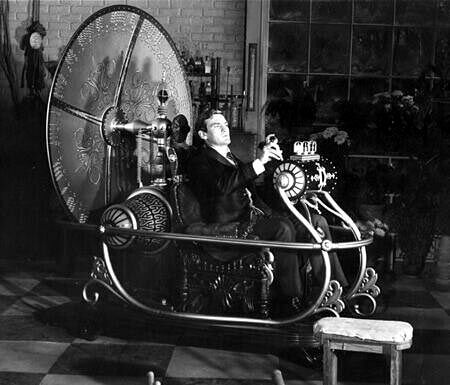
When I was little I did think more along those lines; I envisioned a future that I now recognize as some variation on steampunk, full of Wells-ian time machines

Now, I'd like to imagine I'm more realistic, and my conjured images include cures for African sleeping sickness (alternatively, effective treatments [read section "treatment"] that aren't as deadly as the disease) and music players that read your mind and time machines.
When I was little I did think more along those lines; I envisioned a future that I now recognize as some variation on steampunk, full of Wells-ian time machines
 |
| Oooh, flying cars! |
 |
| gotta love time machines |
All these fantasies and imaginings and ideas are a source of woe for me. Because I probably won't live to see them.
Granted, the things I just described that I dream of now (in my 20s) may be close enough that they'll happen in the next decade or so, but of course I've no way of knowing. No one knows. It just makes me sad that I won't be around for new things. I'm not planning on checking out anytime soon (at least for the next 80 or so years), but even if I make it to 100 I won't see the year 2100.
I think all this stuff about chronological milestones (the decade, the century, the millenium) hits people alive now with more oomph. We all lived through the turn of the millenium (unless you're under 10, then you're SOL). That's friggin' huge. That's only happened 3 times in recorded history (I start counting with the Romans, maybe the Greeks and Egyptians so 4). It makes me feel like I have a place in history sort of. 'Course everything's history when you get right down to it, but we as humans feel the need to ascribe particular significance to certain events, and the turn of the millenium was one of them.
The prospect of a human living to see 2 century-changes is fairly slim, and that occurs to me more clearly than I suppose it would to someone born in 1918 who lived to 77. We're so damn close to surviving two century-turns! Ah, pointless frustration! Perhaps at some point humans will be able to live that long; I seriously doubt it, as aging seems to be in the framework of our cells and scientists are having little success with "anti-aging" treatments.
I seriously doubt that I will see another millenium. Though you never know...
Tuesday, February 22, 2011
Daily Silver: The future looms, but I think I'm seeing tropical medicine through the fog.
Today's thoughts are on graduate school. I know that I want to get my master's degree, and I'm thinking public health. I have to do a little looking around... Then I want to get my Ph.D. But that's farther in the future than I'm willing to consider at the moment.
The career path I'm looking at right now is getting my Ph.D in parasitology or tropical medicine and working in a hospital as a specialist. Maybe public health, though, and I could work with a Health Dept. and do some more epidemiological things...
The career path I'm looking at right now is getting my Ph.D in parasitology or tropical medicine and working in a hospital as a specialist. Maybe public health, though, and I could work with a Health Dept. and do some more epidemiological things...
Friday, February 18, 2011
Daily Silver: Friday!!!
Today's silver is brief: it's Friday! And it's nice out! I am excited at the prospect of sleeping in tomorrow, but I am not excited about writing my humanities essay (due Monday morning). My assignment is to write about how I think two authors (out of five or so choices) would react to people flying planes into IRS buildings. Specifically Andrew Joseph Stack. It won't necessarily be a hard write, it's just tedious and not what I want to be doing/writing about.
But about the weather: it's gorgeous! If you're not from upstate NY or similar climes you may not understand my amazement at 50degF, but it's 50 freaking degrees in February. This is a big thing, like jump-and-shout-and walk-around-in-shorts-and-a-tshirt-because-you-don't-have-to-worry-about-frostbite big. The fields outside my window are green. It's crazy.
So I leave you now to walk in the balmy spring breezes and cavort in the sun, because it's been a long winter (actually it's been a winter of average length, but you get the idea).

But about the weather: it's gorgeous! If you're not from upstate NY or similar climes you may not understand my amazement at 50degF, but it's 50 freaking degrees in February. This is a big thing, like jump-and-shout-and walk-around-in-shorts-and-a-tshirt-because-you-don't-have-to-worry-about-frostbite big. The fields outside my window are green. It's crazy.
So I leave you now to walk in the balmy spring breezes and cavort in the sun, because it's been a long winter (actually it's been a winter of average length, but you get the idea).
Thursday, February 3, 2011
Pondering the soul, and what it means to have one. Also, assuming I do.
All I can see is land and sky. That seems like a lot, even everything, I suppose, but when it's just the land and the sky, a horizon way off as far as I can see, and nothing else, now that's something. Yeah, that's something. No houses, not any buildings to block the skyline, make it irregular. Not even any plants. No trees, or shrubs, or even grasses. I can see forever.
But obviously I can't; if I could see forever I'd see all the buildings and trees on the other side of that horizon. And I can't, because I'm gloriously alone. I can see the sun in the sky; it's big and yellow, hanging there like it's got nowhere else to go. Well, it doesn't really. It's stuck in place, because what's going to move the sun? Objects in motion tend to stay in motion; objects at rest tend to stay at rest, or some such thing. It's sitting in space, a big, fat, lazy ball of simmering plasma, and it's not going to move, dammit.
Every living thing has a… soul… for lack of a better term. The fifth element. Life. We are all made up of the five elements: water is in our blood and our breath and our cells; earth is in our tissues, muscle and bone, tendon and ligament; air is the stuff we breathe, and it fills our bodies, allows them shape; fire is in the chemical processes that keep us alive, in thought and movement. The fifth element, I'll call it the soul, is in everything. Those reactions, that fire, that moves us and keeps us, don't have to work. They do work, but nothing except some force means they have to do so.
If I was so inclined, this is where I'd find God. Or gods. It isn't though; they come in elsewhere. Because they have to be made of something, too, right? Even if they're just some pseudo-corporeal manifestation of energy, like particles of light. Sure, two hydrogens and an oxygen are attracted to each other, and they form this molecule called water, but nothing really says they have to. I mean, why? Why is the question of the hour, isn't it? Sure, glucose goes through the chemical process of respiration, and it involves oxygen, and the atoms and electrons dance and we get ATP, which holds energy in the bonds in its phosphate tail. But why? Ask a biologist, she'll start talking about metabolic pathways and evolution, if she is so incline. Ask a chemist; he'll just go back to electron transfers and oxidation numbers and electronegativity. Ask a physicist; he'll talk about the laws of thermodynamics, and matter and energy. Ask a philosopher; he'll probably spout some nonsense about JCGod or a greater power, or if he's a Marxist he'll probably just say something about the good of the whole (note to self: find a Nihilist and ask about why chemical reactions work). But none of them get to the root of it, and this is where human finds religion.
.
Or faith; I have faith. Religion (see definition #2) is such a deplorable word. Burdened with the pain and hatred and guilt and sorrow and zealotry and filth of ages of men and women. I choose to believe (and I know this is right, but I recognize that my knowledge is reached and accepted in the same way as a priest thumps his JCBible (but he's wrong, I know, for isn't that the basis of faith)) that this fifth element is natural in origin, as the other four. But what is natural? JCGod (the god of Christians and Jews and Muslims, and many others I suppose) is a manmade thing; a creation of short-sighted minds fumbling in the dark abyss of space (where they oughtn't be). They seek an answer where there is not one that is solid, that men can cling to like the slick board tossed in a feral sea.
My fifth element, life, soul, is not concrete in the sense that the JCBible is. Well, to point out the obvious, the JCBible is an actual book, that I can go to Barnes & Noble and purchase and hold in my hands. And, may I point out, write in. But even more than that, there is an intelligence, a design behind those words, those ideas, that I just cannot find in the world. I reach my faith from observation and long hours of introspection, not from the fantastic (albeit entertaining) ramblings of some random dude(s).
I entertained the idea of a "cult" of sorts, mostly to screw with the norm, though. I do think it would be fun, certainly interesting, to tell other people what I know. I mean, I'll tell people what I know, and if they then know it too, that's cool. But I think there should observation and introspection involved in formulating your own faith. Faith is very much an individual thing. That is not saying that there are not aspects for sharing. Feasts and celebrations are great times for sharing, and in this way I understand the attraction of a church. In a church, or a temple, or any other sort of religious community, people can find just that: community. There is a comfort to being with people who believe in the world the same way as do you. I understand that completely; I wish there was just such a community that I could be part of. However, there is one basic difference in the formation of community and shared celebration, and in a church-like community: faith is not at all a group endeavour. Religion is a group endeavor, and, as we have already discussed, I view "religion" as a word not to be spoken without full comprehension of the weight and meaning behind it.
And that's where religion goes wrong; people believe these things that they do not know (and in this statement, I hope you've been paying attention, because in the context of these ramblings of mine, "know," as well as other key words, mean something other than they normally mean in everyday conversation). It's kind of ludicrous. There is no truth but one's own; what may be true for you may not be true for me. This is hard for many to grasp; I myself have struggled a lot with this one. But I have finally come to the conclusion that truth, like time and perception (and because of perception), is relative.

But obviously I can't; if I could see forever I'd see all the buildings and trees on the other side of that horizon. And I can't, because I'm gloriously alone. I can see the sun in the sky; it's big and yellow, hanging there like it's got nowhere else to go. Well, it doesn't really. It's stuck in place, because what's going to move the sun? Objects in motion tend to stay in motion; objects at rest tend to stay at rest, or some such thing. It's sitting in space, a big, fat, lazy ball of simmering plasma, and it's not going to move, dammit.
 |
| Like this guy. |
But me, I move. I move all the time. I can't stay still, and this is not just me. Animals have to move all the time. Stop moving, and you're dead. Not just that you'll die, but a state of immobility is the definition of death. I guess. Yeah, that works; death is just you being still. Your heart doesn't beat, your diaphragm doesn't contract or relax, your blood doesn't circulate, your neurons don't fire and the ions don't dance around the synapses. You're still. Your soul doesn't move you, because it's not there anymore.
Every living thing has a… soul… for lack of a better term. The fifth element. Life. We are all made up of the five elements: water is in our blood and our breath and our cells; earth is in our tissues, muscle and bone, tendon and ligament; air is the stuff we breathe, and it fills our bodies, allows them shape; fire is in the chemical processes that keep us alive, in thought and movement. The fifth element, I'll call it the soul, is in everything. Those reactions, that fire, that moves us and keeps us, don't have to work. They do work, but nothing except some force means they have to do so.
If I was so inclined, this is where I'd find God. Or gods. It isn't though; they come in elsewhere. Because they have to be made of something, too, right? Even if they're just some pseudo-corporeal manifestation of energy, like particles of light. Sure, two hydrogens and an oxygen are attracted to each other, and they form this molecule called water, but nothing really says they have to. I mean, why? Why is the question of the hour, isn't it? Sure, glucose goes through the chemical process of respiration, and it involves oxygen, and the atoms and electrons dance and we get ATP, which holds energy in the bonds in its phosphate tail. But why? Ask a biologist, she'll start talking about metabolic pathways and evolution, if she is so incline. Ask a chemist; he'll just go back to electron transfers and oxidation numbers and electronegativity. Ask a physicist; he'll talk about the laws of thermodynamics, and matter and energy. Ask a philosopher; he'll probably spout some nonsense about JCGod or a greater power, or if he's a Marxist he'll probably just say something about the good of the whole (note to self: find a Nihilist and ask about why chemical reactions work). But none of them get to the root of it, and this is where human finds religion.
.
 |
| Nope, not here. |
My fifth element, life, soul, is not concrete in the sense that the JCBible is. Well, to point out the obvious, the JCBible is an actual book, that I can go to Barnes & Noble and purchase and hold in my hands. And, may I point out, write in. But even more than that, there is an intelligence, a design behind those words, those ideas, that I just cannot find in the world. I reach my faith from observation and long hours of introspection, not from the fantastic (albeit entertaining) ramblings of some random dude(s).
 |
| It's not kool aid; whatever are you talking about? |
And that's where religion goes wrong; people believe these things that they do not know (and in this statement, I hope you've been paying attention, because in the context of these ramblings of mine, "know," as well as other key words, mean something other than they normally mean in everyday conversation). It's kind of ludicrous. There is no truth but one's own; what may be true for you may not be true for me. This is hard for many to grasp; I myself have struggled a lot with this one. But I have finally come to the conclusion that truth, like time and perception (and because of perception), is relative.
Saturday, November 20, 2010
Following Time (Also: Time's Following Me)
I'm still puzzling over the nature of time. I can't help but think of relativity in an Einstein-ian sense, specifically time dilation; the theory of relativity seems to suggest that time is subjective. I was listening to the Radiolab podcast called "Falling" and in the first section they talk to a neuroscientist named David Eagleman author of several books about life and living and death and dying (I realize that's an accurate description of pretty much anything in the world…). He talks about that life-or-death moment, when you fall off a roof (as he did) or when you're on an out-of-control horse (like me) and time
Saturday, November 13, 2010
The [Enigmatic] Nature Of Time
If this wasn't on the Psychology Today website, I'd think it was fake. But it is. On PT that is. So it got me thinking about my perception and conceptions of time. Humans perceive time as linear; events have chronology, ie one thing happens, then another, then another and so on. But is time linear?
I believe the multiverse to be a collection of discrete moments (ie events, the time frame of which is the smallest unit of time imaginable [or more correctly, unimaginable]) that an entity (eg a human consciousness) follows in a random path (like connect the dots). Because humans perceive time as linear, this path should be roughly linear (straight, zig-zag, wavy, it doesn't really matter as long as no moment is ever visited twice). Hashing this out with my roommates a few weeks ago I came to the conclusion that time is probably a fourth dimension. I thought of this when trying to consider where all these moments were. I mean, they had to be somewhere, right? Somewhere out of reach of all of us (as in, we can't jump out of our time-bubble moments to view the "big picture"); there must be another dimension, in addition to xyz that contains them all! Brilliant! Anyway, in this model time isn't linear, rather it's sort of like an amorphous gel that all the moments are suspended in. Kind of like the plum pudding model of the atom. Interesting…
I think this PT article lends credence to my floating moments model. (I kinda like that name, too; I think I'll keep it.) What this article is suggesting—that the brain can have some (limited) precognition—suggests that time is not linear but a substance(?) that pervades reality. Not circular, I think, because then precog would only extend to a certain period of time (like thirty-two nanoseconds or five minutes or ten millennia or something). Unless time circles were infinite and concurrent…
Just what kind of substance(?) is time? Hmmmm…
I believe the multiverse to be a collection of discrete moments (ie events, the time frame of which is the smallest unit of time imaginable [or more correctly, unimaginable]) that an entity (eg a human consciousness) follows in a random path (like connect the dots). Because humans perceive time as linear, this path should be roughly linear (straight, zig-zag, wavy, it doesn't really matter as long as no moment is ever visited twice). Hashing this out with my roommates a few weeks ago I came to the conclusion that time is probably a fourth dimension. I thought of this when trying to consider where all these moments were. I mean, they had to be somewhere, right? Somewhere out of reach of all of us (as in, we can't jump out of our time-bubble moments to view the "big picture"); there must be another dimension, in addition to xyz that contains them all! Brilliant! Anyway, in this model time isn't linear, rather it's sort of like an amorphous gel that all the moments are suspended in. Kind of like the plum pudding model of the atom. Interesting…
I think this PT article lends credence to my floating moments model. (I kinda like that name, too; I think I'll keep it.) What this article is suggesting—that the brain can have some (limited) precognition—suggests that time is not linear but a substance(?) that pervades reality. Not circular, I think, because then precog would only extend to a certain period of time (like thirty-two nanoseconds or five minutes or ten millennia or something). Unless time circles were infinite and concurrent…
Just what kind of substance(?) is time? Hmmmm…
Saturday, October 23, 2010
realities (aka the multiverse)
I need to meditate more on my concept of reality. Because I think of realities as personal and individual, I thought there was not center. But then how does anything happen at all? The easy answer is that there's one central happening. A core. But that can't be, because what happens is subjective. It's like Plato's Forms. The problem with the Forms is the inevitability of infinite regression. The Forms are what's real, adn all we see/experience are the shadows. But since the shadows are a reality in themselves and are different from the "truth," there must be some embodiment of the difference.
My realities are parallel only in the sense that they exist. Actually they aren't parallel at all; they are discrete events, strung together like a filmstrip or a flipbook. So is there fate? No. Everything that will ever exist exists now (not that there's a present) but the path a consciousness takes is fairly random. Not random, of course, because of the bell curve and parsimony and Occam's Razor, but far more random (or apparently random) than consciously concievable.
My realities are parallel only in the sense that they exist. Actually they aren't parallel at all; they are discrete events, strung together like a filmstrip or a flipbook. So is there fate? No. Everything that will ever exist exists now (not that there's a present) but the path a consciousness takes is fairly random. Not random, of course, because of the bell curve and parsimony and Occam's Razor, but far more random (or apparently random) than consciously concievable.
Subscribe to:
Posts (Atom)
