Showing posts with label Free Will. Show all posts

Saturday, April 9, 2011

Daily Silver: Remember when the weekend was actually a time to relax?

Not anymore...  Well, maybe it's just a college thing.

My beef with weekends:
  • The next week looms: many of my friends actually use the weekends as time to work all day long.  Sometimes straight from Friday night into Saturday and on til Sunday night.  That way they can do other stuff (like human/living stuff) during the week.  Not that they do necessarily.
  • They inspire laziness: all I want to do all weekend is sit around in my pj's and watch movies on my computer.
  • Guilt: the logical conclusion from the two preceding bullets is that I end up doing a whole lotta nothin' on my weekends (I do work, just somehow not as much as some of my friends (I swear, she's gotta make stuff up to do)) while other people spend their waking hours nose-deep in a textbook.  I'm the kind of person who feels incredibly (inCREDibly) guilty in a situation like this, even if someone is literally making shit up to study.  So I spend the whole weekend feeling like worthless crap.  Woohoo.
  • Mondays: enough said.
So that's my little weekend rant.  This weekend?  Well I have two essays due next week, so you know what I'll be doing.  Right now, though, I'm thinking of going to sleep.  Buonanotte...

Tuesday, March 22, 2011

Something important to talk about: the fraudulent link between the MMR vaccine and autism, and a mini-lesson on vaccines..

Okay, here's something for me to talk about: measles.
Graph from WHO showing the estimated childhood death toll worldwide.  (Measles is red.)
The WHO (World Health Organization) factsheet on measles starts out with the key points.  The first key point is:
"Measles is one of the leading causes of death among young children even though a safe and cost-effective vaccine is available."
Another point is:
"Measles vaccination resulted in a 78% drop in measles deaths between 2000 and 2008 worldwide."
Here's the CDC (Centers for Disease Control and Prevention) page on possible complications of measles.  Okay, pneumonia (what else is new), ear infections, diarrhea... whoa, wait.  SSPE (Subacute Sclerosing Panencephalitis)? "Rare, but fatal" encephalitis?  

Yeah, you heard it: encephalitis.

Here's an article from Medical News Today about how much of a stir the disease causes even in "developed" countries like the US.

Good news!  It's covered under the MMR (Measles/Mumps/Rubella) vaccine, usually given to young kids, which confers lifelong immunity!

You may have been hearing about this lately, because it's rumored to "cause" autism.  Okay, that's unfair; mostly people who are proponents of this theory are saying MMR and autism are "linked."  Only slightly better, since word choice doesn't change that it's a load of crap.  Okay, I guess that's unfair, too, because [as a reasonable, thinking scientific person] I would approach it as a possibility.  Pertinent: a possibility and no more.  There's literally no scientific evidence that even remotely suggests such a connection.

Finally, here's the CDC page addressing this precise topic.  Guess what?
"To date, the studies continue to show that vaccines are not associated with [Autism Spectrum Disorders]."
(That emphasis on "not" is theirs.)  In the meantime panicked parents and fear-mongers (who we sometimes refer to as "the media" when we're feeling charitable) are using falsified information from a 30-year-old study by some British physician.  Oh yeah, and the study was found to be fraudulent.  Made-up.  Hogwash.  This physician, Andrew Wakefield, was subsequently found guilty of several conflicts of interest and professional misconduct by the General Medical Council of the UK and they basically kicked him out, disallowing him from ever practicing medicine again in the UK (not that anyone else would have him, either).  The article was originally published in The Lancet, a prestigious medical journal in 1998, but when they found out he screwed with the data they retracted it, even going so far as publishing a statement (you can get a free Lancet account to see the whole thing, but it basically lists the allegations against Wakefield) distancing themselves from Wakefield and his bunk study (NB couldn't even find the study on TheLancet.com, though I did find Wakefield's response to the retraction).  Even after all this the MMR vaccine controversy goes on (1, 2, 3, 4, 5).  *sigh*

The worst part is that lives were worsened because of Wakefield's irresponsible idiocy.  This is an article by the parent of an autistic child who suffered under the false claims of a connection between autism and MMR.

Oh wait, maybe the worst part is that lives are in danger because of Wakefield's irresponsible idiocy.  Like most vaccines, the MMR depends heavily on "herd immunity," which is the idea that if the majority of the members of a population are vaccinated and are therefore immune to the disease, the few members of the population that can't be vaccinated for whatever reason (immunocompromised, allergies, etc) are protected.  Maybe there isn't a 100% guarantee that they won't contract the disease they can't be vaccinated against, but the un-vaccinated members of a population are normally few enough that a disease can't just leapfrog between populations.

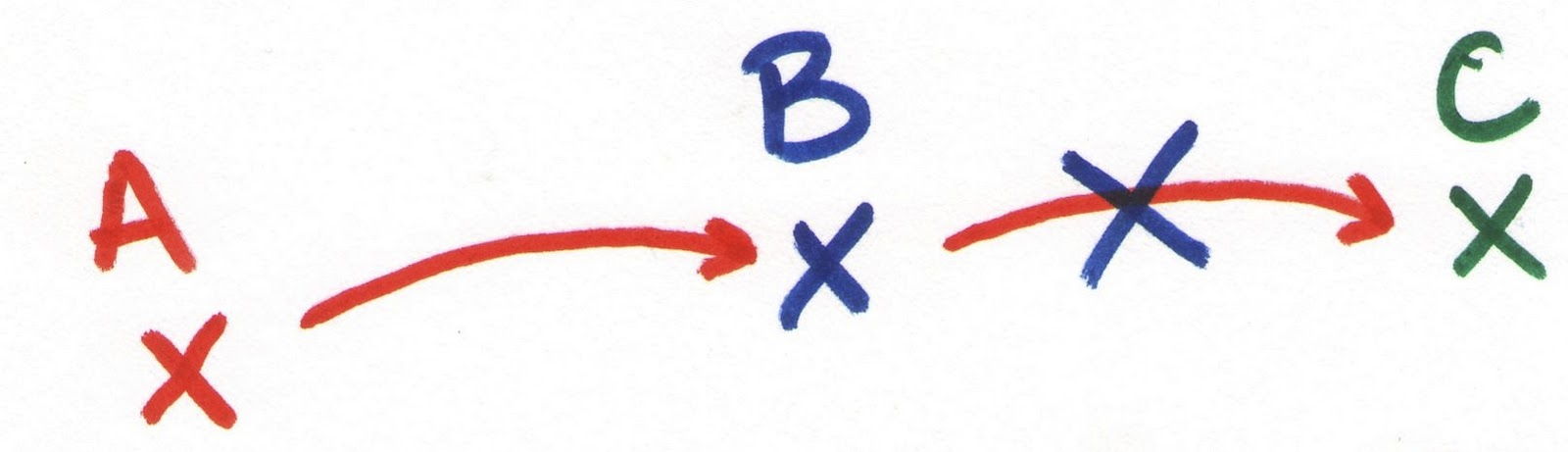
I feel the need to explain herd immunity farther (here begins the mini-lesson on vaccines and epidemiology).  Think about a hypothetical situation in which there are three populations of about a hundred members, and there's a communicable pathogen--for simplicity, we'll just stick with measles.  If you plotted the locations of the populations on a map, they would roughly form a line; let's call them A (western-most), B (middle), and C (eastern-most).
Excuse my handwriting, but I thought I could explain it better with a figure.
Okay, in this figure the measles virus is not present in any of the populations (A, B, and C).  Now imagine that red means the virus is present (most/all members of the population are infected/infective), blue means that most/all of the members of the population has been vaccinated (immune, or resistant) and green means most/all members of a population have not been vaccinated but don't have the disease (susceptible).  (For those of you keeping track, I'm simplifying the terms "infected," "resistant," and "susceptible."  You can decide for yourself if you want [I'm using the SIR model].)
Pop A is infected (either partially or wholly), B has been vaccinated (either partially or wholly), and C has been protected from the spread of the virus (red arrow) by the vaccine (blue X) even though they haven't been vaccinated.
I've simplified transmission a bit using geographic location (putting B between A and C) but you get the idea, right?  The virus could not physically get to C to infect it because it can't even get a foothold in the B population because they're immune.  Now consider this: C might not have been vaccinated for some random reason, like they just never got around to it, or it could be because C couldn't be vaccinated.

What if C is allergic to something in the vaccine?  There are lots of things in vaccines that aren't the actual "active ingredient," things like antibiotics to prevent bacterial contamination, that people can be allergic to.  Here's an info sheet (PDF) about what's in a vaccine from the American Association of Pediatricians.

Another possibility: C could have a weakened immune system.  Maybe C has cancer and is undergoing radiation or chemotherapy, or has an autoimmune disorder (eg rheumatoid arthritis) and takes immunosuppressant drugs to keep their symptoms in check.  C could also take immunosuppressants because they recieved an organ transplant and need to keep their body from rejecting the foreign cells of the organ.  C could have HIV or AIDS.  It's extremely dangerous to give many vaccines to people with compromised immune systems, because many vaccines are what's known as attenuated vaccines (they contain only weakened viruses, not completely killed).  Why would we do this, purposely expose someone to a potentially infective organism?  Because sometimes that's the only way to get the body to react enough to make the vaccine work (look for the blue highlighting).  It also has the added benefit of triggering a longer-lasting (in some cases, lifelong) immunity.  But if someone has a weakened immune system, even the extremely weakened virus in the vaccine could produce disease symptoms.  So we can't vaccinate them.  (Actually, I know I already linked to this ("react... work") but it's a really good primer on vaccines.)

Back to my story: for some reason (which isn't important here) C cannot be vaccinated.  Well, guess what happens if B isn't vaccinated because his parents didn't know about herd immunity (among other reasons)...
Look'a that: everyone's infected.
 The virus has unfettered access to population C, and so everyone's infected.  Whoop-dee-doo.  Now, this would be bad enough if C had a regular, healthy immune system to begin with, but remember how we said earlier that C had a lowered immune system?  The upshoot is that not only could C not be vaccinated and protected, but now C is going to suffer more from the disease than either A or B.  Kinda blows, huh?

These diagrams and explanations can also be applied to a three-person system (as in A, B, and C are just people).  So let's look at another system.
The colors mean the same thing; red is infected, blue is resistant, and green is susceptible.
In this seven-person model, A is infected/infective, B is vaccinated = immune, and C is not vaccinated = susceptible.  Statistically, C can only get the virus from six people (A and 5 B's); C has one-in-six chance of contacting an infective person.  Now if B isn't vaccinated...
C has a six-in-six (aka 100%) chance of contacting an infective person, ie a much greater probability of being infected and developing symptoms.  And C is immunocompromised, so the disease will be worse for C than for either A or the B's.  Sucks to be C.

In short: not vaccinating your children because of lies spun by a morally-bankrupt "scientist" is irresponsible and potentially injurious to: a) your children, because it is far more likely that no vaccination will lead to potentially life-threatening (and preventable) illness than vaccination will lead to autism, and b) to the your community, both local and larger, because you risk upsetting the balance and benefit of herd immunity.

Please: vaccinate your kids.

Wednesday, March 16, 2011

Playing god and other human pursuits.

Today I'm thinking about euthanasia.  Alternately, murder.  I don't know.

Up until a few years ago I was set on a career in veterinary medicine.  I wanted, needed to be a veterinarian.  I... honestly, I don't really know why it was so important to me.  At first I suppose it was just like, "Oh I love animals, and I want to work in the sciences, and I want to help the animals that live with us."  I have always liked animals more than humans to some extent; as I've aged it's shifted from disgust with the human race and reverence of non-human animals to, well, I'm still pretty disgusted with humans, but it's less of a generalization and more on a case-by-case basis.  So when I was little I deemed non-human animals more deserving of medical care.  I counter any protests of "But you're human, and our pets need humans to provide that care," with "I was, like, six years old."  Six-year-olds aren't known for their expansive considerations of reality (ie how the world works).

As I got older I developed more concrete reasons for becoming a vet.  I started feeling that pulling at my heart when I thought of animals suffering illness or mistreatment.  I realized that I felt personally obligated to do whatever I could to help them, for they could not help themselves.  I still feel that obligation, but I realize now that your life's work should also be something that is fascinating to me, and my fascination is not in veterinary medicine.

My career plans are not the point.  So what is? you ask.  The point: one disparity between medicine for humans and non-humans is at the end of medicine.  By that I mean, of course, how and when death comes.

The very simple fact is: humans often choose when an animal will die.  Another simple fact: it is illegal and usually considered amoral for humans to choose when a human will die (with exceptions and/or loopholes).  Why?  If you ask someone that question, chances are they will have a hard time with a solid answer.  I've thought about this question a lot, and I've come to the conclusion that the law is as it is because there is an inherent assumption that humans are more important than non-humans.   I wouldn't expect an easy answer out of anyone to this question, either, even though it's basically a yes/no question.

My take is that it's something that people believe deeply--perhaps subconsciously--but are uncomfortable voicing aloud.  But shouldn't a person be able to say what she thinks?  Also, this belief in human superiority is probably widely-held, so speaking it aloud would place one squarely within the clear--albeit close-mouthed--majority.

I will speak: I do not agree with the statement that humans are more important than non-humans.  I strongly believe that humans are of equal importance with non-humans.  Who knows, maybe I'll change my mind in a few years; I did start out believing that non-humans were of more importance than humans.

The most trouble I have with that statement is the use of "important."  Calling something important implies that there is a purpose for it, and we've already said there is no purpose for living things, nor even for living.  Actually, Oxford English Dictionary defines important as "of great significance or value; likely to have a profound effect on success, survival, or well-being."  You could argue that because of the inclusion of "profound effect on... survival" it might have bearing on the relationship between these two things (humans and non-humans); actually there is no relevance to this comparison because the it is not comparing to methods of finding food or shelter or anything like that, so there is no element of survival.  It is not calling into question the survival skills of either being, but comparing them as if they were instrumental to some sort of universal scheme, which smacks of monotheism (and actually most religions with divinity/-ies). 

So the natural next question is "Why then do we decide when animals die and not when humans die?"  When we can't easily answer that one, we might go to "Why is it socially acceptable to decide for animals and not humans?" or even "Is it right?"  And then we get to right vs wrong, my least favorite dichotomy of all time (and I can even say with confidence that I will never meet another dichotomy that I loathe more).

It's been a hard week.

Saturday, February 26, 2011

Daily Silver: A recap of stuff I haven't told you yet. And "the weather isn't evil, it just wants a hug."

Can I write Friday's Daily Silver even though it's technically Saturday?  Of course I can!  I'm running the show. (bwahahahahahahahaha!!!)


What can I tell you about Friday.  Other than "TGIF" or rather, TGIWF (Thank Gods It Was Friday).  Oh, well it snowed a bit up here in the wild wild North (better known as Western NY).  Lessee... oh, we have an accumulation of about 8 or 9 inches, and it was all melted two days ago.  So not overnight, but pretty good.  Actually, snow on the ground is okay.  It's when it's blowing in your face that's not so cool.  Hot.  Whatever.  Today I got up and (mistake #1) did not look out the window.  I had no idea what it was like outside, but I assumed that it would be much like yesterday: sunny and clear with snow on the ground but none in the sky.  As I was preparing to leave for class, still not looking out the window, I (almost mistake #2) debated putting on my winter hat or my baseball cap.  I luckily chose the winter hat and opened the door (surprise!).  The snow was coming down at about a 45deg slant, and they were fat, slushy flakes, the kind that can sting in a sudden [sadistic] gust of wind but then will accumulate on your hat and coat and any exposed skin and make you shed water when you walk inside like molting snakeskin.  Except cold and wet.

Now make it 50-80degF colder and dump some ice water on him.
In other news, I'm taking a practice GRE tomorrow.  I'm excited about the future (Ooooh, the future...) but I'm not excited about getting up on a Saturday.  Ah, the sleep I sacrifice...

Speaking of sleep: I think I'll pretend to go to sleep now.  I say pretend because I'll end up laying in bed staring at the ceiling.  Or the wall.  I've become sort of attached to staring at the wall lately.  Buonanotte!

Monday, February 21, 2011

Daily Silver: In fact, I do still exist, I merely spent yesterday in the real world.

What a tedious place the real world is.  I was writing the essay that I told you about not writing on Saturday in a rush of inspiration!  Yeah, if having it due the next morning can be termed "inspiration."  Anyway, it's done and I'm pretty happy with it, and now I can blog again!  For a while, at least...

So today was un-extraordinary.  Neurobiology this morning was pretty cool, because it's always cool when you understand the material.  Also, His Vexing-ness (you know, that kid in class that has to show off everything he knows and it turns out he just read the text but didn't understand the concepts?) was relatively quiet today.  Also, my friends and I asked a bunch of relevant, well-considered questions which is always a plus.  All in all, a good day in the field of Molecular Neurobiology.

Abnormal Psych was pretty ho-hum.  Not that it's a bad thing; certain classes, you just pray they're ho-hum.  Not that I don't like psychology (although see here and here) but this class is... I don't really know why, but I didn't expect it to be a study in suffering.  That's all it is, really; I'm not saying that's bad, necessarily, because my area of interest, parasitology and tropical medicine, is also full of such reflection.  The only way we can change our world is if we can understand it; the only way to help people suffering from blood flukes or from bipolar disorder is if we understand these afflictions.  I just... didn't realize it would be so depressing.  I really don't know why; I'm intimately familiar with many of the faces of mental disorders, but I guess I thought learning clinically about them could distance me or something?  Hmmm...  Anyway, today we watched a video, actually two videos featuring a woman with bipolar disorder, and pretty severe at that.  In the first she was in a depressive episode, and she had been hospitalized because she'd assaulted a little girl (we didn't hear the details) because the voices had told her to.  (NB I'm sure schizophrenia presents a very different clinical picture, but at this point I couldn't tell them apart except that our professor told us she had bipolar disorder.)  She was suffering from psychomotor retardation, which is when someone thinks, moves, and talks slowly, and she looked like she was going to fall asleep and go right off her chair.  But the combination of this movie and the next one was what was really disturbing.  In the next one, the same woman in the throes of a manic episode(a week later or so) was chewing bubble gum and blowing bubbles, all while she was a spy for Jesus Christ and could call up wind, rain, or sunshine at will.  She reminded me of a happy-go-lucky thirteen-year-old girl, and she had that look on her face, the one of blank, almost fake happiness, just utterly pleased with herself.  It was disturbing on such a visceral level... you could just tell that something was wrong, could almost tell that this mania wasn't going to last and she was going to plummet deep, deep into the hellish vice of depression.

Sorry for the flowery language; it's late and you know what that means..!  (It means I start writing like a Renaissance poet.)  Mi apologia.

So that's it for today.  I do have to admit that somedays (usually concordant with large academic projects and looming due dates) I might not write.  I'll try, but it just might not happen.  In the meantime, I plan to be writing every day this week, because I don't have any papers due for a while!  (Huzzah!)  Buonanotte!

Thursday, February 17, 2011

Filial piety is such an antiquated term. I just like it because it sounds funky.

I apologize for throwing more Frankenstein in your face, but we are discussing it in my humanities class, so it's at the forefront of my mind.  So our discussion today was on the second volume of the book, and especially the sort of climax of the book, when Frankenstein and the creature actually meet and converse.  The creature tells his [surprisingly long] story, basically the story of his life.  This started me thinking on duty, especially of children to parents (this has no connections to recent events and relationships in my own life, of course).  Some sort of duty of the children to the parents is a common theme in many cultures, the idea that a child is beholden to her parents because of all they did for her when she could not do for herself.  I do not believe that such a duty exists.

I love my mother, and I like to hang out with her and give her little presents and call her and make her happy.  But I don't do it because I feel like I owe her for bringing me up.  Sure, I owe her for a great many other things, but bringing me up is not one on my list.  I suppose the defining factor for me lies in choice, namely mine.

If I ask for a book and someone gets it for me, I fee I owe that person a debt.  Depending on many factors (circumstances, relationship, and the values and ideas of the giver) I may owe them a gift of my own or just gratitude.  But if I don't ask for a book and someone gets it for me, I feel I do not owe that person anything.  This does not mean that I will not be grateful, it just means that my reciprocation, be it gratitude or a gift of my own, will be given freely and on my own terms.  

It doesn't have to be specific, either.  Take for example a birthday present.  If I ask for that book for my birthday and my brother gets it for me, then I owe him; since it's my birthday (and he's my brother) my debt will not be more than gratitude and a call to thank him (as in, no more will be expected by him or anyone else).  Similarly if I ask for a book for my birthday and my brother gets me that book or any other book, then the same debt is owed (though in some circumstances, perhaps less).  However, if I don't ask for a book or that book and my brother gets me a book for my birthday I don't owe him anything.  Because I love and respect him and want to let him know that I appreciate his gift, I will call him to thank him, but not because of anything owed to him.

This is a generalized example, but I feel the principle applies to child/parent relationships as well.  Children don't--indeed, can't--ask to be conceived/born, yet they are.  Infants can't ask to be cared for, fed, clothed, and housed, yet they are.  And children don't ask to be brought up, but they are.  The beauty of the thing is that they are not required to ask.  As much as I believe children do not have a duty to their parents, I believe parents do have a duty to their children (this is my tie-in to Frankenstein).  Inherent in the word "duty" is the expectation that there is no expectation of reciprocation; then duty is not a task of honor and responsibility but a manipulative perversion.  Parents do choose to conceive and bring their children into the world.  Once they are in the world, parents have a duty take care of their children and bring them up. And since children don't ask for this, whether because of inability or ignorance, they owe nothing to their parents for this.

I think a healthier relationship springs from this understanding.  Because there is no duty to the parents, all children do for their parents is pure, unencumbered by responsibility and perhaps guilt.  Children do things for their parents because they love them.  Or if the children don't do anything for their parents, that is their prerogative.  This I think applies especially to grown children and their aged parents.  So your mother can't use the line "you owe me because I raised you" to justify her moving into your house.

No, I haven't forgotten what I said earlier about receiving gifts you've asked for.  If you ask for something, like a birthday present or tuition for college, you do owe your parents for what they give.  The way I look at college is: it's not yet a right (although it's close to one).  Until it becomes a right (that is, necessary for survival), college tuition is a gift from your parents that you have asked for, and you owe them.

That said, you can't collect on debts later, except in certain situations.  For example, if your friend asks for a cake for her birthday and you make it for her, she owes you a debt of gratitude.  If you give it to her and don't say anything, just expect gratitude in return because it's her birthday then it's all good.  If it comes to be a few days or a week or so later after you gave her the cake in exchange for gratitude, you cannot then expect something in return, like a cake for your birthday.  Not that it wouldn't be right for her to make one for you, since she's your friend and it's your birthday and, hey, you made her a birthday cake so she'd like to make you one, too.

So, going back to the parent/child examples, if you ask for and your dad gives you a bike for your twelfth birthday and doesn't ask for anything in return, he can't then turn around ten years later and expect his gift of a bike on your twelfth birthday means you owe him anything, like spending time with him.  You might spend time with him because you want to, but if you don't want to then you don't have to.

Is that it?  Yeah, I think that's pretty much it.  If I think of anything else, I'll post it later.

I'm not too hot on some of their conclusions, but it's funny and it kinda illustrates my point: Cracked.com - 7 Life Altering Decisions Made For You (Before Your Birth) 

Monday, January 31, 2011

A family is more than the sum of its parts, or the relative densities of blood and water.

I'm pretty much thinking I never want to have kids.  And, while this is personal choice, I also believe it is a matter of faith.  I believe very strongly in zero population growth, even the negative population growth that comes from having no biological children of your own.  The least you could do with all the poverty and homelessness in the world is to adopt children who need families, and then you're not adding to the overall population of the world anyway.

In the event this raises questions in the validity of a family with adopted children, I would like to point out that family is not confined to your blood relatives; rather, it's a shared experience of living.  I live with three other girls, and I would consider them as much my sisters as my biological sisters (had I any).  But it doesn't even have to be the shared experience of living together; when I worked backstage in high school, I had a family in the people I worked with, spent time with, shared joy and frustration with.  Family is much more than a nuclear unit of Mom, Dad, Jane, and Billy.

I don't think it's responsible to suggest that some people you live with would have the same rights to you, your possessions, and your life as the family you grew up with.  I suppose that's the defining factor: growing up and coming of age.  Yes, there are all the legal definitions that [necessarily] allocate resources and responsibilities.  Those are important, too, in our society.

I write this thinking about families I know with adopted children.  It's no big secret to them, and as far as I know my friend has always known she was adopted.  She has had contact with her biological mother, starting when she was 18 (which I believe was the mother's stipulation).  And that's that.  The two other children in the family are biological, but she has no less claim to her parents' affection.

Thursday, January 27, 2011

No, you can't blow up pineapples with your mind, but thinking happy thoughts doesn't hurt, either.

I know I just bashed positive thinking, so what I want to talk about today might seem a little hypocritical.  I could spend a paragraph (and I just might) telling you about how it's not (hypocritical, that is) but that would be a waste of words.  You're going to decide for yourself, whatever I say, and that's the beauty of being an individual.  But what are words for if not wasting, so yeah, there's a bit about why this is different than my rant on positive thinking.  Just roll with it.  Anyway, here I go...

Last night I had what you might call a revelation.

The night began with business as usual; I was lying in bed, staring at the ceiling, unable to find a position that was comfortable for more than two minutes, and generally feeling horrible.  While most people (I presume) are able to drift into a vaguely comforting and blissfully thoughtless pre-sleep state in a timely manner (read: not two hours) after they get into bed, "sleepy-time" does not translate for my brain.  My thoughts do not slow down and I am not able to turn them to counting sheep or visualizing numbers 1-100 or floating in a void.  Most of what I do is worry.

I have resigned myself to the fact that I am a worrier, like my mother and my grandmother.  I try not to worry about what I can't control, of course; for the most part it works pretty well.  I would even suggest that I sometimes adopt a rather devil-may-care attitude.  However, all bets are off when I go to bed.  It's not that I worry about things I can do nothing about, but the opposite; I worry about things I would normally have a hand in but don't because I'm trying to go to sleep. Key word: trying. When you're in bed it doesn't do you any good to think of what clothes you're going to wear tomorrow or that the due date for your next tuition payment is coming up or that you have to read 100 pages for class in two days, because you're in bed.  It's like these things pounce on me when they see me mentally vulnerable, because there is one thing I worry about that I don't really have control over: getting enough sleep.  It's my very own encyclopedia illustration of "The Vicious Cycle."

So I was lying there listening to my classical music when I thought, "what if jI just eliminate "should" from my thoughts?"  So I changed every "I have to..." and "I should..." and "I need to..." to "I want."  And it worked.

Instead of "I should get up early and go to the gym tomorrow," I thought "I want to get up early and go to the gym tomorrow," and with that small substitution I felt better.

My worry about getting enough sleep was mostly coming from that, so instead of listening to classical because "I should listen to something quiet so I'll go to sleep soon" I changed my ipod to pop rock because "I want to go to sleep but I don't have to so I want to listen to the music I feel like listening to."  My mom always says, what's the worst thing that could happen if you don't go to sleep?  You're tired the next day.  Eventually, you're going to be tired enough (probably the next night) to go to sleep.

I do want to go a little bit into the difference between this and the positive thinking I was talking about earlier.  I feel like this whole "power of positive thinking" thing is way out of hand.  I see people expecting job prospects and other people's ideas and even actual physical realities to change just because they wish really, really hard on that star or believe everyone is born with an angelic conscience.  This is delusional.  Jobs will open up to you if you do the legwork, and a lot of the time even after that they don't pan out.  You have a chance of changing someone's mind if you argue your case convincingly, but even then it's like that person is an arbitrary judge with the final "yea" or "nay."  And influencing physical things with your mind?  Even now psychologists and physicians are undecided as to whether your thoughts influence your biochemistry or it's the other way around.  Influencing things outside your own body: forget it.  Delusional.

But your thoughts are all words; try to think of the last time you didn't have a spastic inner monologue (or dialogue, or poly-logue) continuously running through your mind?  Bet you can't.  The human experience is defined by language.  And before you protest, when you were a baby (without language) your thoughts and experiences were still framed with communication (probably, because it's not something we can really know).

So if words make up your mind and, by extension, your perception (which is really what we're talking about, because perception is reality and experience and emotion and thought), couldn't you affect your own mind through control of words?  Words and language have an intimate power, and since emotions are thoughts (perhaps unconsciously) and thoughts are words, then you can control (or at least shape) your emotions with words.

Okay, so in theory it works.  Try it with me. (I honestly have no idea if it'll have an effect on you.)  Pick something that stresses you out: impending exams; looming bills; that report you have to get to your boss by next week.  Phrase it with an "I have to" or an "I should," eg "I should study for my test next week."  Ugh, even knowing I don't have a test next week, that makes me feel all slimy inside.  Okay, now change it to "I want to."  eg "I want to study for my test next week."  Maybe add a "because," like "I want to study for my test next week because I want a good grade."  Look, another "I want."  We're on a roll.  Now, does that make you feel better?  I feel better.  Now, even though my test was hypothetical, I feel better about it and better about hypothetically studying for it.

I just wanted to share this with y'all, because I think it's so awesome.  I didn't necessarily go to sleep faster after that, but I am an insomniac...

Anyway, to finish up I just want to emphasize that this is not what I would call "magical" positive thinking.  As my parents have always told me, you can't change anyone's mind but your own.  In the same vein, you can't get a new car through wishing, Dad's Alzheimer's isn't going to go away even if you pray, and $30,000 isn't going to appear in your bank account just because it would be really, really awesome.

It would be awesome.  Oh well.

NB The title reference is from "Accepted."  Good movie.  I recommend it.

Thursday, January 20, 2011

The Fallibility of Positive Thinking

As expected, school is severely curtailing my writing; be not afraid, because I'm still here!  I'll post at least once a week, when I find time.  And on that thought...

Words have power, as do emotions and ideas.  These things can influence others and even the world around us in ways we cannot comprehend.  But wishing will not always make it so.

Along the lines of "Smile or Die," too often we put faith in the power of reason or right.  "It'll all work out in the end," we assure ourselves.  We (at least, people my age) grew up with Disney princesses who were beautiful and just and always got the guy in the end while saving the kingdom, Power Rangers who were granted magical powers to do righteous battle with the slimy forces of evil, and our parents and teachers telling us "you can be anything you want when you grow up;" even Pokemon is a story about an ordinary kid beating the odds and saving the world from injustice.  And because we were kids the adults around us would have been foolish to let on that the world isn't always shiny and fair, because we would have thrown hissy fits.

But now I see people my age and older buying into the childlike delusion that "everything will be alright."  I don't mean to sound pessimistic; there is good in the world (I suppose depending on how you define "good"), and most people could benefit from a little positive thinking.  I accept the evidence for the placebo effect, and I believe that the right attitude can help you fight disease.  Well, its effectiveness has been demonstrated.  Many forms of Eastern Asian medicine talk about chi.  I call it the fifth element.  But if you have chronic bronchitis, or stomach cancer, or hepatitis, it's not a miracle cure.  Just thought I'd mention this.

Sometimes, no matter how hard you wish on that shooting star and click your heels together and imagine a better world, the world is not going to get better unless you get up and do something about it.

More thoughts on positive thinking (no pun intended)...

Sunday, January 16, 2011

Brought To You by PSY 101

I'm not terribly impressed with the American Psychological Society, and the motives behind its formation.  Science is supposed to help people.  Yes, there should always be research.  How else would we get anywhere at all?  But the application of the knowledge gained through research (among other methods) should not be underappreciated, nor its impact underestimated.  If you need to tie everything back to gain, research would flounder if people who did not appreciate research for the sake of research were to disappear.  A project needs simple, tangible things to proceed; resources such as money, labor, and materials must be procured, and by someone who wants to study that particular area.  Resources will not be forthcoming if no one wants the research done, and the people with the most money (usually businessmen and/or governments) don't really care about research for the sake of research.  They want results; they want profit, or power, or prestige, or sometimes, as I elaborate on later, they want to "help people."  There are "real- world" repercussions of research, and therefore research must spring from the "real world."  If for no other reason than to perpetuate research, practical application should be given its due.

Describing science, any science, as "the study of…" only accurately describes one aspect of it.  The point of science is to further knowledge and understanding of a subject, but for a purpose.  Always, there is a purpose.  A motive.  In a way there is no "pure" science.  The gain, not necessarily monetary or financial, or for prestige or power, is always there.   Nothing is done without potential for reward.  Isn't that a tenet of psychology itself?  Perhaps just behaviorism.  But it is relevant to all the disciplines.

Humanism is kinda, sorta, um… crap.  (I said it! Oh, oh, burn!)  I will repeat: nothing is done without the potential for reward.  And this is the basis of my own personal philosophy.  Oooh, I shudder to call it that.   Okay, perception of the world and reality, and whatever else is relevant.  Nothing is magnanimous.  In my first draft of this piece, I wrote completely magnanimous. But I think now that I'll just leave the "completely" out entirely.  Because I put it in, I suppose, as a concession to the ideas of people before me and people around me.  Now I can finally identify this… weakness (don't I sound like a fanatical control freak?) as humanism.  Which I consider completely bunk.  (Haha! There's the "completely!")

I have removed the "completely" because (and now I'm back to my main point) my own perception of this topic leaves no middle ground.  Magnanimity is an illusion, sort of like free will.  I dislike extremes, and when there is no spectrum leaving room for doubt, but I see no way around this.  It's a yes/no thing.  An on/off switch.  And the magnanimity switch is off.  Stuck in the "off" position, in fact.  Everything is self-serving in some manner.  This is not necessarily a "bad" thing.  It seems nature or some god (in the form of evolution and natural selection) has built reward into the concept of "doing good."  When a person does something "good," e.g. giving money to charity, he receives a reward.   He feels good about himself, and is fulfilling his need for self-validation.  Or if he is pressed by an individual or individuals he cares about, he feels good about pleasing his loved one(s).  Or if the act is for a public image, he is released from the scrutiny of the aforementioned public.  Etc.

Thursday, January 13, 2011

Teach Free Thought

Last night I was on the internet again, searching for some sort of guide, a sort of "manual to faith."  But then it struck me--I had an epiphany, if you will--I think organized religion is [insert expletive here].  That's how I started all those many years ago to gather and organize my thoughts into a faith of my own.  Belief is all your own and faith is ultimately a personal experience.  The ultimate personal experience.  I don't think believing in common divines is a problem.  After all, humans are a social species and just because you incorporate the ideas of another is only the difference between a research paper on original lab work and a review of other's lab work (ie your own conclusions).

Gods, what am I trying to say?  I feel like I should invoke the muse.

I guess you could take an example, such as the Christian tradition of Sunday School.  The idea of Sunday School is just... *shudders*  Someone "teaching" you what to think.  Thought cannot be "taught."  But (as evidenced by the prevalence of Sunday Schools) it can be shaped.  Like damming a river to change the contours of the land.  Virtually irreversible, I might add.  "Taught" implies the introduction of something new and foreign; numbers can be taught, and grammar, and history, but you cannot be taught the truth because the truth is yours.

But what are we [as a species] without religion?  The short answer is: I don't know.  This simple question has kept me up at night.  Keeps.  I don't know.

Wednesday, January 12, 2011

"Hallelujah" part III

For the purposes of this analysis (to keep things simple) I will refer to the singer as W (woman)  and the singer's lover (who I believe is the intended audience) as M (man).  I'm going to do this in a few installments, because otherwise it's ridiculously long.


part I


part II


Maybe there’s a God above
But all I’ve ever learned from love
Was how to shoot somebody who outdrew you
It’s not a cry you can hear at night
It’s not somebody who's seen the light
It’s a cold and it’s a broken Hallelujah


More questioning of faith.  W (the singer) is apparently not enamored with the religion set out in popular doctrine.  This is also addressed in the next line, when she references Church teachings that "God is love" and such, saying that she didn't really learn anything useful from these teachings except how to duck out of a relationship before getting stung.  A "quit before they can fire you" mentality.  Somewhat defeatist, in my opinion.  Then again, the whole reference to love and learning could have to do with the more immediate experience of romantic love, and implies again that she's been hurt in relationships before and is not eager to undergo more pain.  Again the line "a cold and... broken Hallelujah," presumably used to describe "love," whatever that is.  The lines immediately preceding are just further emphasizing the last line, crying that love is not benevolent and transcendental.  (I'm feeling wordy today; can you tell?)

You say I took the name in vain
I don't even know the name
But if I did, well really, what's it to you?
There's a blaze of light
In every word
It doesn't matter which you heard
The holy or the broken Hallelujah


Again this seems a religious reference.  Perhaps to the hypocrisy of religion, "teaching" love without feeling it.  This verse really resonates with me, as it describes the individuality of faith.  W's concept of divinity is different from M's, so her "name" is not his.  Furthermore (in the third line) why does he care?  Her faith is her own, her ideas personal, and her thoughts her right.  The next two lines suggest the power of language and its ability to express feelings and ideas beyond just consonants and vowels.  The last two lines seem like a dismissal of M; "it doesn't matter to me what you think because you're outta here."

I did my best, it wasn't much
I couldn't feel, so I tried to touch
I've told the truth, I didn't come to fool you
And even though
It all went wrong
I'll stand before the Lord of Song
With nothing on my tongue but Hallelujah


W is tired of arguing, and it really doesn't matter anyway what M says.  She's done.  She'd fallen out of love before this, but for the sake of harmony she held onto the relationship.  Because of that she has no regrets, and she can stand before the Lord of Song without shame.  The "Lord of Song" could refer to a god, to Death, or just to some amorphous ruling power (like human conscience), so it's a reference to a sort of judgement by that higher power.  And she will stand dignified.


Is W's whole hang-up on religion just a metaphor for her romantic relationship with M?  I think it could be interpreted as such, and W's rocky relationship with divinity as a metaphor for her crumbling relationship with M.  Or the other way around, I suppose.  Either way, I still very much like the song.  Thanks for reading!

Tuesday, November 30, 2010

Hubris, aka We Humans Really Do Give Ourselves Too Much Credit

I worry that my faith is changing, and that my main ideas are just becoming a diatribe against religions in general and Christianity in particular.  I really don't know why I hate them so much; this must be what they feel.  So actually, and sort of ironically, I pretty much know exactly where they are coming from.  But I cling to the fact that I came to my faith of my own volition; I wasn't born into it or raised in its presence, and I started forming my ideas when I was still quite young and didn't have this mysterious animosity toward Christians.

I remember when I was four or five and in kindergarten, I had this friend, Erica, who was a Christian.  Nothing special; most of my friends were probably Christians in the sense that their parents had said "you are Christian."♦  Even then I realized the sanctity of the earth and nature, and I did not relish the idea of humans as the masters of the world.  One day (or over the course of a few days) we had a discussion involving the Christian god♥, my Mother earth (reminiscent of Native American religions), and the creation of the earth and humankind.  I was still willing to "play nice" with Christians at that point, as she was willing to with me; also important to note is that I had not defined myself as anything other than Christian at that point, although I did not see myself as one of that religion and did not follow its tenets (church, prayer, etc).  Erica and I eventually decided that my Mother had made the earth, including the land, the oceans, and all the animals and plants, and that her god had made the humans.  I would have to say I got the better deal.  My personal feelings aside, I find it interesting that we would compromise so, and I am extremely curious as to how we would deal with it now.  Perhaps that is the mindset that I seek to return to.

I don't want to hate people just because of what they believe; that in itself is sort of against my ideas.  I don't want to have a double standard and think myself and my faith above criticism.  But that is the direction that I find myself moving in; I think that conservative Christians are so idiotic for believing such ridiculous fairytales as the bible, but I believe things that could be described as "fanciful" and "ludicrous."

The key for me is to be humble; nothing and no one is above the scrutiny of the living, and so I should be used to being tossed aside like so much ridiculous trash.  As long as I can think they're morons; but then I am in danger of falling into that trap of the double standard… I do hate the double standard, and Christians (and really most recognized religions, especially the monotheistic ones) are shameless perpetrators of this hubris.♣


♦ I also remember asking my mother, and my friends asking their mothers, "What are we?"  As in, what religion are we?  This in itself is utter folly, because any faith or religion must be reached by yourself, in my opinion.  Religion is totally your own, so children having religion is ridiculous.


♥ You will never see me call the Judeo-Christian deity "God" because I am insulted by the inference that he is the only god.  Being a polytheist of a sort I recognize the existence of many divine forces, though I may not recognize their sovereignty.  Hence my use of "JCgod."


♣ Hubris is commonly used to describe a mortal who thinks he is equal to a god, but I propose that it also describes religions/faiths and followers of religions/faiths that consider themselves above other religions/faiths, or, more importantly, consider themselves above scrutiny.  No thing in the universe is above scrutiny.


Tuesday, November 23, 2010

Mind Control: Who's Really in Charge?

I often wonder: who's running the show?  Is it me, or my mind?  Or are we the same?

I don't think we are.  I mean, if we were, there would be no issue of control.  If my thoughts were intrinsic in myself, I wouldn't have to school them.  This lends to my thoughts on the separation of the mind and body; our bodies do stuff we don't want them to do, so our bodies must not be intrinsic, in a sense.

I guess what I'm trying to say is that when I think of a person (or really of any living thing) I think of the cooperation (or not) of three separate entities: body, mind, and (*grimace*) spirit.  Soul.  Whatever you want to call it.  It's the fifth element (fire, air, water, earth, spirit).  All five elements (and no, I'm not one of those wackjobs that denies the existence of things like calcium and helium) are in varying amounts in every living thing, so yes, every living thing has a soul.  My soul is me.  I am my soul.  The body is a shell, and to an extent the mind is, too.  We tack a possessive adjective in front of these things: my body, my mind, my thoughts and feelings and ideas.  I know the possessive thing doesn't always work, because we say things like my soul, but my point is that I can have/own/possess a body and a mind, but I am a soul.  (Incidentally, next time someone tells you you're soulless, you can agree with them.  Just a thought.)  Think of old sailors talking about seafaring; you know how when a ship sinks they talk about how many souls were lost?

Enough semantics; semantics and arguing about words is so much fun I often get carried away. (sarcastic: "Really?")  This is important to me, so much so that I've spent many an hour lost in my head, thinking about the separation of mind, body, and soul.  Theoretically, if something (like spirit) was me, it would be completely under my control.  (Better:) I wouldn't have to tell it what to do.  There are a lot of things going on in my body and my mind that I don't know about or at least aren't consciously controlling; if you think about it that way, it's extremely fortunate for us that our bodies and minds aren't us.  For instance, I'm a biology major and so I have to learn about all the millions of molecular and cellular processes going on in our various tissues at any given time.  On many occasions I've thought to myself: "Isn't it a good thing that I don't need to know how my body works in order to live?"  Essentially, I'd have to understand every single cellular process and remember everything perfectly if I was going to go about consciously controlling my body.  Think of it like a construction site; if I was the foreman, I wouldn't want to have to know everything, and I probably wouldn't.  I'd have a few electrical engineers, some lumber specialists, and some guys who know all about building the framework and struts, and I wouldn't have to micromanage because they'd be able to operate independently, but in concert with all the other workers.  Read: I'd be totally screwed if my bodies was me.  So try to wrap your mind around the statement that our bodies and our minds are just that: our bodies and our minds, not us.  (I'll wait.)

Ready?  Okay, next question: am I in control of my mind, or is it the other way around?  My answer: both.

What an answer, right?  But psychologists and doctors and the guy down the street acknowledge the existence of two minds: the conscious and the unconscious (okay maybe not the guy down the street, but he also wears tinfoil hats, so...).  And the unconscious mind is defined [in some cases] as the stuff we don't even know about, much less control.  So wouldn't it be reasonable to jump from "I don't control it" to "it controls me?"  I think so.  That of course assumes that there has to be some controller somewhere in the equation, and I think that it's mine (not a part of me, as we already went over).

Well sometimes it is me, I think.  When an issue is under the purview of my conscious mind, it's in my control.  Therefore I--the soul--am controlling it.

Sum it up, you say?  Okay: I don't think anything can be put in a box.  I think that everything falls somewhere on a spectrum.  So any thought, any action is a blend of conscious and unconscious.  Nothing is certain.

Thursday, November 11, 2010

The Empty Room Accepts Your Apologies, But Do I?

Today I read something at The Wild Hunt that got me thinking.  Well, Wild Hunt always makes me think, but today I feel like writing about it.  It's the last section, "Medicine Man Confidentiality" of today's post.  It addresses equal rights for non-Christian religions to have a sort of "confessional confidentiality."  You know how if a murderer confesses his crime to a priest in confession it's considered sacred and the police can't force the priest to tell them?  Yeah, I think it's bullshit too.  And here's why:

I think why Christians are so okay with this is because their central dogma revolves around the spiritual world (the "next world") and the fact that this, physical world is fleeting.  Unimportant.  Basically, they're saying it doesn't matter what happens in "this" world, because it's all gonna come out right in the end.  Hey, the evil will be punished eternally and the virtuous will party in heaven and everyone's happy, right?

Dear gods, NO!  Are they HEARING themselves?  (I'm sorry, this really gets me.)  Oh, it doesn't matter that the murderer confessed to the priest but is still out on the streets to kill more people, and their families will be torn apart by grief and uncertainty for years and years to come, because he confessed his sins and he'll be punished in hell for all eternity when he dies.  Which could be after he kills twenty more people, or whatever.  Or no wait, doesn't confession mean he's absolved?  So you mean to tell me that he's "not guilty" anymore in your estimation because he's "seen the error of his ways" and confessed to the priest?  Oh, so that time he dismembered some random hooker in a dark alley and threw the parts in the East River was just an "oopsie" and didn't really count?  (Why yes, I do get a lot of my material from L&O…)  Oh, yeah, it does count, but kiss a string of beads a few hundred times and apologize to an empty room, or better yet, a manmade symbol, and all will be forgiven.  I'm sorry: WHAT?  What are you on?  And this is written into our LEGAL SYSTEM.

"This" world matters.  I understand that there's a historical precedent for this.  But here's the bottom line: while you have a right to believe in such things as the Invisible Pink Unicorn, you DO NOT have the right to subject me to your beliefs.  This is relevant when the victim and the victim's family are not of the same persuasion as you.  If a Catholic murdered a Hindu, then went to confession and told the priest all the gory details, should the victim's family (not being of the belief that JCgod will judge everyone at the end of days and everyone will be allotted their deserved space in heaven/hell) be content with the priest clamming up?  No, the priest is then complicit in the crime.  The priest should GO TO JAIL (DO NOT pass go, DO NOT collect $200).  The American legal system recognizing the confidentiality of Catholic confession (etc) impinges on MY rights to MY OWN beliefs: that everyone should be held accountable (assuming we are actually pursuing justice) in "this" world because there is no "next" world (what is this "next world" of which you speak of) where some "higher power" is going to do it for us.

And if you think that argument (yeah, that one ^ right up there) is an impingement on separation of church and state, just turn right around and consider that, in this case, our legal system is already taking cues from religious beliefs.

And if you're like Christine O'Donnell, who denies the validity of the interpretation of the second Amendment to the Constitution as "separation of church and state," then you should have no problem with the [slightly] religious nature of my argument.

So the article at Wild Hunt doesn't deal with Catholic confession; it's about equal rights for other faiths, namely native American faiths.  Up in Canada there's a murder trial going on, and as I understand it the suspect (being an adherent to a native American faith) may have said some things to a medicine man and the court is hemming and hawing about the legality of entering confessions to a spiritual leader into evidence.  Can you see where I'm going with this?
~~~~~

Okay, now I've had a few hours to cool down about this, but I still vehemently oppose this unconstitutional practice of the law.  I have two more points to make:

There might be a historical precedent for respecting the confidentiality of confession, but we don't live in the past.  Our society is much larger and communication over long distances and to a lot of people is much easier, so do we really want to send a message (that will be heard by millions, if not billions of people around the country and the world) that we don't punish "good Christians?"

And what's to say that certain unscrupulous elements (as criminals are wont to be) won't take advantage of this loophole in the legal system?  Are we really saying that a priest won't be fooled by a seasoned con artist or a pathological liar?

This chance for criminals to slide by the legal system in our country needs to be addressed.  The article may have been about events in Canada, but it just got me thinking about our own country (and how much confession confidentiality peeves me on L&O).  Sorry for all the vitriol, but I feel that it needs to be said.

Thoughts?

Friday, November 5, 2010

To Do Or Not To Do, Because Is It Really My Decision In the End?

Not really a question, in my opinion.  Today I'm going to talk about: free will!

Hmmm... free will...  That's a tricky one.  No, I'm not a conspiracy theorist; I won't try to convince you that the government is controlling your mind through little chips they put in your feet when you're a newborn and they draw blood.  No Al-foil hats here.  I would venture to suggest that my views on free will are unique, because I base them on my view of the multiverse and multiple realities as discrete time-bubbles, or moments, and as of yet I haven't heard anyone else suggest this (although there is string theory, but I haven't heard anyone link it to free will yet).  Well, here goes nothing...

According to my concept of the multiverse (I really need to come up with a more concise name for "my concept of the multiverse") everything that will exist already does exist (as does everything that has existed and everything that does exist [which may seem redundant, but actually isn't]).  Life (/time/continuity/the path/whatever) is like a game of connect the dots; life draws a line from dot to dot.  If you prefer to think about things having an inherent chronology, you can picture the dots as lining up in the semblance of a straight line (or a wavy line or zig-zaggy, but generally going in one direction).  This is how I usually picture it, although I don't like the idea of organizing things into chronology.

Since each moment already exists, and each one will occur in a reality, at some point, free will is kind of a moot point.  The basic concept of choice is that something won't happen, and if everything is going to happen anyway, choice really doesn't matter so much.

Silver Lining Time! Somewhere, somewhen, somehow, something will always go "right."  Furthermore, something "good" will always happen to you (somewhere)!

Yeah, the silver lining doesn't really work for me, either.  So I thought a bit more, and instead of being totally defeatist, realized this: although free will as a whole does not exist, free will for the individual realities does.  Free will exists in an entity's choices that lead to each moment.  For instance, you may choose to take the right fork in the road, and that will lead you to one reality.  Or, you may choose to take the road less travelled [in a yellow wood], and that will lead you to a different reality.  Yes, both realities exist(ed) but you chose which one to move on to.  It's sort of like the road itself; both forks of the road exist [in a yellow wood] but you only experience one of them based on the choice you make.  Where the analogy fails is when you turn around on the road and backtrack to take the other fork.  NO backtracking! (Since we're still viewing this as a chronological line of dots, there is a "back.")

Since I don't feel like arguing with Augustine tonight, I'm just gonna leave it at that.  But you should definitely shout if you want me 'n Augustine to duke it out!

Thursday, November 4, 2010

i started talking about intelligence, and then my thoughts went on a walk

At dinner, my roommate (J) said this:

Quote: Intelligence does not exist. End quote.

Then she said it again.  Four more times.

J says that everyone possesses the same capacity to learn, and that if, for instance, someone has trouble with algebra it's not because they can't solve algebra problems but because they don't have the time/motivation/perserverence to solve algebra problems.  She mentions a case study in which two classrooms full of kids were each given easy puzzles.  When they completed the puzzles, the teacher in one room congratulated them, saying they must be smart, while the other teacher congratulated the students on how hard they must have worked.  When they moved on to harder puzzles the classroom full of kids who had been told that they worked hard outperformed the kids who had been told they were smart; more, they enjoyed the challenge.  Finally, the kids were given easy puzzles again.  The "hard working" students enjoyed the puzzles, completed them quickly and easily, and even wanted to take some of the puzzles home to work on them.  The "smart" students did badly on the puzzles, even though they were at the same level as the first set of puzzles; furthermore, they did not enjoy these puzzles.  This study shows that everyone can perform equally well, and that even a small turn of phrase has power on a person's "intelligence."

I talked about the power (and its flip, the lack of power) of words earlier, although in a different context.  But really, the context is the same in the end.  I think the confusing part about my assertion that words are not powerful if they are not given power is that in many situations we do not have the power ourselves to deny words power.  Let me try to clarify that.  I said that words don't have power unless the hearer gives them power (eg hurtful words are only hurtful to those who are hurt by them).  But there is (I think) a general consensus that our emotions are not under our control, or perhaps our conscious control.  Whether or not we have the strength to consciously dictate our own emotions, we do affect them.  We are in control of them.

A lot of times it doesn't seem like it.  I have a lot of experience with emotions getting out of control, for better or [mostly] worse.  I have long struggled with severe depression, and while I have never actually attempted to kill myself, I've gotten pretty damn close and used to think about doing it every day.  I will be the first to admit (advertise, shout on the rooftops...) that I do not always have conscious control of my emotions.

The difference in my way of thinking is that "control" is not synonymous with conscious decision.  (Maybe more on control later...)  But because the human is the one "having" the emotions, they [the emotions] are within one being.  They are internal, though they can and often do have external effects.  I think we can all agree (maybe? plz?) that we cannot share emotions, in the sense that even if two people are having similar emotions (because by this logic no one can have the same emotions) they are each having their own separate emotions, not some sort of group emotion.

So, let me try to bring it back to intelligence.  I totally agree with J's interpretation of the case study, but I'm not so sure about her assertion that "intelligence" as a concept does not exist.  A concept?  By definition, a concept exists.  I guess she's talking about the nonexistence of "intelligence" as...  What is intelligence?  Wow.  J says that she is equating "intelligence" with "IQ."  IQ is certainly changeable, and totally bunk as a method of measuring "intelligence."  But in light of that (my immediately proceeding statement) I do not equate "intelligence" with "IQ."  (see Beyond IQ and IQ Paradox @ SciAm)  Hmmm.  I guess I believe that intelligence exists, but I define it differently.  As with everything, I believe that intelligence is relative.

I shall revisit these subjects at a later date, but for now... physics...